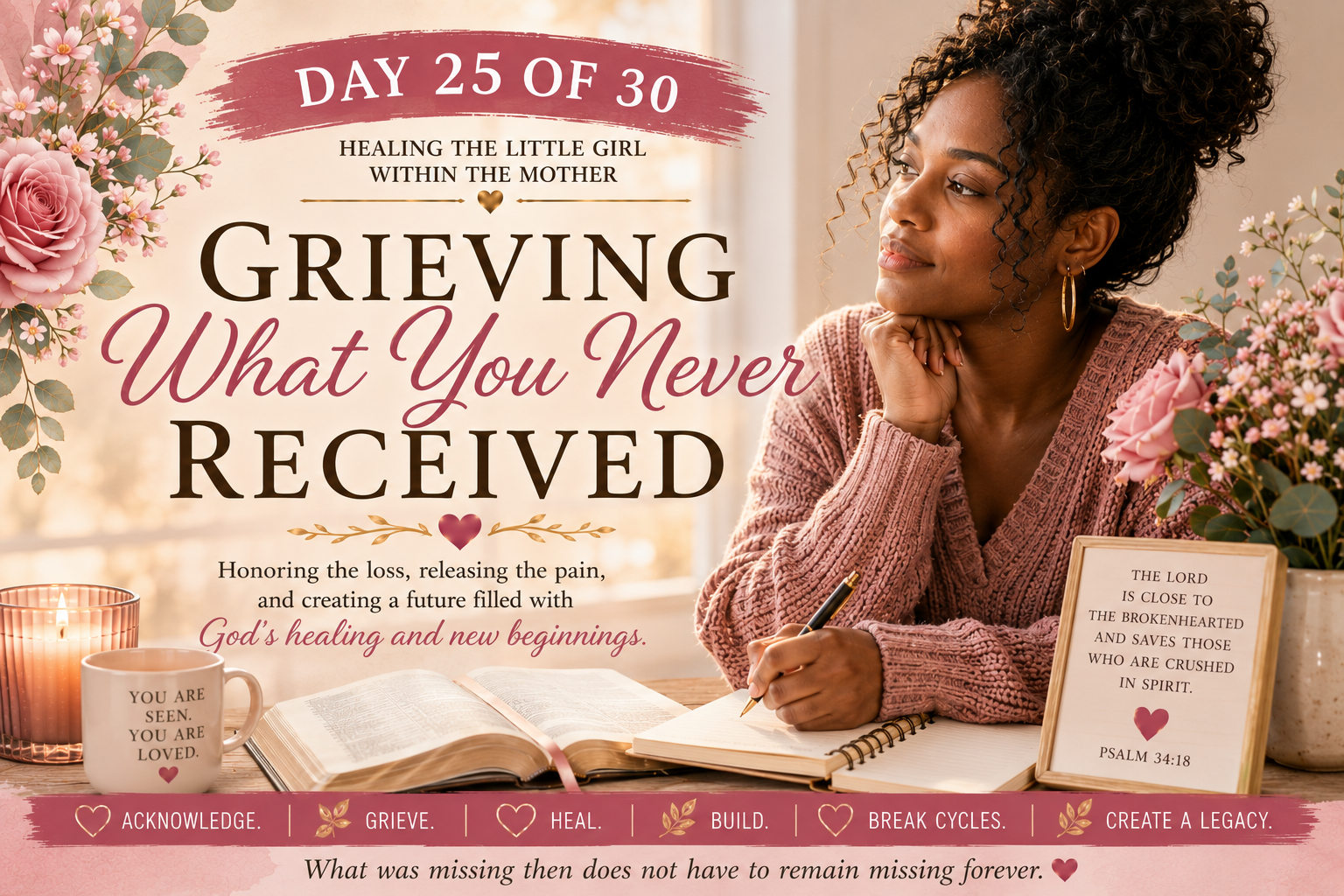
Day 25 of 30 — Grieving What You Never Received
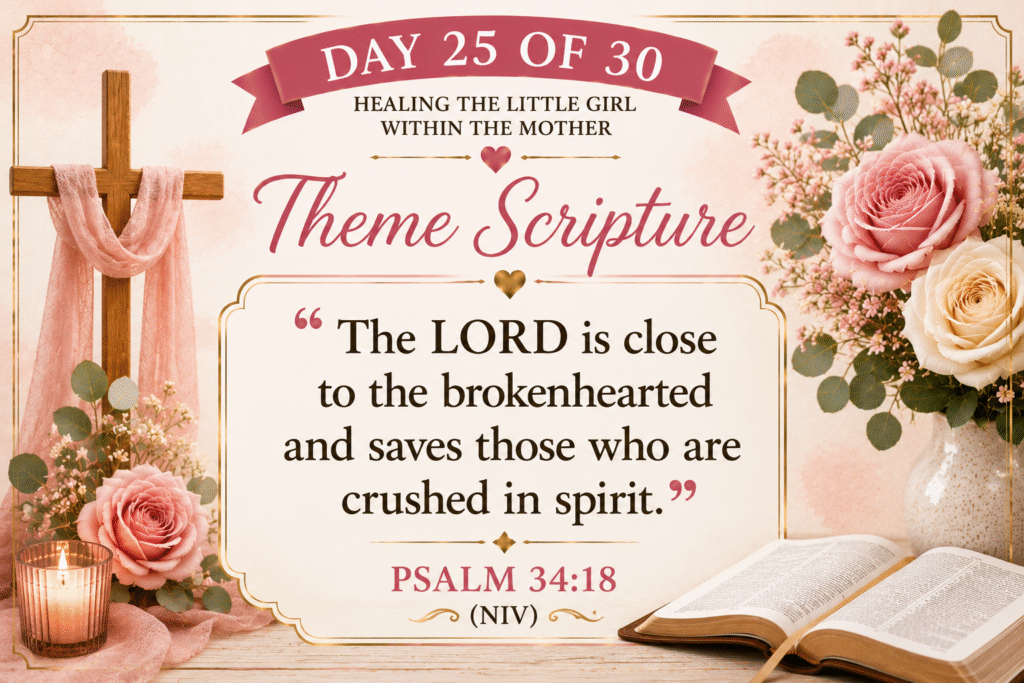
Theme Scripture
“The LORD is close to the brokenhearted and saves those who are crushed in spirit.”
— Psalm 34:18 (NIV)
There are some things from childhood that we grieve because they happened.
But there are other things we grieve because they never happened at all.
The hug you needed but never received. The mother who should have protected you. The father who should have been present. The safe home you deserved. The childhood where you should have been allowed to simply be a child. The words “I’m proud of you” that you waited to hear. The person who should have believed you. The apology that never came. The protection that should have been automatic. The feeling of being wanted, treasured, celebrated, defended, and safe.
Sometimes healing requires grieving more than what was done to us. We must also grieve what should have been done for us.
Yesterday, on Day 24, we talked about learning to trust yourself again. Today we are going somewhere even more tender.
Sometimes the little girl within us is not only hurting because of what she experienced. She is grieving the childhood she should have experienced instead.
Today, we are giving ourselves permission to acknowledge that grief. Not to become trapped in it. Not to live bitterly. Not to dishonor God by refusing to recognize the blessings we have today. But to finally say: “That mattered. I needed it. I didn’t receive it. And it hurt.”
Sometimes healing begins there.
You Can Grieve Something You Never Had
We often associate grief with death. But grief is much broader than that.
We grieve relationships, lost opportunities, dreams, versions of ourselves, and real losses that may not have a clear ending or socially recognized moment of mourning.
For the wounded little girl, that may mean grieving the mother-daughter relationship she imagined, the father who was absent, childhood innocence lost too soon, security she never experienced, family traditions she watched others enjoy, the ability to trust without fear, or years spent surviving instead of simply growing.
These losses are real. What is missing can leave a wound too.
Sometimes You Don’t Realize You’re Grieving Until Adulthood
As a child, you may not have had words for what was missing. You simply knew something hurt.
Then you grew older. You saw other families. Perhaps you became a mother yourself. Suddenly you thought: “Wait… I should have had that too.”
Sometimes becoming a mother makes childhood wounds clearer because you begin giving your children things you never received. You hug them. You listen. You protect them. You apologize. You tell them you love them.
And sometimes another thought quietly appears: “Why wasn’t this done for me?”
You don’t need to feel guilty for asking it.
Loving Your Life Today Does Not Erase What You Lost
You can be grateful for your life today and still grieve your childhood. You can love God deeply and still have questions. You can forgive someone and still grieve what their choices cost you.
Gratitude and grief can exist in the same heart. One does not cancel the other.
“But Other People Had It Worse”
Sometimes we invalidate our grief by comparing it. Another person’s suffering does not erase yours.
A child needs more than survival. Children also need affection, safety, protection, encouragement, consistency, guidance, comfort, belonging, healthy discipline, and emotional connection.
You are allowed to appreciate what you received while acknowledging what was missing.
Stop Telling the Little Girl She Should Be Over It
Imagine a little girl standing in front of you crying. You likely would not tell her to simply get over it.
Instead of asking, “Why am I still bothered by this?” try asking: “What part of me still needs compassion here?”
That question invites healing instead of shame.
You May Be Grieving the Mother You Needed
A little girl naturally looks to her mother for comfort, guidance, protection, identity, reassurance, and belonging.
When that relationship is painful, absent, neglectful, unpredictable, emotionally unavailable, or unsafe, the wound can follow a daughter into adulthood.
Part of healing may involve grieving the relationship you wanted while learning how to relate to the person who actually exists.
Sometimes we aren’t only grieving a person. We are grieving the version of that person we kept hoping would appear.
Acceptance Does Not Mean Saying It Was Okay
Acceptance does not mean what happened was fine, that no one should be accountable, or that it did not affect you.
Acceptance means recognizing: “This is part of my story, and I cannot change the past.”
We cannot change what happened. But with God’s help, we can change what happens next.
You May Never Receive the Apology You Deserve
Sometimes we imagine healing will finally happen when the person who hurt us says: “I was wrong. I believe you. I should have protected you. You didn’t deserve that. I’m sorry.”
Those words can matter deeply. But your healing does not have to remain imprisoned until someone else decides to take responsibility.
Their apology may be something you deserve. But your healing cannot be completely dependent upon receiving it.
Grief Sometimes Comes in Waves
A birthday. Mother’s Day. A family gathering. A photograph. Watching another mother and daughter together. Holding your own child.
Suddenly there is a familiar ache.
That does not automatically mean you have gone backward. Healing is not always linear.
Becoming a Mother Can Reopen Childhood Grief
You may look at your child at a certain age and think: “I was this little when that happened.”
You see how small, dependent, trusting, and innocent they are. You understand in a new way how much protection you deserved.
Let that realization bring compassion for the little girl you were.
Do Not Blame the Child for How She Survived
Children sometimes develop behaviors that help them cope with pain, neglect, instability, rejection, or unmet emotional needs.
Healing asks you to look at that younger version of yourself with greater understanding. Do not hate the little girl for the ways she tried to survive what she didn’t understand.
Anger Can Be Part of Grief
Anger can sometimes reveal where a boundary was violated or something valuable was lost.
Bring it to God. Name it honestly. Ask what is underneath it.
Often beneath anger is grief: “I needed protection.” “Nobody listened.” “I deserved better.”
Forgiveness Does Not Eliminate Grief
You can forgive someone and still be sad. You can release vengeance and still acknowledge consequences. You can pray for someone and still maintain boundaries.
Forgiveness is not pretending there was no loss.
Give Yourself Permission to Mourn
You may need to cry, journal, pray, sit quietly, write a letter you never send, or name the things you wish had been different.
Psalm 34:18 tells us God comes close to the brokenhearted.
Your grief does not repel God. Your tears do not make you faithless.
God Is Not Asking You to Pretend
Biblical faith makes room for lament.
You can say: “God, I trust You—and this still hurts.”
God Can Meet You in What Was Missing
God does not erase history. But He can meet you in the places history left empty.
Where you lacked affirmation, He can remind you who you are. Where you lacked belonging, He calls you His own. Where you lacked comfort, He draws near. Where you lacked wisdom, He teaches.
You Can Build What You Never Received
Maybe you didn’t grow up in a peaceful home. You can build one.
Maybe nobody prayed over you. You can pray over your children. Maybe affection wasn’t freely expressed. You can say, “I love you.” Maybe adults never apologized. You can apologize when you are wrong.
Breaking cycles does not mean creating a perfect family. It means becoming intentional about what continues through you.
Be Careful Not to Parent Only From Your Pain
Your children do not need a mother who guarantees they never experience pain. They need a mother who is present, loving, accountable, wise, and willing to repair when mistakes happen.
Your children need your healing—not your perfection.
Debbie’s Reflection
There are parts of my childhood that I cannot change.
For many years, I think part of me wanted answers. I wanted to understand why certain things happened, why I wasn’t protected in the ways I should have been, and why the people who should have recognized my pain didn’t always respond the way I needed.
As I grew older and became a mother, some things became harder to understand rather than easier.
When you look at your own children, you realize how small children truly are. How vulnerable. How dependent. How much they trust the adults around them.
And sometimes you think: “I was that little too.”
There were things I needed that I didn’t receive: protection, safety, reassurance, someone to believe me, someone to recognize what was happening and say, “This stops here.”
Healing has taught me that I am allowed to have compassion for myself.
I can understand someone else’s brokenness without pretending their choices didn’t hurt me. I can forgive without rewriting history. I can love without denying what was missing. And I can grieve.
I can grieve for the little girl who deserved better—not because I want to remain trapped in the past, but because she deserves to finally hear the truth:
“You should have been protected.”
“You should have been believed.”
“You should have felt safe.”
“What happened was not because you weren’t worthy of love.”
I cannot go backward and give that little girl another childhood. But I can honor her now.
I can allow God to help me build something different.
I cannot change the beginning of my story. But with God, I can be intentional about what continues through me.
The pain may have reached me. But it does not have to keep traveling through me.
Stop Waiting for the Past to Become Fair
Some parts of life may never feel fair.
There comes a moment when you may have to say: “I didn’t receive what I deserved then. But I refuse to let that determine everything I receive now.”
That is not denial. That is reclamation.
You Are Allowed to Stop Hoping Someone Will Become Who You Needed
Sometimes healing means accepting a person’s current capacity and adjusting your expectations accordingly.
You can still pray for change. But you don’t have to continually expose your heart to the same disappointment while waiting for it.
Create New Memories Without Trying to Erase the Old Ones
Celebrate birthdays differently. Take family photographs. Start traditions. Cook special meals. Pray together. Write letters. Create peaceful spaces. Say the words. Give the hugs.
These memories can become part of the legacy created from your healing.
You Are Not Betraying Your Family by Telling Yourself the Truth
Honoring people does not require lying to yourself.
You can tell the truth without publicly humiliating anyone. You can acknowledge harm without building your identity around blame.
Truth is where healing begins.
Grief Needs Somewhere to Go
Give your grief somewhere safe to go: prayer, journaling, a trusted friend, a qualified counselor, or a mature spiritual mentor who understands healthy boundaries and trauma.
You don’t have to process everything alone.
There Is Still Life Ahead of You
There are still experiences you haven’t had yet. Memories you haven’t created. Traditions you haven’t started. Laughter you haven’t laughed. Dreams you haven’t pursued. Love and peace you haven’t experienced yet.
Your childhood is over. But your life is not.
There is still more story to write.
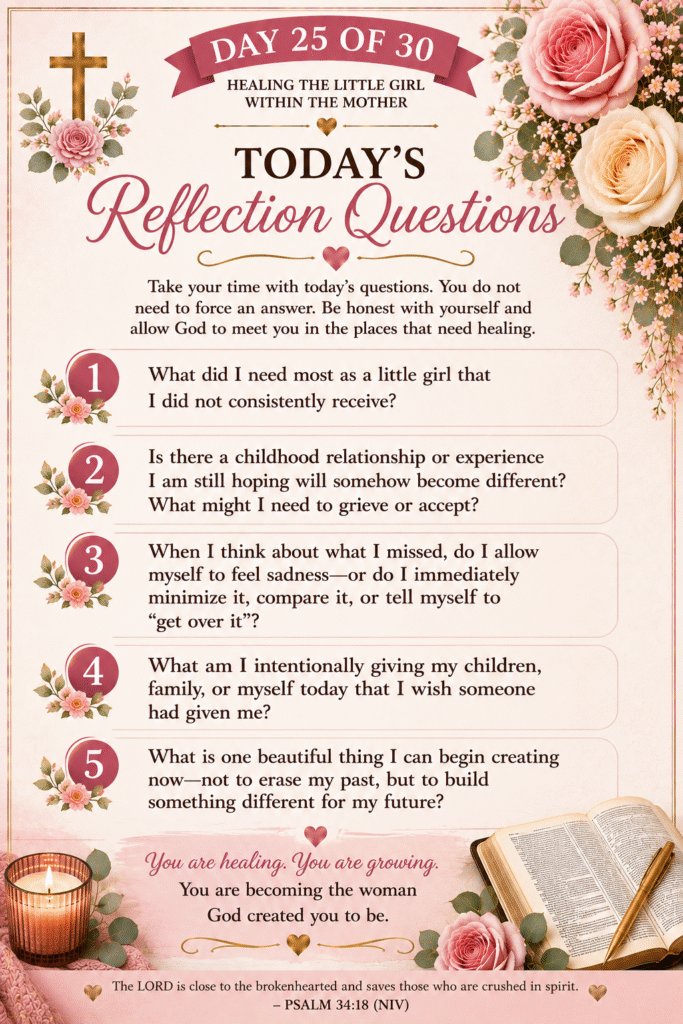
Reflection Questions
1. What did I need most as a little girl that I did not consistently receive?
2. Is there a childhood relationship or experience I am still hoping will somehow become different? What might I need to grieve or accept?
3. When I think about what I missed, do I allow myself to feel sadness—or do I immediately minimize it, compare it, or tell myself to “get over it”?
4. What am I intentionally giving my children, family, or myself today that I wish someone had given me?
5. What is one beautiful thing I can begin creating now—not to erase my past, but to build something different for my future?
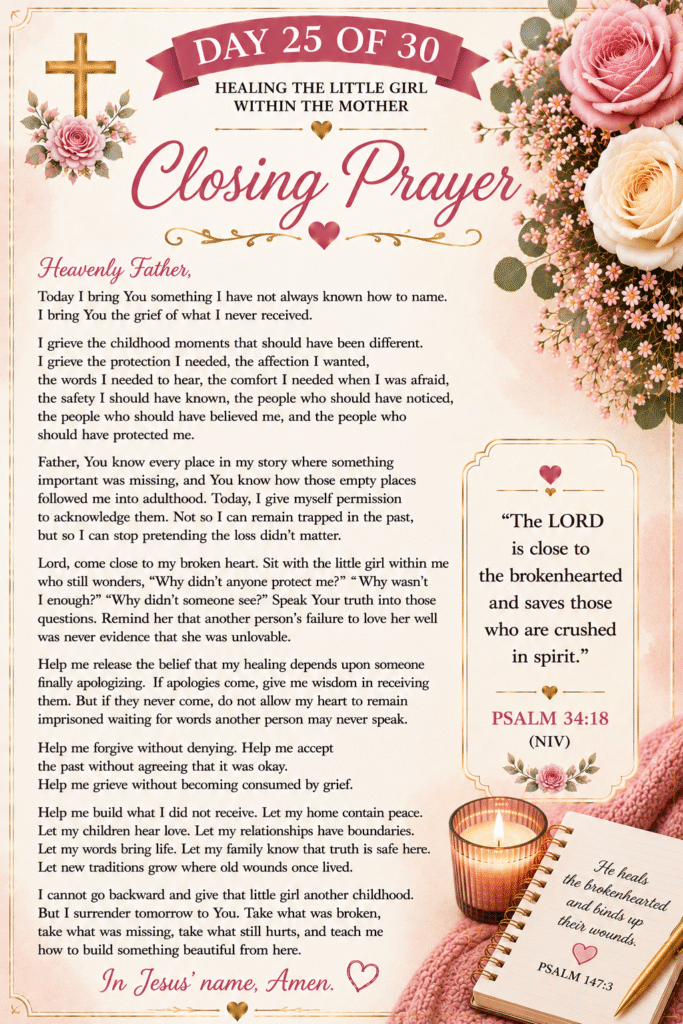
Closing Prayer
Heavenly Father,
Today I bring You something I have not always known how to name.
I bring You the grief of what I never received.
I grieve the childhood moments that should have been different. I grieve the protection I needed. The affection I wanted. The words I needed to hear. The comfort I needed when I was afraid. The safety I should have known. The people who should have noticed, believed me, and protected me.
Father, You know every place in my story where something important was missing.
Today, I give myself permission to acknowledge those places—not so I can remain trapped in the past, but so I can stop pretending the loss didn’t matter.
Lord, come close to my broken heart.
Remind the little girl within me that another person’s failure to love her well was never evidence that she was unlovable. Remind her that she deserved protection, tenderness, to be heard, to be believed, and to feel safe.
Father, help me release the belief that my healing depends upon someone finally apologizing.
Help me forgive without denying. Help me accept without excusing. Help me grieve without becoming consumed by grief. Help me remember without living permanently in the memory.
Teach me to build what I did not receive.
Let my home contain peace. Let my children hear love. Let my relationships have boundaries. Let my words bring life. Let my family know that truth is safe here. Let new traditions grow where old wounds once lived.
Continue healing the little girl within me as You strengthen the woman You created me to become.
I cannot rewrite yesterday. But I surrender tomorrow to You.
Take what was broken. Take what was missing. Take what still hurts. And teach me how to build something beautiful from here.
In Jesus’ name,
Amen.
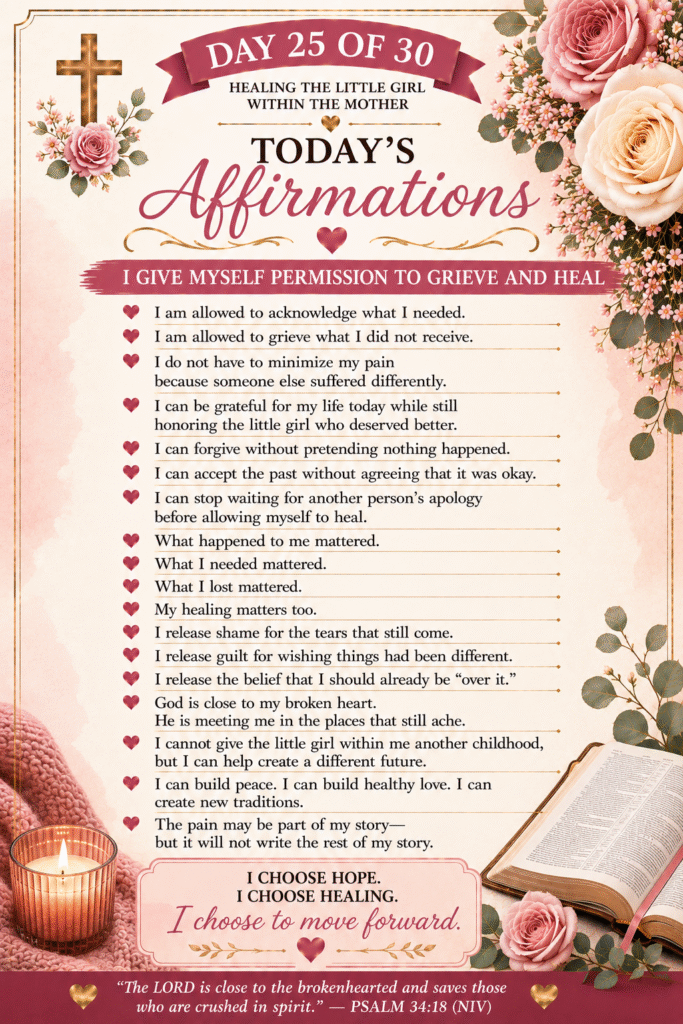
Today’s Affirmation
I GIVE MYSELF PERMISSION TO GRIEVE AND HEAL
I am allowed to acknowledge what I needed.
I am allowed to grieve what I did not receive.
I do not have to minimize my pain because someone else suffered differently.
I can be grateful for my life today while still honoring the little girl who deserved better.
I can forgive without pretending nothing happened.
I can accept the past without agreeing that it was okay.
I can stop waiting for another person’s apology before allowing myself to heal.
What happened to me mattered.
What I needed mattered.
What I lost mattered.
And my healing matters too.
God is close to my broken heart.
I cannot give the little girl within me another childhood. But I can help create a different future.
The pain may be part of my story—but it will not write the rest of my story.
Journal Prompt — What Did I Need?
At the top of today’s journal page, write: “What Did the Little Girl in Me Need?”
Finish these statements:
I needed someone to…
I wish someone had told me…
I wish my home had felt…
I needed protection when…
I wanted my mother/father/caregiver to…
One childhood memory I wish I had is…
Something I am still waiting to hear is…
Create two sections: “What I Cannot Change” and “What I Can Build Now.”
Finish by writing: “I honor what I lost, but I will not allow what was missing then to convince me that beautiful things are unavailable to me now.”
Then write three things in your life today that you are grateful to have.
Today’s Healing Challenge
Today, create one small thing you wish the little girl within you had experienced.
Buy yourself flowers. Make your favorite meal. Sit somewhere peaceful. Write yourself an encouraging note. Look in the mirror and say: “I’m proud of you.”
Or create something for your family: start a small tradition, pray together, write your child a note, or take a family photograph.
The goal is not to pretend you can recreate childhood. The goal is to remind yourself: “What was missing then does not have to remain missing forever.”
A Truth to Carry With You Today
Little girl,
I’m sorry for the things you needed but didn’t receive.
I’m sorry for the moments when you were frightened and needed someone to make you feel safe. I’m sorry for the times you needed someone to believe you.
You were never too difficult to love. You were never too much to protect. You were never responsible for the failures of the adults around you.
You were a child. You deserved to be a child.
We cannot go backward. We cannot rewrite those years. We cannot create memories that never happened. And we cannot force people to become who we needed them to be.
So today, we will do something different.
We will grieve. We will tell the truth. We will cry if we need to. And then, when we’re ready, we will keep building.
We’ll build peace. We’ll build boundaries. We’ll build traditions. We’ll build a home where love can be spoken.
And when grief returns, we won’t shame ourselves.
We’ll remember: God is close to the brokenhearted.
Little girl, I cannot give you another childhood.
But I can promise you something: I will not abandon you while we build the rest of our life.
And with God beside us, there is still so much beauty left to create.
Tomorrow — Day 26: Releasing the Need for an Apology
Theme Scripture
“Be kind and compassionate to one another, forgiving each other, just as in Christ God forgave you.”
— Ephesians 4:32 (NIV)
Tomorrow, we’re going deeper into what happens when the person who hurt you never apologizes.
Day 26 will not be about pretending apologies don’t matter. They do. It will be about refusing to make another person’s apology the key that unlocks your healing.
The little girl within you may still be waiting to hear: “I’m sorry. I was wrong. You didn’t deserve that.”
But the woman God is healing is learning: “I may deserve an apology, but I do not have to postpone my healing until someone decides to give me one.”