
Day 26 of 30 — Releasing the Need for an Apology
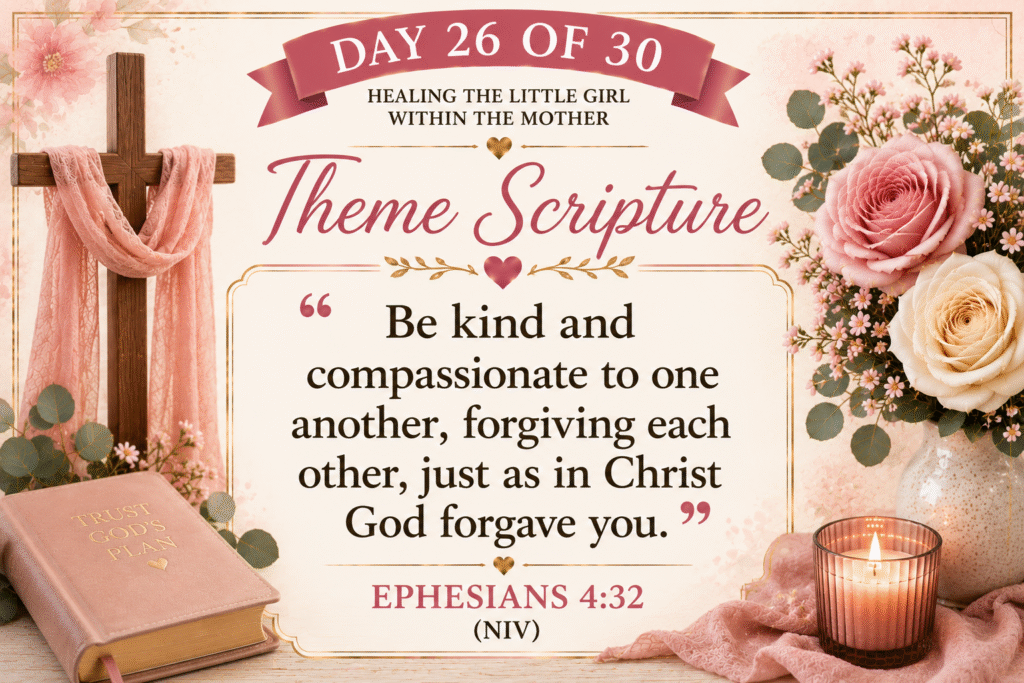
Theme Scripture
“Be kind and compassionate to one another, forgiving each other, just as in Christ God forgave you.”
— Ephesians 4:32 (NIV)
Releasing the Need for an Apology
There are words some of us have waited years to hear.
“I’m sorry.” “I was wrong.” “I should have protected you.” “I should have believed you.” “You deserved better from me.”
Sometimes we imagine the person who hurt us finally acknowledging everything, taking responsibility, and giving us the apology we have deserved for years.
Perhaps part of the little girl within us believes: “If they would just admit what they did, maybe I could finally heal.”
But what happens when the apology never comes? When the person denies what happened, minimizes it, changes the story, blames you, says they don’t remember, refuses to discuss it, or continues living as though nothing happened?
Yesterday, on Day 25, we talked about grieving what you never received. Today, we are grieving something else you may never receive: the apology you deserved.
This is not about pretending apologies don’t matter. They do. Accountability, repentance, and acknowledgment matter. But your healing is too valuable to place entirely in the hands of someone who may never be willing—or able—to give you those things.
Today, we are learning: I may deserve an apology, but I do not have to postpone my healing until someone decides to give me one.
Why an Apology Matters So Much
An apology is more than the words “I’m sorry.” A meaningful apology communicates: “I recognize that I hurt you. Your experience matters. I take responsibility for my actions. You did not deserve what I did. I understand that my choices affected you.”
For someone whose childhood pain was dismissed, denied, hidden, or minimized, an apology can feel especially important because sometimes you aren’t only waiting for remorse. You’re waiting for confirmation that your reality was real.
When those words never come, it can feel like another wound layered on top of the first one.
Sometimes We Want the Apology to Prove We Were Right
When someone has denied your experience, you may spend years wanting them to acknowledge it because part of you still feels as though you need their agreement before you are allowed to trust your own memory or feelings.
But someone else’s denial does not automatically erase your experience. Someone else’s refusal to take responsibility does not determine whether your pain mattered.
There are situations where memories and perspectives genuinely differ, and humility matters. But you do not have to endlessly argue your pain into existence.
The Apology Fantasy
Sometimes we rehearse an imaginary conversation. They finally call. They cry. They understand. They apologize perfectly and take responsibility without excuses.
There is nothing strange about longing for repair. But we must be careful not to build our healing around a conversation that may never happen.
You cannot require someone else’s transformation before you begin your own.
Some People Will Never Give You the Apology You Deserve
Some people lack emotional maturity. Some refuse accountability. Some protect their reputation. Some rewrite history. Some are ashamed and avoid the truth. Some genuinely remember events differently. Some simply do not believe they did anything wrong.
You cannot force insight, remorse, repentance, accountability, or an apology.
But you can decide what you will do with your own healing.
An Apology Without Accountability Is Not Repair
Sometimes the apology does come—but it isn’t what you hoped.
“I’m sorry you feel that way.” “I’m sorry, but you also…” “I’m sorry if I hurt you.”
Words can sound apologetic without actually taking responsibility.
A genuine apology usually contains ownership. It does not demand immediate forgiveness, require you to comfort the person apologizing, or erase consequences.
Real repentance is demonstrated through changed behavior.
Forgiveness and Reconciliation Are Not the Same Thing
Forgiveness is something that can happen within your own heart before God. Reconciliation involves relationship.
Healthy reconciliation generally requires truth, repentance, accountability, safety, changed behavior, and rebuilt trust.
Forgiving someone does not automatically mean giving them the same access to you. Forgiveness can be offered while boundaries remain.
Forgiveness Does Not Mean Forgetting
Your brain may remember. Your body may remember. Your life may still contain consequences.
Forgiveness does not require pretending you have no memory. It means you are no longer committed to revenge, hatred, or allowing the offense to control your entire life.
Wisdom often remembers what forgiveness releases.
Forgiveness Does Not Mean Calling Evil Good
You can forgive while still calling wrong wrong.
Forgiveness only makes sense when there was actually something to forgive. You don’t need to minimize the offense in order to release it.
You Can Forgive Someone Who Is Not Sorry
Forgiveness is not a reward you give someone because they apologized properly.
Forgiveness is also about what you refuse to continue carrying. It says: “I will not spend the rest of my life emotionally chained to what you did.”
It does not mean the person escapes accountability. It means you stop requiring your heart to serve as the courtroom forever.
Forgiveness Can Be a Process
Sometimes forgiveness happens in layers.
You forgive. Then a memory returns. You feel angry again. You bring it back to God and release it again.
That does not necessarily mean your first forgiveness was fake. It may mean the wound had more than one layer.
Do Not Shame Yourself for Needing Time
You may know intellectually that you want to forgive while emotionally still struggling.
Bring the struggle honestly to God. You can pray: “Lord, I want to forgive, but part of me is still angry. Help me release this. Show me what I am still holding.”
God does not require you to lie to Him about your heart.
Sometimes the Apology You Need Is Specific
Perhaps you want to hear: “I’m sorry I didn’t believe you. I’m sorry I blamed you. I’m sorry I stayed silent. I’m sorry I failed to protect you.”
Specific wounds often create a longing for specific acknowledgment.
If those words never come, part of healing may involve telling the little girl within you what she needs to know: “You deserved to be believed. You deserved protection. You were not responsible for an adult’s choices.”
Stop Arguing With People Committed to Misunderstanding You
There may come a time when explaining yourself again is no longer healing.
Sometimes peace means realizing: “I cannot make this person understand something they are committed to denying.”
There are times when speaking truth is important. But you are allowed to stop repeatedly reopening your wounds in conversations that go nowhere.
Closure Does Not Always Come From the Other Person
Sometimes closure is a conversation. But sometimes closure is a decision.
A decision that says: “I know what happened. I know what it cost me. I know what I learned. I know what boundaries I need now. And I am choosing to move forward.”
Closure doesn’t mean you never think about it again. It means the past no longer gets unlimited authority over your future.
You Don’t Need Their Agreement to Set a Boundary
Forgiveness does not eliminate wisdom.
If someone repeatedly demonstrates unsafe behavior, you are allowed to respond to the pattern you see.
Boundaries do not require the other person’s agreement to be valid.
Be Careful With Forced Reconciliation
Reconciliation without accountability can recreate the environment where harm occurred.
God values forgiveness. God also values wisdom. Peace does not always mean proximity.
Sometimes peace requires distance. Sometimes reconciliation is possible slowly. Sometimes the healthiest available relationship is limited.
The goal is truth, wisdom, peace, and safety.
What If They Apologize Years Later?
If the apology you stopped waiting for eventually comes, you are allowed to take your time.
You can listen, pray, observe, ask questions, and pay attention to whether there is genuine accountability and changed behavior.
You can appreciate an apology without instantly restoring trust. Trust is usually rebuilt through consistency.
You Are Not Responsible for Making Them Feel Better
You can receive an apology without minimizing what happened.
You can say: “Thank you for acknowledging that.”
You do not need to erase your pain to relieve someone else’s discomfort about causing it.
Releasing the Apology Is Not Releasing Accountability
When we say, “I’m releasing my need for an apology,” we are not saying nobody should be accountable.
We’re saying: “My healing will no longer be held hostage by whether accountability comes.”
There may still be consequences, boundaries, distance, difficult conversations, or appropriate legal or professional accountability.
Give the Desire for Justice to God
Romans 12:19 reminds believers not to take revenge but to leave room for God’s justice.
You can ask God: “Lord, handle what I cannot. Bring truth into the light. Give me wisdom about what responsibility belongs to me. Protect me from bitterness.”
Trusting God’s justice frees you from believing you must personally balance every scale.
Debbie’s Reflection
There have been apologies I wanted. Words I thought would somehow make everything make sense.
I wanted people to acknowledge what happened, what they knew, and what they should have done. Sometimes you’re not only waiting for an apology. You’re waiting for someone to validate the little girl you were.
But healing has taught me something difficult: I cannot make another person face what they are unwilling to face. I cannot force accountability, remorse, or an apology.
If I make my healing dependent upon those things, I am giving another person power over a part of my life they have already affected enough.
That doesn’t mean the apology wouldn’t matter. It would. But I no longer want my peace to wait at someone else’s door.
I can bring the unanswered questions to God. I can tell the truth about what happened. I can establish boundaries. I can forgive. I can grieve. And I can move forward.
Today I am learning to tell the little girl within me: “You don’t need their permission to heal. You don’t need their agreement to know your pain mattered. You don’t need their apology before you are allowed to have peace.”
God knows. God saw. And I trust Him with what I cannot resolve.
I am no longer willing to postpone my healing while I wait.
The Apology You May Owe Yourself
Perhaps you owe an apology to yourself—not because you caused what happened, but because of the way you may have treated yourself afterward.
Maybe today you need to tell yourself: “I’m sorry I blamed you for what you were trying to survive. I’m sorry I expected you to know things you had never been taught. I’m sorry I called you weak when you were doing the best you could.”
Sometimes the apology we keep waiting to hear from others should not prevent us from offering compassion to ourselves.
What About Apologizing to Others?
Healing also requires humility.
Sometimes, while examining what others did to us, we become aware of ways our own unhealed pain affected other people.
Healing does not mean blaming yourself for what happened to you. But it does mean taking responsibility for what belongs to you.
We can desire accountability from others while practicing accountability ourselves. That is how cycles begin to break.
Let Your Apologies Look Different
If you grew up in a home where adults never apologized, learning to apologize can become part of your healing.
There is power in a mother saying: “Mommy was wrong. I shouldn’t have spoken to you that way. I’m sorry. Can we try again?”
That doesn’t weaken your authority. It teaches your children that love and accountability can exist together.
In this family, we do not have to be perfect—but we do take responsibility.
Release the Conversation You Keep Rehearsing
Write down everything you wish you could say. Don’t send it. Then write everything you wish they would say back.
Notice what you are actually longing for. Maybe beneath “I want an apology” is: “I want to know I mattered. I want someone to believe me. I want acknowledgment. I want justice. I want permission to stop blaming myself.”
Then bring those needs to God.
You Can Move Forward Without Every Question Answered
Some questions may remain.
Why did they do it? Why didn’t anyone stop it? Why didn’t they believe me? Why won’t they apologize?
There may never be an answer that feels sufficient.
Healing sometimes means learning to live peacefully without forcing every question to have a satisfying conclusion.
You can say: “I don’t understand everything that happened. But I know what I want to build from here.”
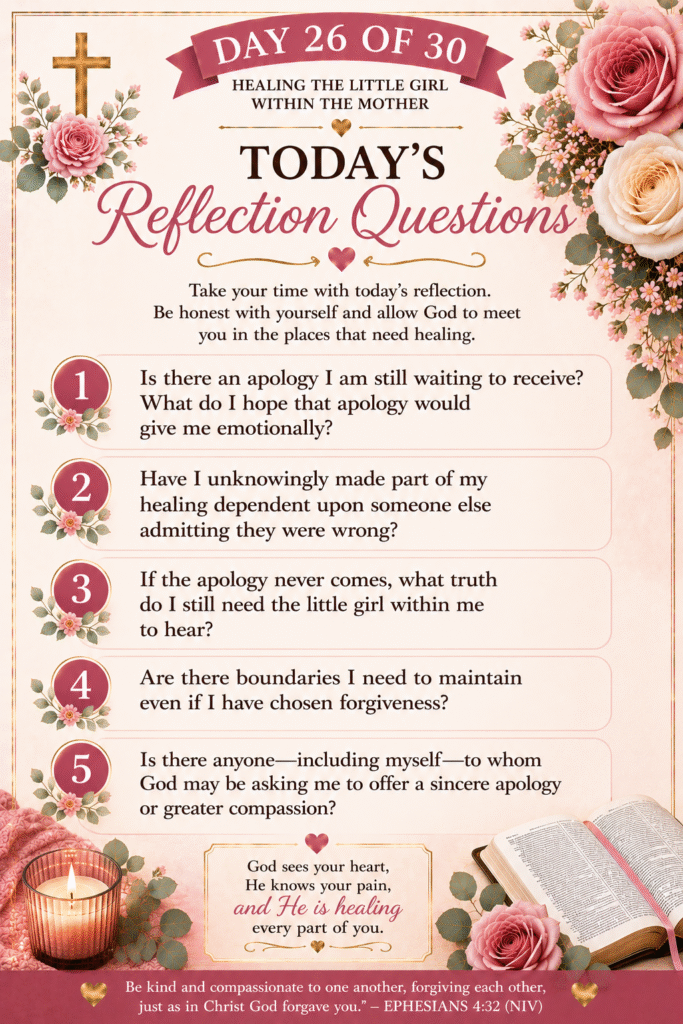
Reflection Questions
- Is there an apology I am still waiting to receive? What do I hope that apology would give me emotionally?
- Have I unknowingly made part of my healing dependent upon someone else admitting they were wrong?
- If the apology never comes, what truth do I still need the little girl within me to hear?
- Are there boundaries I need to maintain even if I have chosen forgiveness?
- Is there anyone—including myself—to whom God may be asking me to offer a sincere apology or greater compassion?
Closing Prayer
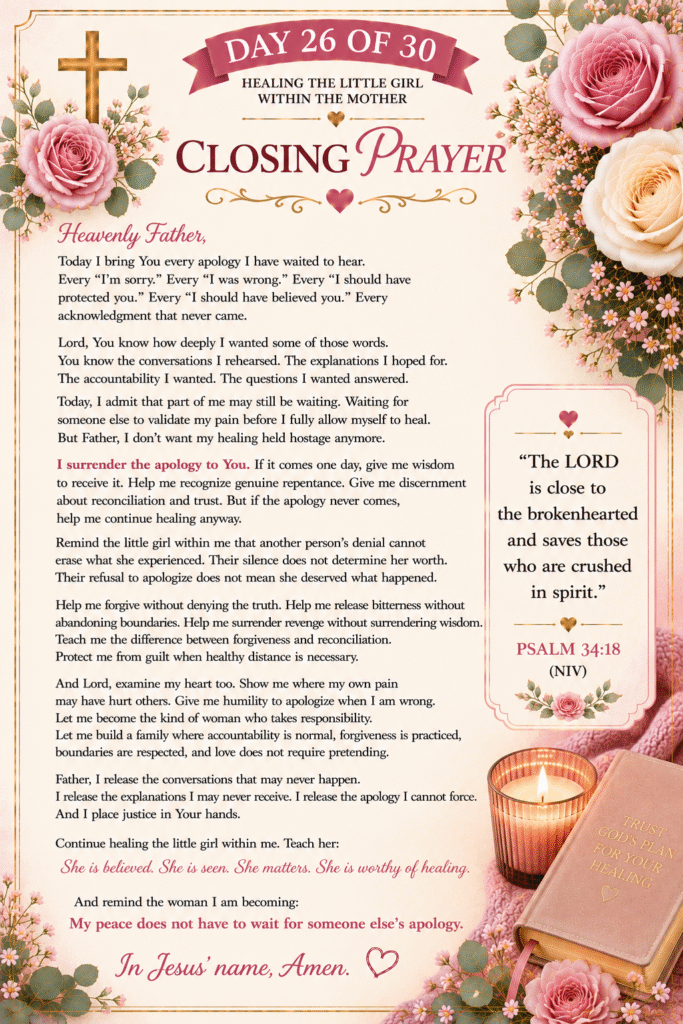
Heavenly Father,
Today I bring You every apology I have waited to hear.
Every “I’m sorry.” Every “I was wrong.” Every “I should have protected you.” Every “I should have believed you.” Every acknowledgment that never came.
Lord, You know how deeply I wanted some of those words. You know the conversations I rehearsed, the explanations I hoped for, the accountability I wanted, and the questions I wanted answered.
Today, I admit that part of me may still be waiting—waiting for someone else to validate my pain before I fully allow myself to heal.
But Father, I don’t want my healing held hostage anymore.
I surrender the apology to You.
If it comes one day, give me wisdom to receive it. Help me recognize genuine repentance. Give me discernment about reconciliation and trust.
But if the apology never comes, help me continue healing anyway.
Remind the little girl within me that another person’s denial cannot erase what she experienced. Their silence does not determine her worth. Their refusal to apologize does not mean she deserved what happened.
Help me forgive without denying the truth. Help me release bitterness without abandoning boundaries. Help me surrender revenge without surrendering wisdom.
Teach me the difference between forgiveness and reconciliation. Protect me from guilt when healthy distance is necessary.
And Lord, examine my heart too. Show me where my own pain may have hurt others. Give me humility to apologize when I am wrong.
Help me build a family where accountability is normal, forgiveness is practiced, boundaries are respected, and love does not require pretending.
Father, I release the conversations that may never happen. I release the explanations I may never receive. I release the apology I cannot force. And I place justice in Your hands.
Continue healing the little girl within me. Teach her: She is believed. She is seen. She matters. She is worthy of healing.
And remind the woman I am becoming: My peace does not have to wait for someone else’s apology.
In Jesus’ name,
Amen.
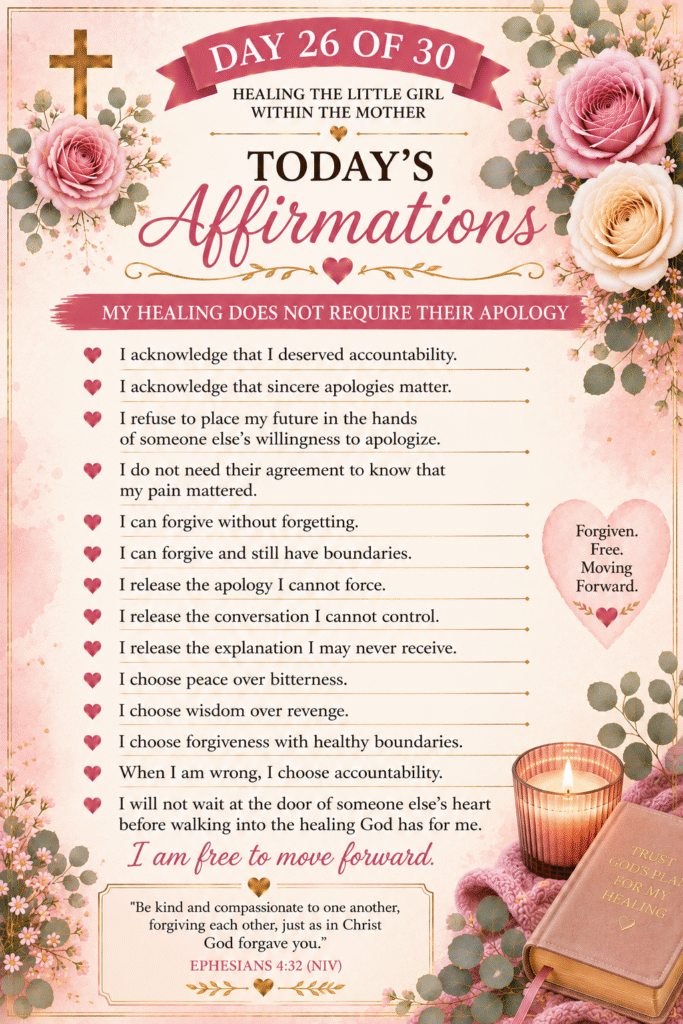
Today’s Affirmation
MY HEALING DOES NOT REQUIRE THEIR APOLOGY
I acknowledge that I deserved accountability. I acknowledge that sincere apologies matter.
But I refuse to place my future entirely in the hands of someone else’s willingness to say, “I’m sorry.”
I do not need another person’s denial to become my truth. I do not need their agreement to know that my pain mattered.
I can forgive without forgetting. I can forgive without immediately reconciling. I can forgive and still have boundaries. I can release bitterness without giving unsafe people unlimited access to me.
My healing belongs to me and God.
I release the apology I cannot force. I release the conversation I cannot control. I release the explanation I may never receive. I release the need to make someone understand what they refuse to understand.
I choose peace. I choose wisdom. I choose forgiveness. I choose healthy boundaries. And when I am wrong, I choose accountability.
I will not wait at the door of someone else’s heart before walking into the healing God has for me.
I am free to move forward.
Journal Prompt — The Apology I Wanted
At the top of today’s journal page, write: “What I Needed You to Say”
Finish these statements:
I wanted you to apologize for…
I wanted you to acknowledge…
I wanted you to understand that…
What hurt me most was…
The words I needed to hear were…
I believed your apology would finally give me…
Now ask: “How can I begin receiving or building this without waiting for that person?”
Next, write a short note to the little girl within you:
“You deserved…”
“You were not responsible for…”
“I believe…”
“I want you to know…”
Finally, write:
“I release my healing from dependence upon an apology I cannot control. If the apology comes, I will receive it with wisdom. If it does not, I will continue becoming whole.”
Today’s Healing Challenge — Release the Empty Chair
Find a quiet place and place an empty chair across from you.
Imagine, just for a moment, that the person whose apology you have been waiting for is sitting there. You do not have to relive traumatic details.
Simply say what you need to say: “What happened hurt me.” “I deserved better.” “I needed you.” “I wanted you to apologize.”
Then say: “But I am no longer going to make my healing dependent upon what you choose to do.”
Afterward, pray and ask God to help you release what belongs to Him.
If this exercise feels too emotionally intense, skip it and use the journal prompt instead. Healing does not require forcing yourself into distress.
A Truth to Carry With You Today
Little girl,
I know you’ve been waiting.
Waiting for someone to finally look you in the eyes and say: “I’m sorry.” Waiting for them to admit they should have protected you. Waiting for someone to say they believe you.
Perhaps part of you believed: “When they apologize, then I’ll know I mattered.”
But listen carefully.
You mattered before the apology.
You mattered while they denied it. You mattered while they remained silent. You mattered when nobody understood.
Their apology does not create your worth. Their acknowledgment does not create the truth. And their silence cannot take your healing away.
Would an apology be meaningful? Yes. Would accountability matter? Absolutely.
But little girl, we are not going to sit at the door forever waiting for someone else to bring us permission to leave.
We’re getting up. We’re taking God’s hand. And we’re walking forward.
If they apologize one day, we’ll decide what to do then.
But today, we choose healing. We choose peace. We choose truth. We choose boundaries. We choose freedom.
You are loved. You are seen. You are worthy. You are not forgotten. You are not abandoned. And you are allowed to heal.
Even without the apology.
Tomorrow — Day 27: Learning to Receive Love Without Fear
Theme Scripture:
“There is no fear in love. But perfect love drives out fear…”
— 1 John 4:18 (NIV)
After childhood hurt, sometimes receiving love can feel almost as frightening as losing it.
You may question kindness, wait for someone’s behavior to change, feel uncomfortable when someone treats you well, push people away before they have the opportunity to leave, or wonder: “What do they want from me?”
Tomorrow, we will talk about learning to recognize healthy love and allowing ourselves to receive it without constantly waiting for something bad to happen.
The little girl within you may have learned: “Love isn’t safe.”
But the woman God is healing is learning: “I can use wisdom, maintain healthy boundaries, and still allow safe, consistent love into my life.”