
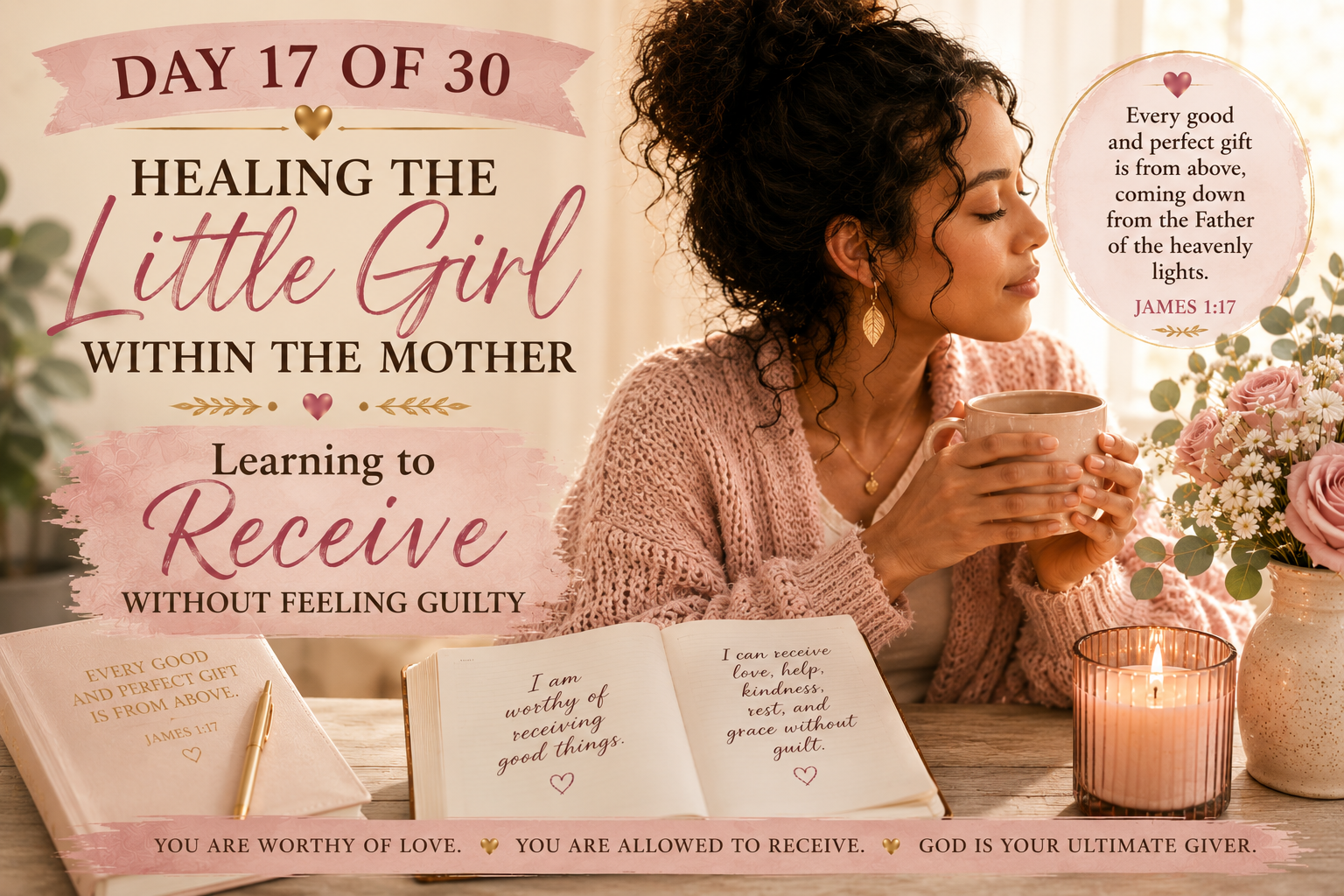
Day 17 – Learning to Receive Without Feeling Guilty
Theme Scripture
“Every good and perfect gift is from above, coming down from the Father of the heavenly lights.”
— James 1:17 (NIV)

For many women, giving comes naturally.
We give our time. We give our energy. We prepare meals. We care for our children. We support our husbands, families, and friends. We pray for people. We listen. We encourage. We remember birthdays, appointments, grocery lists, school schedules, family needs, and a hundred little details that keep life moving.
And when someone needs help, we often respond almost automatically: “I’ll take care of it.”
But what happens when someone tries to take care of us?
Suddenly, receiving can feel uncomfortable. Someone offers help, and we say, “No, I’m okay.” Someone gives us a compliment, and we immediately minimize it. Someone buys us something, and we start thinking about how quickly we can repay them. Someone offers to take something off our plate, and instead of feeling relieved, we feel guilty. Someone asks, “What do you need?” And sometimes we genuinely don’t know how to answer.
For women who learned very early that their value came from what they could do for other people, receiving can feel far more vulnerable than giving.
The little girl within may have learned: “If I am useful, I am valuable.”
But the woman God is healing is learning: “I am valuable even when I am not doing anything for anyone.”
Today, we’re going to talk about opening our hands. Not only to give. But also to receive.
When the Little Girl Learned to Be the Helper
Some little girls were allowed to simply be children. Others became helpers very early.
Maybe you cared for younger siblings. Maybe you learned to cook, clean, organize, or manage responsibilities long before you should have needed to. Maybe you became emotionally responsible for an adult. Perhaps you were the child who tried to make everyone feel better.
You became responsible. Dependable. Helpful. Strong. People may even have praised you for it.
And while responsibility can develop wonderful qualities, sometimes something else quietly develops alongside it: the belief that being needed is what makes me valuable.
The little girl begins connecting love with usefulness. If I’m helpful, people appreciate me. If I make things easier for everyone, maybe they won’t be upset. If I don’t need anything, I won’t become a burden. If I take care of everyone else, maybe I’ll be safe.
Eventually, she becomes a woman who knows exactly how to give. But she has no idea how to receive.
Sometimes Independence Is a Wound in Disguise
Independence can be a wonderful quality. Being capable is good. Knowing how to solve problems is valuable.
But sometimes what we call independence is actually something deeper: “I learned not to depend on anyone because people disappointed me.”
There is a difference between “I can do this myself” and “I have to do everything myself because I cannot trust anyone to help me.” One comes from capability. The other can come from self-protection.
Maybe you asked for help before and nobody came. Maybe people used what they did for you against you later. Maybe receiving always came with strings attached. Maybe someone made you feel guilty for needing them. Maybe promises were repeatedly broken.
Eventually, you stopped asking. You told yourself: “I’ll figure it out.” And you did. Again and again.
You became strong because you had to. But healing may now require learning that strength isn’t only carrying everything yourself. Sometimes strength is being able to say: “Yes, I could use some help.”
God Created Us to Both Give and Receive
There is beauty in generosity. Scripture continually teaches us to serve, give, encourage, love, and care for one another. But notice the phrase: one another.
Healthy relationships involve movement in both directions. Sometimes you encourage; sometimes you need encouragement. Sometimes you cook the meal; sometimes someone brings you one. Sometimes you pray for someone; sometimes you need someone to pray for you. Sometimes you carry another person’s burden; sometimes you need help carrying yours.
There is no shame in either position. If God wanted you to live completely independent of other people, He would not have created community. Receiving does not make you weak. It makes you human.
Every Good Gift Ultimately Comes From God
James 1:17 tells us, “Every good and perfect gift is from above…”
God’s provision can arrive through ordinary people and ordinary moments: a friend brings dinner, someone sends an encouraging message at exactly the right time, your husband takes care of something you were worrying about, someone offers childcare, a family member gives you something you needed, a stranger shows unexpected kindness, someone prays for you, a door opens, or an opportunity arrives.
Instead of immediately wondering, “How do I repay this?” perhaps you can sometimes simply say: “Thank You, God.” The person may be the vessel, but the goodness ultimately points back to the Giver.
You Don’t Have to Earn Every Good Thing
This can be difficult for women who learned that good things came through performance. Maybe affection depended on behaving correctly. Praise depended on achievement. Acceptance depended on being useful.
But grace challenges that entire system. Grace says: You cannot earn what God freely gives.
We obey God because we love Him. We pursue holiness because we belong to Him. We serve because Christ has transformed our hearts. But we do not perform our way into becoming worthy of God’s love. God’s love isn’t wages. It’s love.
Receiving a Compliment Shouldn’t Feel Like a Crisis
Someone says, “You look beautiful today,” and you answer, “Oh please, my hair is a mess.” Someone says, “Dinner was delicious,” and you respond, “It wasn’t my best.” Someone says, “You’re doing a great job,” and you immediately list everything you’re doing wrong.
Humility doesn’t require rejecting every kind word. You can receive a compliment without worshipping it. You can simply say: “Thank you. That means a lot to me.” You don’t have to argue someone out of seeing something beautiful in you.
You Are Allowed to Receive Help
You are allowed to receive help before you completely fall apart. You don’t have to reach exhaustion first. You don’t have to prove that you tried everything. You don’t have to become overwhelmed enough to qualify for support.
Sometimes receiving help allows another person to use their gift. When you refuse every act of kindness, you may unintentionally deny someone else the joy of giving. You know how good it feels when you help someone you love. Allow other people to experience that too.
Rest Is Something You Can Receive Too
Rest can be surprisingly difficult for women who connect worth with productivity. Sitting down feels lazy. Doing nothing feels irresponsible. A quiet afternoon produces guilt.
There will always be something to do. If you wait until everything is finished before allowing yourself to rest, you may never rest.
Jesus Himself withdrew from crowds. Rest is not evidence that you lack discipline. Sometimes rest is wisdom. You do not have to earn every moment of rest by reaching exhaustion first.
Receiving Can Feel Vulnerable
Giving often keeps us in control. Receiving means opening our hands and allowing someone else to contribute. Sometimes it means acknowledging, “I need something.” And that can feel vulnerable, especially if needing people once led to disappointment.
Healthy receiving requires discernment. You don’t accept everything from everyone, and you don’t allow generosity to become manipulation. But neither do you reject genuine love simply because receiving feels unfamiliar.
You Don’t Owe Everyone Who Does Something Kind for You
Reciprocity is beautiful in relationships. But love is not an accounting ledger. Healthy relationships aren’t built on constantly keeping score.
Sometimes someone blesses you because they genuinely want to. You can receive it, be grateful, express appreciation, and allow the kindness to simply be kindness.
Receiving God’s Forgiveness Is Part of Healing
God offers forgiveness. Do you receive it? Or do you keep trying to punish yourself for what Christ has already forgiven?
You cannot repay grace. That’s what makes it grace. You receive it. You thank God for it. And then you allow that grace to change how you live.
Sometimes receiving God’s forgiveness means finally allowing yourself to believe: “God’s mercy really does include me.”
Receiving Love Without Suspicion
When love was inconsistent earlier in life, someone can be kind and you wonder, “What do they want?” Someone loves you well and part of you waits for them to change.
Those reactions may make sense considering what you’ve experienced. But healing invites you to stop requiring today’s relationships to continually pay for yesterday’s wounds.
Not everyone is the person who hurt you. Not every act of kindness has a hidden motive. Not every relationship ends in betrayal. You can remain discerning without living permanently suspicious of love.
Receiving From God Requires Open Hands
Sometimes healing requires opening our hands to God’s comfort, correction, love, peace, provision, opportunities, people, and unexpected blessings.
We often pray, “Lord, bless me,” and then when the blessing arrives differently than we expected, we resist it. Stay open.
Debbie’s Reflection
Being strong can become a habit. When you’ve walked through difficult seasons, survived painful experiences, cared for children, managed responsibilities, and learned how to keep moving even when life feels heavy, eventually people begin seeing you as “the strong one.”
There is strength in that. But I’ve also learned that there can be a danger in becoming so comfortable with being strong that you forget how to receive.
Sometimes the hardest words aren’t “I’ll help you.” They’re “I need help.” And sometimes the hardest response isn’t giving. It’s saying, “Thank you. I receive that.”
God has been teaching me that receiving doesn’t erase my strength. Rest doesn’t erase my strength. Allowing someone to help doesn’t erase my strength. Being loved doesn’t create a debt I must immediately repay. I can simply be grateful.
The little girl within me may have learned that being useful made her valuable. But the woman God is healing is learning: My value does not begin when someone needs me.
I have value when I’m serving. I have value when I’m resting. I have value when I’m helping. I have value when I’m receiving help. I have value when I’m accomplishing something. And I still have value when I’m sitting quietly in God’s presence doing absolutely nothing to earn His love.
Mothers Need to Learn to Receive Too
Motherhood naturally involves enormous amounts of giving. But there is something important our children can learn when they see us receive.
When your child says, “Mom, let me help,” and you allow them, they learn contribution. When your husband offers to handle something and you allow him, partnership grows. When a friend offers support and you receive it, relationship deepens. When your children see you rest without apologizing for existing, they learn that human beings have limits.
Your children are not only watching how you give. They are watching how you allow yourself to be loved.
Let Your Children Give to You
Your child brings you a cup of water. Receive it. They make you a card. Treasure it. They try to help with dinner. Let them. They give you a compliment. Believe them.
You are teaching: Love moves in both directions. And that lesson may become part of breaking a generational cycle.
The Little Girl Within You Does Not Have to Earn Love Anymore
Imagine sitting beside the little girl you once were. Maybe she is busy, helping, watching, trying to be good, trying not to need anything, trying to make life easier for everyone around her.
Tell her: “You can put that down now. You don’t have to earn love by being useful. You are allowed to need things. You are allowed to receive. You are allowed to rest. You are allowed to be cared for. You are valuable even when you’re doing nothing.”
And then tell her the most important truth: “God loved you before you ever did anything for Him.”
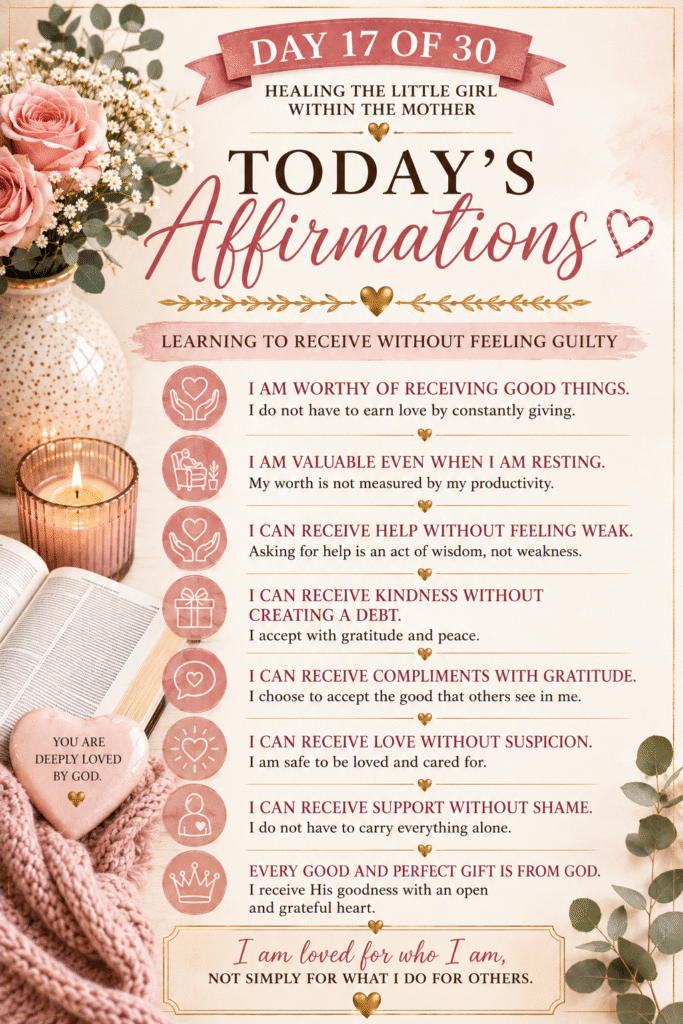
Reflection Questions
1. Do I feel more comfortable giving to others than receiving from them? Why do I think that is?
2. Did I learn early in life that being helpful, responsible, strong, or useful made me more worthy of love or acceptance?
3. What emotions come up when someone offers to help me—gratitude, guilt, discomfort, suspicion, embarrassment, or something else?
4. Where might God be inviting me to receive help, love, rest, encouragement, or support instead of insisting on carrying everything myself?
5. What would change in my life if I truly believed I did not have to earn every good thing God allows me to receive?
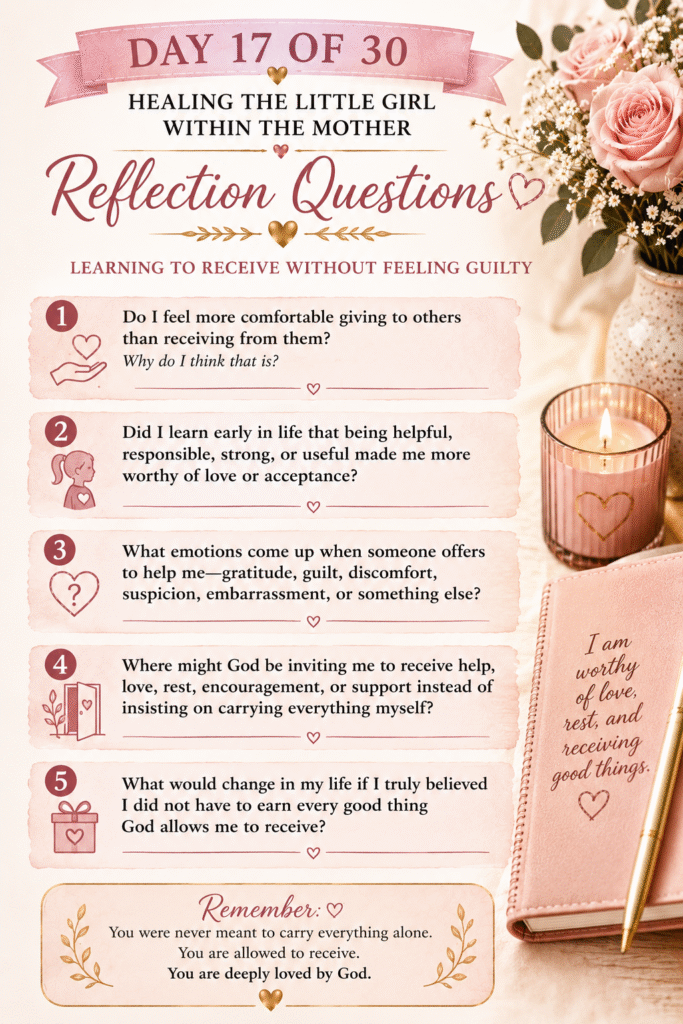
Closing Prayer
Heavenly Father,
Thank You for being the Giver of every good and perfect gift. Thank You for loving me before I could ever do anything to earn Your love.
Today I bring You the part of me that feels more comfortable giving than receiving. Heal the little girl within me who learned that being useful was the safest way to feel valuable. Heal the places where I learned to believe that needing help made me weak, burdensome, or dependent.
Forgive me for the times I have tried to carry everything alone when You were sending people, opportunities, rest, encouragement, and support to help me.
Teach me how to receive with gratitude instead of guilt. When someone offers genuine kindness, help me accept it without immediately feeling that I owe something in return. When someone speaks an encouraging word over me, help me receive it instead of dismissing it. When my body needs rest, help me honor that need without condemning myself for not being productive. When I need help, give me humility and courage to ask.
When You send love into my life, heal the places within me that are still afraid to trust it. Give me discernment to recognize healthy love and genuine generosity while maintaining wise boundaries.
Most of all, Father, teach me how to receive from You. Help me receive Your grace, forgiveness, peace, provision, correction, comfort, and love. Remind me that I do not have to perform for Your affection. I am Your daughter.
Continue healing the little girl within me as You strengthen the woman You created me to become. May my hands remain generous enough to give and open enough to receive.
In Jesus’ name, Amen.
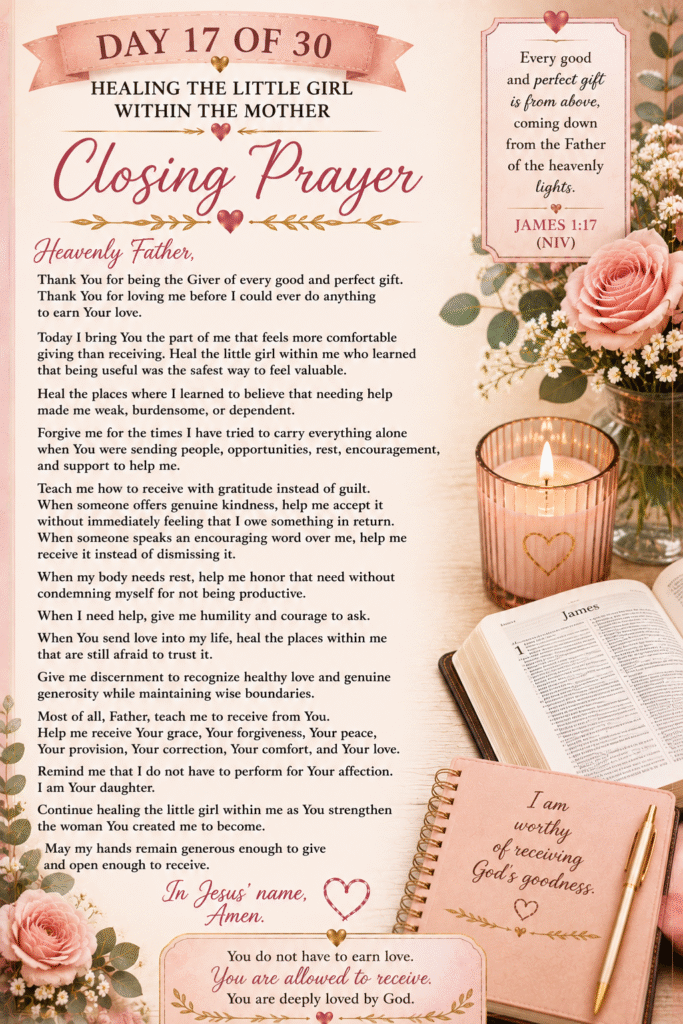
Today’s Affirmation
I AM WORTHY OF RECEIVING GOOD THINGS
I do not have to earn love by constantly giving.
I am valuable even when I am resting.
I can receive help without feeling weak.
I can receive kindness without immediately creating a debt.
I can receive compliments with gratitude.
I can receive support without shame.
I can receive rest without guilt.
Every good gift in my life ultimately comes from God, and I will receive His goodness with an open and grateful heart.
I am loved for who I am, not simply for what I do for others.
Journal Prompt
At the top of today’s journal page, write: “What Is Difficult for Me to Receive?”
Create several categories: Help, Love, Compliments, Rest, Gifts, Support, Forgiveness, Kindness, and God’s grace.
Beside each one, write what you honestly feel when someone offers it. Do you feel grateful, uncomfortable, suspicious, guilty, embarrassed, or obligated?
Then ask: “What am I afraid receiving this will mean about me?”
Now write God’s truth beside that fear. Finish by writing: “God, teach me to recognize the good things You send into my life and receive them with gratitude instead of guilt.”
Then write down three good things you have received recently, no matter how small. Thank God for each one.
Today’s Healing Challenge
Today, practice receiving one thing without minimizing, rejecting, or immediately repaying it.
If someone compliments you, simply say: “Thank you.” If someone offers genuine help that would benefit you, consider saying: “Yes, thank you. I appreciate that.” If your body needs rest, allow yourself a short period of intentional rest without mentally listing everything you “should” be doing.
When something good happens today, pause and say: “Thank You, God. I receive this with gratitude.”
A Truth to Carry With You Today
Healing isn’t only about releasing. Sometimes healing is about receiving.
Receiving truth where lies once lived. Receiving peace where chaos once lived. Receiving love where rejection once lived. Receiving grace where shame once lived. Receiving help where hyper-independence once lived. Receiving rest where exhaustion once lived. Receiving your voice where silence once lived. Receiving God’s goodness without wondering whether you have done enough to deserve it.
The little girl within you may still believe: “I have to earn love.” But today, gently remind her: “No, sweetheart. You don’t.”
You are allowed to be cared for. You are allowed to be encouraged. You are allowed to rest. You are allowed to receive kindness. And above all, you are allowed to receive the love God has been offering you all along.
Open your hands. You don’t always have to be the giver. Sometimes the blessing is found in learning how to receive.
Tomorrow – Day 18
Giving Yourself Permission to Rest
Theme Scripture
“Come to me, all you who are weary and burdened, and I will give you rest.”
— Matthew 11:28 (NIV)
Tomorrow we will go deeper into one of the areas many women struggle most to receive: rest.
We will talk about why women who learned to measure their value by productivity can feel guilty when they stop, why constantly being “the strong one” can leave us emotionally exhausted, and why biblical rest is not laziness.
The little girl within you may have learned: “Keep going. Don’t stop. Someone needs you.”
But the woman God is healing is learning to hear Jesus say: “Come to Me… and I will give you rest.”

1 Comment
[…] Healing the Little Girl Within the Mother […]