
Before You Set New Goals, Celebrate How Far You’ve Come
By Debbie Doyle | Moms Building Wealth
As the year begins winding down, it can be tempting to turn our attention immediately to what comes next.
We start thinking about the goals we want to set, the habits we want to change, and the things we hope to accomplish in the new year. Perhaps we want to manage our money more carefully, grow a business, strengthen our faith, or create more time for ourselves and our families.
Those desires can be meaningful. But before we write another list of what needs to improve, I believe we should pause and acknowledge what has already changed.
Before you set new goals, celebrate how far you have come.
You may have unfinished plans. You may still be working through something you hoped would be resolved by now. Yet those unfinished things do not tell the whole story of your year.
There may be growth you have overlooked because it happened quietly. There may be decisions that took courage even though nobody else saw them. There may be moments when you responded differently, asked for help, or gave yourself permission to begin again.
Those things deserve a place in your reflection, too.
Look Beyond Your To-Do List
When we evaluate a year, we often begin with what we can count.
How much money did we save? How many projects did we complete? Did we reach the goal we wrote down in January?
It is useful to review those things. But a list of completed tasks cannot capture every way a woman grows.
Maybe you learned to express a need instead of expecting others to recognize it. Maybe you stopped agreeing to things you did not have the time or energy to do. Perhaps you became more willing to receive support.
You might have returned to prayer after a difficult season. You might have apologized to someone you love. You might have made a decision you had been avoiding.
These changes may never appear on a traditional goal sheet, but they can affect the way you live every day.
Ask yourself:
What can I do, understand, or face today that felt harder at the beginning of the year?
Give yourself time to answer. Your first response may be, “I’m not sure.” Keep looking with kindness.
Remember the Circumstances You Were Living Through
It is easy to judge your progress without considering what the year required of you.
A goal that seemed manageable in January may have become difficult after a move, a change in your household, an unexpected expense, or a demanding season of family responsibilities.
Your plans were made with the information you had at the time. As life changed, your priorities may have needed to change with it.
That deserves an honest review.
Instead of asking only, “Why didn’t I finish?” you can also ask:
- What changed during the year?
- What needed my attention?
- Which responsibilities took more time than I expected?
- Was the goal realistic for the season I was in?
- What support or resources were missing?
These questions help you understand your experience and make wiser plans.
There may still be choices you want to improve. You can acknowledge those choices without dismissing the effort you made under difficult circumstances.
What My Recent Move Is Teaching Me About Growth
My recent move has given me a practical example of what it means to enter a new season thoughtfully.
Before moving, I decided not to take everything with me. There were things I hardly used and things I barely used at all. I donated some items and threw others away.
I enjoyed the opportunity to have a clean slate.
When it came to furnishing our new home, I chose to take my time and do it room by room. I did not want to rush to fill every space.
That decision has given me something to think about as I reflect on personal growth.
I can apply the same thoughtful approach to my plans. I can look at what I have been carrying, decide what still serves my life, and consider what I am ready to release.
I can also allow my next chapter to take shape gradually.
Just as every room does not need to be finished at once, every area of my life does not need a new goal at the same time. I can choose where to focus and give that area the attention it needs.
There is freedom in allowing progress to happen at a pace I can sustain.
Celebrate the Choices That Helped You Grow
Sometimes we focus so much on an outcome that we forget the decisions that made it possible.
A stronger relationship may have begun with one honest conversation. A more peaceful schedule may have begun with declining one commitment. A creative project may have begun with sharing an idea before you felt completely ready.
Look back at the choices you made this year.
Which ones helped you care for your family? Which ones protected your time? Which ones brought you closer to something meaningful?
You may recognize courage in a decision you have been treating as ordinary.
For example, you might celebrate:
- Following through on something you had been postponing.
- Asking a question when you needed clarity.
- Taking a break before exhaustion became overwhelming.
- Beginning a project with the resources you already had.
- Returning to a habit after getting out of the routine.
- Choosing a calmer response during a difficult conversation.
Celebration does not have to involve a purchase or an event. Sometimes it begins with writing, “That took effort, and I am glad I did it.”
Give Yourself Credit for Beginning Again
Many of us have a habit of counting interruptions as failures.
We miss a few days of a routine and decide we have ruined it. A project takes longer than expected, and we feel embarrassed to return to it. We make a mistake and begin questioning whether we should have tried at all.
But returning matters.
If you started again this year, acknowledge that.
Perhaps you reopened a document you had set aside. Perhaps you returned to budgeting after an expensive month. Maybe you resumed prayer, reached out to someone, or took another step toward a goal that still matters to you.
You do not have to erase the interruption to appreciate the return.
Learning to begin again can help you keep going through the ordinary changes and challenges of life.
Bring Your Reflection Before God
Year-end reflection can become a meaningful time of prayer.
We can thank God for what we recognize and ask Him to help us understand what we have missed. We can bring our disappointments honestly, without pretending the year was easy.
Philippians 1:6 offers this encouragement:
“Being confident of this very thing, that he which hath begun a good work in you will perform it until the day of Jesus Christ.” — Philippians 1:6, KJV
This verse points us toward confidence in God’s continuing work. It reminds me that spiritual growth does not end when the calendar changes.
I do not have to arrive at December with everything resolved.
I can thank God for the ways He has helped me grow and continue seeking His guidance for the work still ahead.
You might pray:
Lord, help me see this year honestly. Show me where I have grown, where I need to take responsibility, and where I need Your help. Teach me to receive progress with gratitude.
Ask What This Year Taught You About the Woman You Are Becoming
Before choosing new goals, consider what you have learned about yourself.
Perhaps you discovered that you need more quiet time than you had allowed. Maybe you realized you enjoy creating, teaching, cooking, writing, or bringing people together.
You may have learned that a certain commitment no longer fits your priorities. Or you may have recognized a responsibility you want to approach with greater care.
These discoveries can help you decide what comes next.
Try completing these sentences:
- This year, I learned that I need __________.
- I felt most purposeful when __________.
- A decision I am proud of is __________.
- I want to make more room for __________.
- I am ready to release __________.
- I want to continue growing in __________.
Your answers do not need to sound impressive. They need to be truthful.
A simple realization—such as needing a more realistic schedule—can shape a much more useful plan than a long list of goals chosen out of pressure.
Recognize What You Want to Carry Forward
Reflection helps us notice what is worth continuing.
There may be a habit that supported you, a routine that made family life easier, or a way of praying that helped you remain connected to God.
Before replacing your entire approach in January, consider what already works.
What helped you follow through? What brought joy into your week? What made your responsibilities more manageable?
You may need to strengthen something you have already begun.
For example, if a short weekly planning session helped you this year, you might keep it and make it more consistent. If working on one project at a time helped you finish, you might build your new goals around that approach.
Progress can include recognizing a good practice and giving it room to continue.
Choose New Goals From What You Have Learned
Once you have reflected, you can begin planning with a clearer understanding of your life.
Choose goals that connect to your values and fit your current responsibilities. Consider the time, money, energy, and support they will require.
Instead of giving every area of your life a major assignment, choose a few priorities.
For each one, ask:
- Why does this matter to me?
- What would meaningful progress look like?
- What is the first manageable step?
- What might get in the way?
- How can I adjust when life changes?
If your goal is to grow a business, your first step might be completing one useful product. If you want a more peaceful home, it might be creating a routine for one area. If you want to strengthen your spiritual life, it might be setting aside a regular time for prayer and scripture.
Give yourself a starting point you can recognize and act on.
Consider a Word and Scripture for the New Year
After reflecting on your year, you may find it helpful to choose a word that expresses the direction you want to take.
That word can serve as a reminder when you are making decisions. It does not need to become another standard you feel pressured to meet.
You might choose:
| Word | What it could remind you to practice | Scripture to reflect on |
| Wisdom | Seek God’s guidance before making decisions. | James 1:5 |
| Peace | Bring your concerns to God and make room for prayer. | Philippians 4:6–7 |
| Courage | Take a meaningful step while trusting God’s presence. | Joshua 1:9 |
| Renewal | Allow God’s truth to shape your thinking. | Romans 12:2 |
| Faithfulness | Continue doing the good work in front of you. | Galatians 6:9 |
Read the surrounding passage before choosing your scripture. Let its meaning guide your reflection.
You can write your word and reference in a journal, place them near your workspace, or return to them during a weekly check-in.
Ask yourself: How could I practice this in an ordinary part of my life?
That question helps connect your intention to daily action.
A Simple Year-End Reflection
Before you write your new goals, take a few quiet minutes with these prompts:
Three things I am grateful for:
What brought help, joy, comfort, or opportunity into my year?
Three ways I have grown:
What has changed in my choices, understanding, or responses?
One difficult thing I faced:
What helped me through it, and what support might I still need?
One lesson I want to carry forward:
What do I want to remember when I make plans?
One thing I am ready to release:
Is there a commitment, expectation, or unused goal I need to reconsider?
One next step:
What is a manageable action that supports the woman I want to become?
There is no need to finish the reflection in one sitting. You can return to it over several days.
Acknowledge the Woman You Are Today
Before you become absorbed in who you hope to be next year, take a moment to appreciate who you are today.
You have lived through a year of decisions, responsibilities, changes, and experiences. Some may have brought joy. Others may still be difficult to understand.
You can be honest about all of it.
You can celebrate progress while acknowledging disappointment. You can recognize a mistake and still appreciate the effort you made to repair it. You can have a meaningful life while continuing to learn.
As I settle into our new home, I am allowing each room to come together in its own time. I want to bring that same patience into the way I approach growth.
I can appreciate what is already here. I can make thoughtful choices about what comes next. And I can keep building, one meaningful step at a time.
Before you set new goals, give yourself that moment of recognition.
What is one way you have grown this year that you have not yet given yourself credit for?
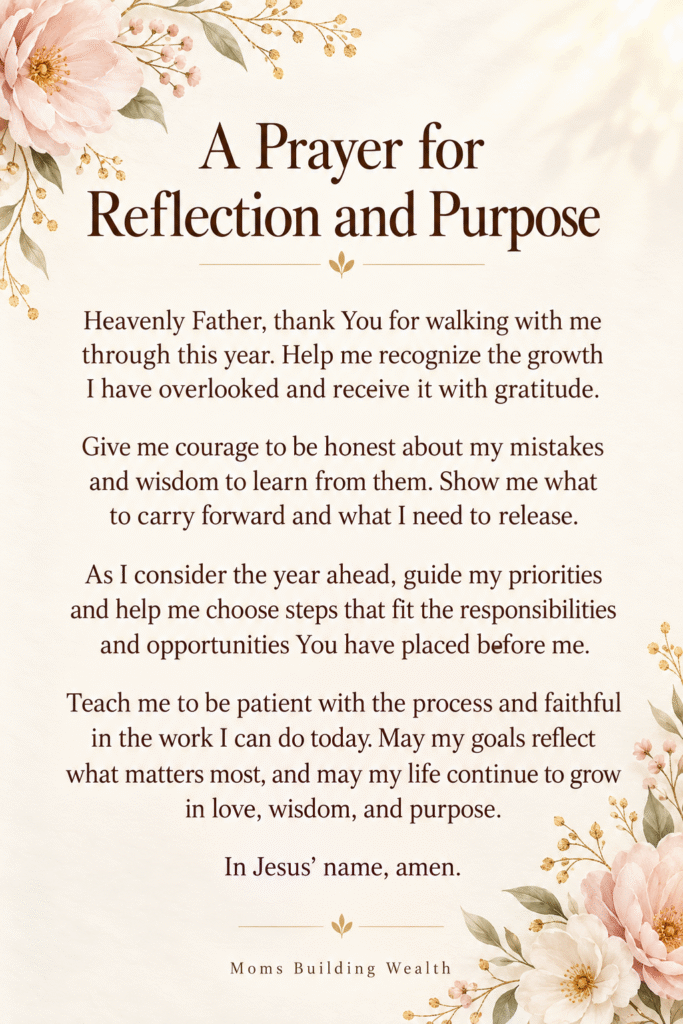
A Prayer for Reflection and Purpose
Heavenly Father, thank You for walking with me through this year. Help me recognize the growth I have overlooked and receive it with gratitude. Give me courage to be honest about my mistakes and wisdom to learn from them. Show me what to carry forward and what I need to release. As I consider the year ahead, guide my priorities and help me choose steps that fit the responsibilities and opportunities You have placed before me. Teach me to be patient with the process and faithful in the work I can do today. May my goals reflect what matters most, and may my life continue to grow in love, wisdom, and purpose. In Jesus’ name, amen.