

Day 16 – Finding Your Voice Again
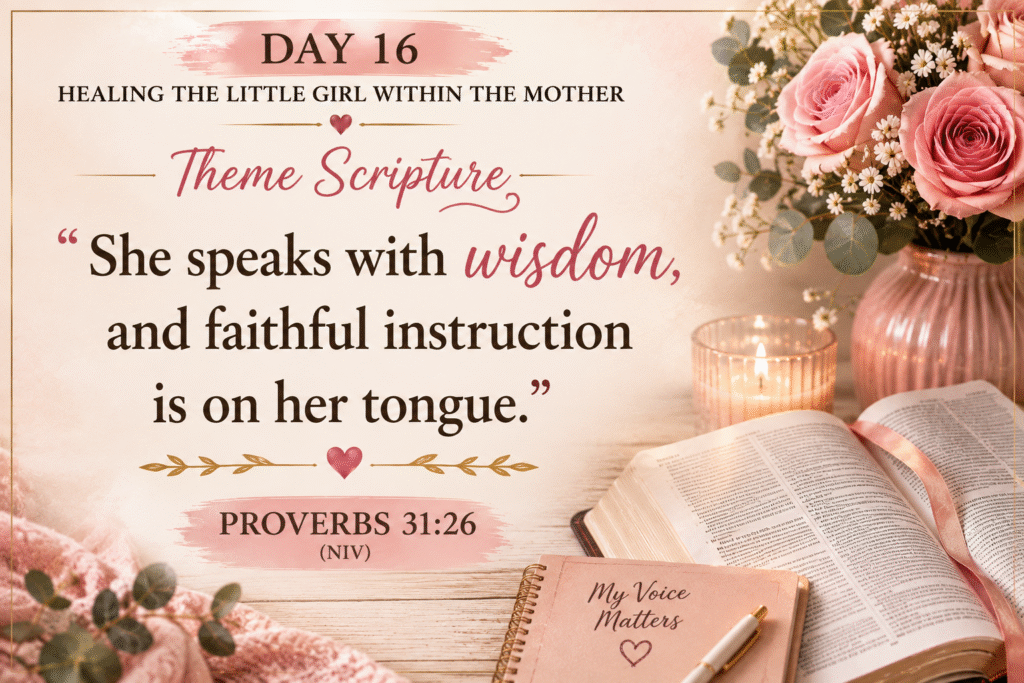
Theme Scripture
“She speaks with wisdom, and faithful instruction is on her tongue.”
— Proverbs 31:26 (NIV)
Finding Your Voice Again
There is a difference between having a voice and believing you are allowed to use it.
Many women have always been capable of speaking. They work, raise children, manage households, build relationships, solve problems, encourage others, and advocate for the people they love.
Yet somewhere deep inside, there may still be a little girl who learned:
Don’t say anything.
Don’t make trouble.
Don’t disagree.
Don’t tell anyone.
Don’t ask for what you need.
Don’t say how you really feel.
Just keep the peace.
Sometimes silence was learned because speaking didn’t change anything. Sometimes it was learned because speaking brought punishment, rejection, ridicule, anger, or shame. Sometimes no one asked the little girl what she thought. Sometimes she spoke—and nobody listened.
Eventually, she may have stopped trying.
But that little girl grew into a woman. And although her circumstances changed, the silence sometimes remained.
Day 15 taught us to release the need for everyone’s approval. Today we take the next step.
Because when you stop living for everyone’s approval, something beautiful begins to happen: You start discovering your own voice again.
Today is about learning to speak with wisdom rather than fear, honesty rather than people-pleasing, and grace rather than silence.
Your voice does not need to be loud to be powerful. It simply needs to become yours again.
When a Little Girl Learns That Silence Is Safer
Children learn quickly which behaviors feel safe.
Imagine a little girl who tries to explain that something hurt her. She hears, “Stop being so sensitive.” She tries to say she is uncomfortable. Someone says, “You’re fine.” She expresses an opinion. Someone laughs. She disagrees. She is accused of being disrespectful. She cries. Someone dismisses her feelings. She tells the truth about something difficult. Nobody believes her.
Eventually, she may draw a conclusion: Speaking doesn’t help. Or worse: Speaking makes things harder.
So she becomes quiet. Not necessarily physically quiet. Some wounded children grow into very outgoing adults. But emotionally, they remain silent.
They can talk for hours without ever revealing what they actually need. They can advocate fiercely for everyone except themselves. They can encourage another woman to establish boundaries while struggling to establish their own.
They have a voice. They simply haven’t learned that they are allowed to use it for themselves.
Silence Can Become a Survival Strategy
There may have been a season when silence genuinely helped you survive. Perhaps you lived around someone unpredictable. Maybe disagreeing wasn’t safe. Maybe telling the truth would have created consequences you weren’t equipped to handle. Maybe you learned to study people’s moods before deciding whether it was safe to speak.
If so, don’t shame the little girl who became quiet. She was adapting. She was doing what she knew how to do.
But healing asks a different question: Do I still need this survival strategy today?
What protected you in one season may imprison you in another. The silence that once helped you avoid conflict may now prevent intimacy. The habit of hiding your needs may now create resentment. The fear of disagreement may now prevent honest communication. The instinct to say “I’m fine” may keep people who genuinely love you from understanding what you need.
Healing means recognizing: I have choices now.
Your Voice Matters to God
Today’s Scripture describes a woman whose voice carries something valuable: “She speaks with wisdom, and faithful instruction is on her tongue.”
Her voice is not portrayed as troublesome. It is not portrayed as inconvenient. It carries wisdom.
God did not create you merely to have thoughts that never leave your mind. Your experiences, healing, motherhood, mistakes, and relationship with God have taught you things.
There is wisdom developing within you. And that wisdom can bless your children, your marriage, your friendships, your work, your community, and perhaps women you haven’t even met yet.
Your voice has purpose.
Finding Your Voice Doesn’t Mean Becoming Loud
A healthy voice doesn’t need to dominate a room. It doesn’t need to win every argument. It doesn’t need to speak on every subject. It doesn’t need to become harsh.
Biblical confidence and gentleness can exist together.
Finding your voice may simply mean saying: “That hurt me.” “I disagree.” “I need some time.” “I don’t understand. Can you explain?” “I’m not comfortable with that.” “I need help.” “No.” “Yes.” “I was wrong. I’m sorry.” “This matters to me.” “I would like to try.”
Sometimes finding your voice isn’t about saying more. It is about finally saying what is true.
You Are Allowed to Have an Opinion
Years of accommodating everyone else can disconnect you from your own preferences.
Healing may begin with small things. What food do you enjoy? What colors do you love? How do you like spending your free time? What kind of home environment makes you peaceful? What dreams are in your heart? What do you believe God is calling you toward?
You are allowed to know yourself. And you are allowed to express what you discover.
You Can Disagree Without Being Disrespectful
Some women fear disagreement because disagreement was dangerous in childhood. But healthy relationships can survive differences.
You can say, “I understand your perspective, but I see it differently.”
You can love someone and disagree with them. You can respect someone without automatically adopting their opinion. You can listen without surrendering your convictions. You can be humble without becoming voiceless.
Having a different perspective doesn’t automatically make you difficult.
Your Needs Are Not an Inconvenience
Many wounded women become extremely comfortable giving and extremely uncomfortable receiving.
Finding your voice means learning to say: “I need help” without feeling weak. “I need rest” without feeling lazy. “I need you to listen” without apologizing. “I need some space” without feeling cruel. “I need support” without feeling ashamed.
You are a human being. Having needs is not a character flaw.
Stop Saying “I’m Fine” When You Aren’t
There are times when privacy is appropriate. You do not owe everyone access to your emotions. But there is a difference between privacy and pretending.
Sometimes the truth is: “I’m overwhelmed.” “I’m disappointed.” “I’m tired.” “I’m afraid.” “I’m hurt.” “I don’t know what to do.”
Healing doesn’t require sharing those truths with everyone. It means becoming honest enough to acknowledge them before God and, when appropriate, with trustworthy people.
You cannot heal what you continually pretend isn’t hurting.
Your Voice Can Establish Boundaries
A boundary eventually requires language.
You may need to say: “Please don’t speak to me that way.” “I’m not available for that.” “That topic is private.” “I won’t participate in this conversation.” “I cannot take that responsibility on.” “If this continues, I will step away.”
Boundaries don’t have to be angry. They need to be clear. A boundary whispered with conviction is still a boundary.
Your Voice Is Not Only for Saying No
Your voice is also meant to say yes.
Yes to opportunities. Yes to dreams. Yes to creativity. Yes to trying again. Yes to love. Yes to laughter. Yes to asking for what you desire. Yes to sharing your ideas. Yes to telling your story. Yes to the assignment God places before you.
Healing allows us to acknowledge desire without demanding an outcome. You can say, “This is something I would love to pursue, Lord. If it aligns with Your will, guide me.”
Your voice can carry hope too.
Your Voice Can Break Generational Patterns
Imagine children growing up hearing their mother say: “I was wrong. I’m sorry.” “Your feelings matter.” “Tell me what happened.” “You don’t have to agree with me to speak respectfully.” “You can tell me when something makes you uncomfortable.” “Let’s talk about it.”
You are teaching them something the little girl within you may desperately have needed: Your voice matters here.
That is how cycles begin changing—not through perfection, but through intentionality.
Use Your Voice to Speak Life Over Yourself
Finding your voice also includes how you speak to yourself.
Instead of repeating harsh messages, practice truth: “I am learning.” “I made a mistake, but I can grow.” “God is still working in me.” “My past does not determine my future.” “My voice matters.” “I can speak with wisdom and grace.”
The little girl within you may have internalized harsh voices. The woman you are becoming can introduce a new one—a voice rooted in truth.
Your Voice Should Still Be Submitted to God
Finding your voice does not mean saying everything that enters your mind. Wisdom matters.
Proverbs 31:26 does not simply say, “She speaks.” It says, “She speaks with wisdom.”
There are times when wisdom speaks and times when wisdom remains silent. Times to confront and times to release. Times to explain and times to stop explaining.
Healing means your silence is no longer controlled by fear, and your speech is no longer controlled by emotion. Both become submitted to wisdom.
Before speaking, pray: “Lord, help me know what to say, how to say it, and when to say it.”
Debbie’s Reflection
There have been times when I was much better at speaking up for other people than speaking up for myself.
When you have spent parts of your life surviving, you learn how to adapt. You learn when to keep going, when to push through, and when to keep things inside. Sometimes you become so accustomed to carrying things quietly that silence feels normal.
But healing has taught me that having a voice doesn’t mean becoming angry or confrontational. Sometimes it simply means becoming honest.
I can say, “That hurt.” I can say, “I don’t agree.” I can say, “I need time.” I can say, “I need help.” I can say, “No.” And I can say, “This is something I believe God is calling me to do.”
I don’t need to shout to prove that my voice matters. I don’t need to convince everyone. And I don’t need everyone’s agreement before I speak honestly.
God is teaching me that my voice can carry both strength and grace.
The little girl within me may remember seasons when speaking didn’t feel safe or when her feelings didn’t seem important. But the woman God is healing can reach back and tell her: “I hear you now. What happened to you mattered. What you feel matters. You don’t have to disappear. You have a voice.”
Perhaps one of the most powerful ways I can honor the little girl I once was is by becoming a woman who no longer abandons her own voice.
Your Story May Become Someone Else’s Lifeline
Someone may need what you have learned.
Maybe another mother needs your testimony. Maybe your children need your wisdom. Maybe another woman needs to know she isn’t alone. Maybe your story belongs in a conversation, journal, blog, book, prayer, testimony, or kitchen-table conversation.
You do not have to tell everyone everything. Wisdom determines what is shared and what remains private.
But don’t automatically assume the painful chapters of your life have no purpose. God has a remarkable way of taking the places where we once felt silenced and turning them into places where our voices bring hope.
Start Small
You don’t have to transform overnight into someone who speaks confidently in every situation.
Begin small. When someone asks what you think, pause and ask yourself: What do I actually think? Then answer.
When someone asks where you want to eat, choose something. When you need help, ask. When you need time, say so. When you disagree, practice expressing it respectfully. When someone compliments you, simply say, “Thank you.” When something hurts, acknowledge it.
Small acts of honest communication rebuild your voice.
Reflection Questions
- Were there experiences in my childhood that taught me it was safer to remain silent than to speak honestly?
- In what relationships or situations do I find it most difficult to express what I truly think, feel, or need?
- Do I often say “I’m fine” when I am actually hurt, overwhelmed, disappointed, or afraid? Why?
- What is something I need to communicate honestly and respectfully instead of continuing to keep it inside?
- How can I begin using my voice with greater wisdom, grace, and confidence this week?
Closing Prayer
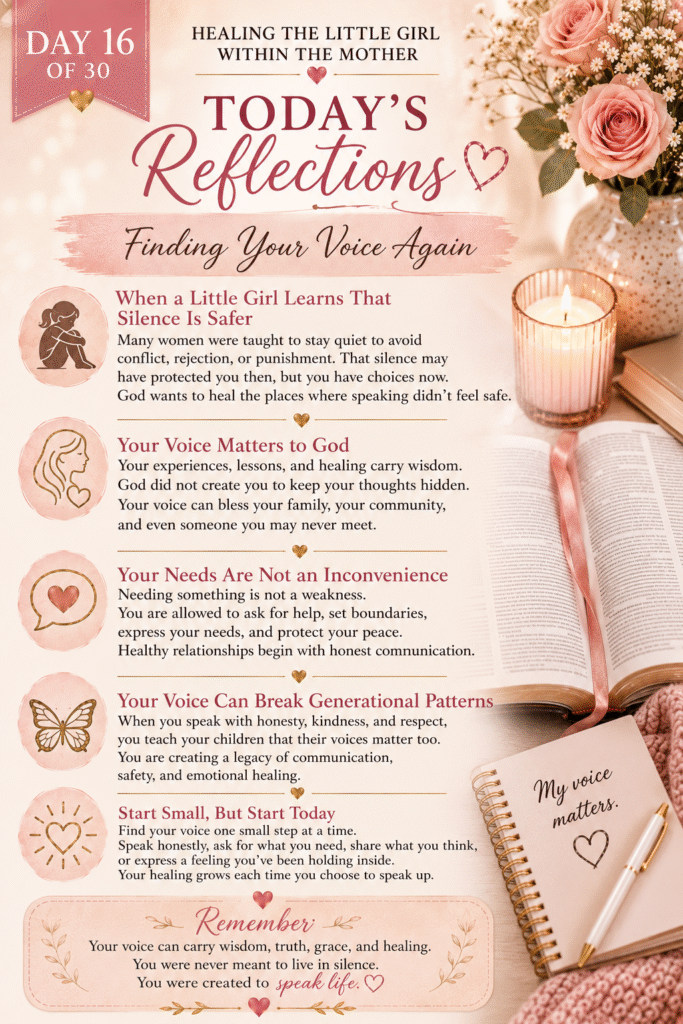
Heavenly Father,
Thank You for giving me a voice. Thank You that my thoughts, feelings, experiences, and needs matter to You.
Today I bring You every place where fear taught me to remain silent.
Heal the little girl within me who learned that speaking up was dangerous, pointless, disrespectful, or inconvenient. Heal the memories of the times she spoke and wasn’t heard. Heal the moments when her feelings were dismissed, her needs were ignored, or her truth was silenced. Remind her that she is safe in Your presence.
Teach me, as the woman I am today, to use my voice with wisdom. Help me speak truth without cruelty. Help me establish boundaries without guilt. Help me express my needs without shame. Help me disagree without becoming disrespectful. Help me apologize when I am wrong and stand confidently when I know something is right.
Give me discernment to know when to speak and when to remain silent. Keep my words from being controlled by fear, anger, pride, or people-pleasing. Let my words carry wisdom, grace, truth, encouragement, and life.
Help me use my voice to speak kindly to myself, lovingly to my family, courageously when something is wrong, and faithfully when You call me to share my story.
Continue healing the little girl within me as You strengthen the woman You created me to become.
May my voice no longer be governed by fear. May it become an instrument of wisdom, healing, encouragement, truth, and love.
And above every other voice, help me recognize and follow Yours.
In Jesus’ name,
Amen.
Today’s Affirmation
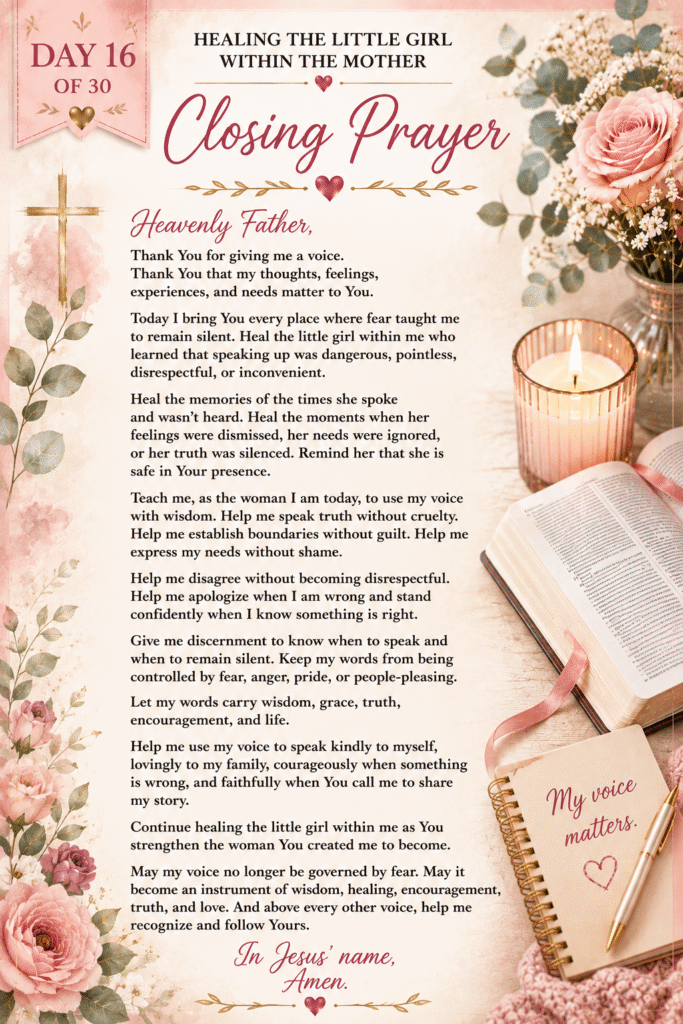
MY VOICE MATTERS
God has given me a voice, and I will use it with wisdom and grace.
I do not have to silence myself to keep everyone else comfortable.
My thoughts, feelings, needs, and boundaries are worthy of honest expression.
I can speak truth without becoming harsh. I can disagree without becoming disrespectful. I can ask for help without shame. I can say no without guilt and yes without fear.
I am learning when to speak, when to listen, and when to release.
The little girl within me is no longer voiceless.
God is healing my heart and teaching me to speak with courage, wisdom, truth, and love.
Journal Prompt
At the top of today’s journal page, write: “What I Wish I Could Have Said.”
Think about the little girl you once were. Was there something she wanted to say but couldn’t? Write whatever comes to mind. Don’t worry about grammar. Don’t edit it. Let her speak on the page.
Then create another heading: “What the Woman I Am Today Can Say.”
Write a response from the woman you are becoming. Perhaps: “I believe you.” “I hear you.” “Your feelings matter.” “You deserved to be protected.” “You don’t have to keep everything inside anymore.” “I will protect the boundaries we need now.” “God has not forgotten us.”
Finish with this declaration: “My past may have taught me silence, but God is teaching me wisdom. I will use my voice with courage, grace, and truth.”
Write three things you are grateful for today.
Today’s Healing Challenge
Practice using your voice in one small, healthy way today. Tell someone what you genuinely prefer, ask for help, say no to something you do not have capacity for, tell someone you appreciate them, express a feeling you’ve been hiding, ask a question instead of pretending you understand, speak an encouraging word over yourself, or share an idea you’ve been afraid to mention.
Choose one. The goal isn’t to become fearless. The goal is to stop allowing fear to decide whether you are allowed to speak.
A Truth to Carry With You Today
Perhaps there was once a little girl who needed someone to listen, believe her, and tell her, “Your voice matters.”
Today, you can begin giving her something different. Listen to her. Acknowledge her. Comfort her. And remind her: “We have a voice now.”
You do not need to shout, argue with everyone, or prove yourself. You simply need to stop disappearing from your own life.
Speak when wisdom says speak. Be silent when wisdom says be silent. Apologize when necessary. Establish boundaries when necessary. Tell the truth with grace. Ask for what you need. Allow your voice to become one more place where God’s healing is visible.
Tomorrow – Day 17
Learning to Receive Without Feeling Guilty
Theme Scripture: “Every good and perfect gift is from above, coming down from the Father of the heavenly lights.” — James 1:17 (NIV)
Tomorrow we’ll address something many women who became caretakers early in life struggle with: receiving—help, compliments, kindness, rest, support, and love without immediately feeling that they owe something in return.
Sometimes the little girl who learned to survive by being useful grows into a woman who feels valuable only when she is giving.
Day 17 will remind her: You don’t always have to be the giver. Sometimes healing looks like opening your hands and allowing yourself to receive what God sends with gratitude instead of guilt.

1 Comment
[…] Healing the Little Girl Within the Mother […]