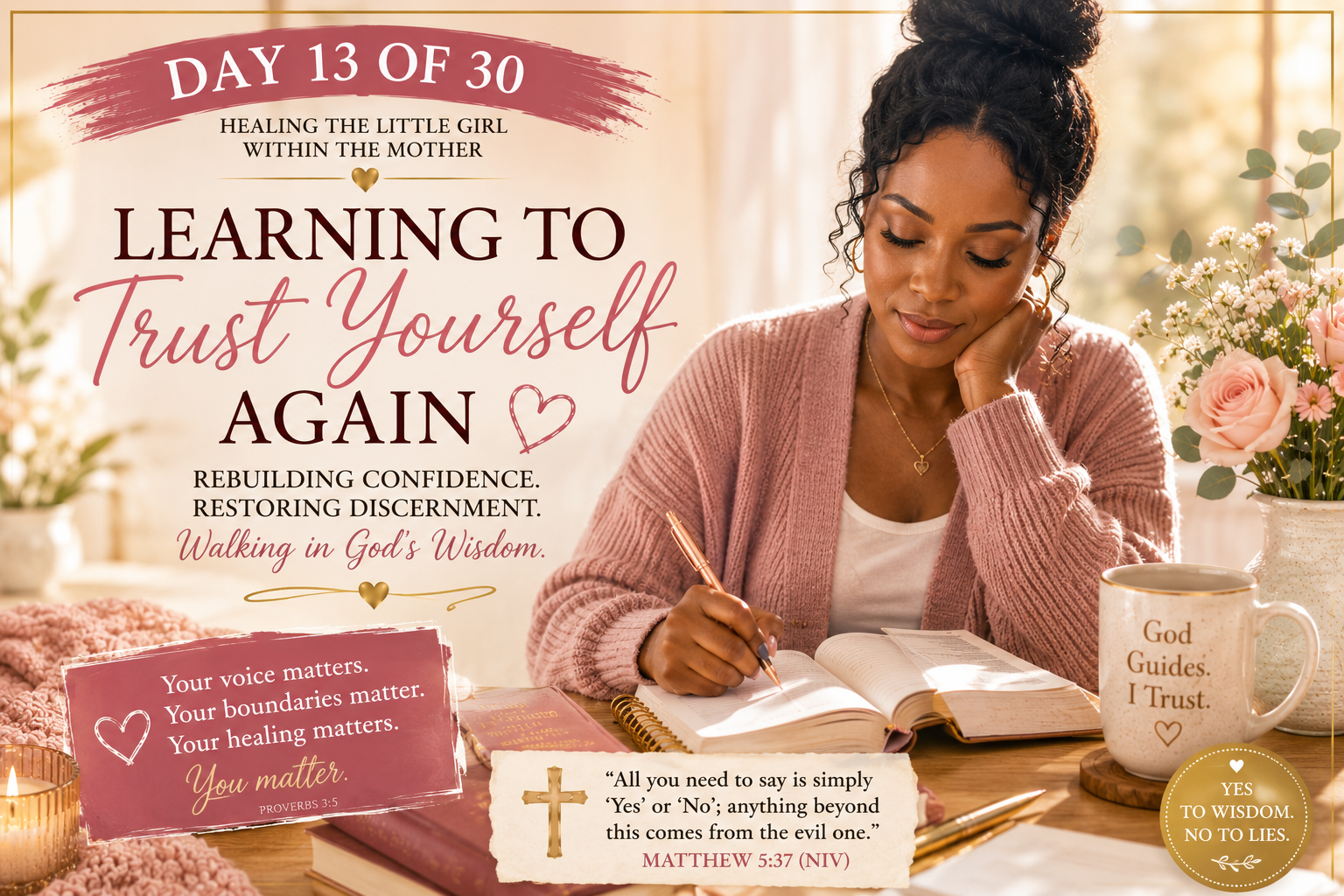
Day 13 – Learning to Trust Yourself Again
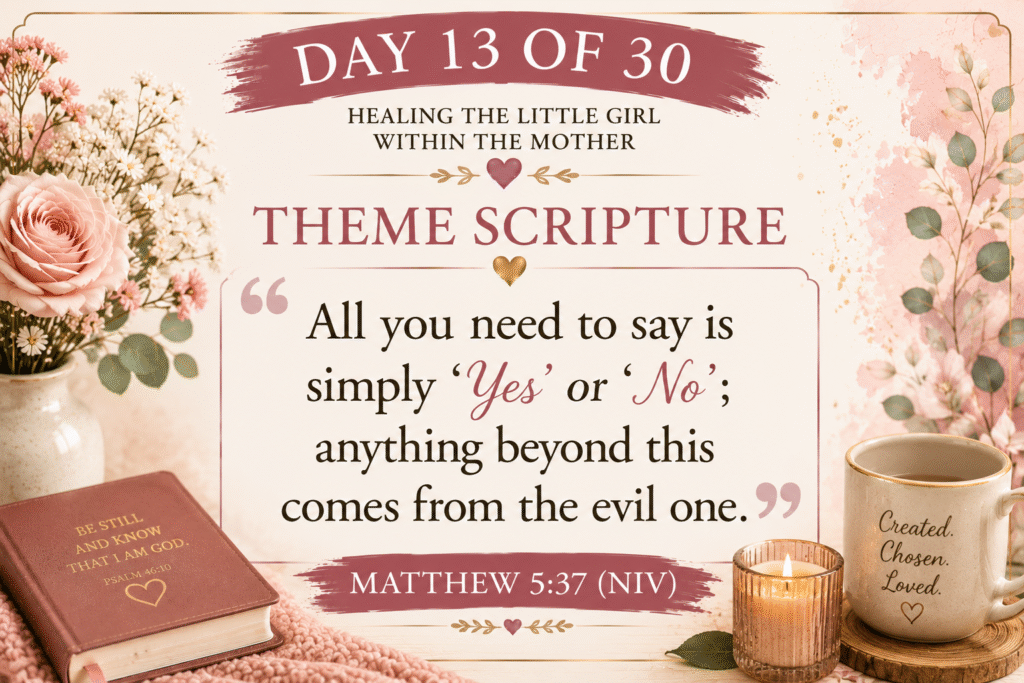
Theme Scripture
“All you need to say is simply ‘Yes’ or ‘No’; anything beyond this comes from the evil one.”
— Matthew 5:37 (NIV)
Learning to Trust Yourself Again
Have you ever made a decision and immediately started questioning it?
Maybe you knew you needed to say no, but after saying it, guilt began whispering:
Was I too harsh?
Should I have just said yes?
What if they’re upset with me?
Perhaps you recognized that someone’s behavior was hurting you, but instead of trusting what you were experiencing, you wondered:
Am I overreacting?
Maybe I’m being too sensitive.
Maybe it’s really my fault.
Or perhaps you have spent so many years asking everyone else what they think that you aren’t sure anymore what you think.
Childhood wounds can affect many areas of our adult lives, but one of the quietest consequences is the loss of self-trust.
When your feelings were dismissed…
When your boundaries were ignored…
When adults told you that what you experienced wasn’t really happening…
When you were blamed for things that weren’t your responsibility…
When speaking up created more problems than staying silent…
When you learned that keeping everyone else happy was safer than expressing what you needed…
You may have slowly learned:
“I cannot trust myself.”
And that belief can follow a little girl into adulthood.
Today, God wants to begin restoring something important within you.
Not independence from Him.
Not the belief that you never need wisdom or counsel.
But the ability to become a woman who walks closely with God, seeks His wisdom, recognizes what she is experiencing, honors healthy boundaries, and confidently follows through on thoughtful decisions.
When a Child Learns to Doubt Herself
Children naturally look to adults to understand the world.
When something hurts, they expect the adults around them to acknowledge it.
When something feels frightening, they expect protection.
When someone crosses a boundary, they expect someone trustworthy to intervene.
But what happens when that doesn’t occur?
What happens when the child says:
“That hurt me.”
And someone responds:
“You’re too sensitive.”
What happens when she says:
“I’m uncomfortable.”
And she is told:
“Stop being difficult.”
What happens when she knows something isn’t right but the adults around her pretend everything is fine?
Eventually, she may stop trusting her own perception.
Instead of asking:
“What am I experiencing?”
She learns to ask:
“What does everyone else say I’m experiencing?”
That is a painful way to live.
Because eventually, the little girl becomes a woman who constantly looks outside herself for permission to believe what she already knows.
Second-Guessing Can Become a Habit
Sometimes self-doubt becomes so normal that we don’t recognize it.
You make a decision.
Then you reconsider it.
Then you ask three people what they think.
Then you replay the situation.
Then you imagine every possible outcome.
Then you change your decision.
Then you regret changing it.
Then you criticize yourself for being indecisive.
It becomes exhausting.
The issue isn’t that seeking wise counsel is wrong.
Scripture repeatedly teaches the value of wisdom and godly counsel.
The problem comes when we become incapable of making ordinary decisions without needing someone else to validate them.
Healing means learning that with prayer, wisdom, Scripture, discernment, and experience, you can make thoughtful decisions.
And sometimes you will make the wrong one.
That doesn’t mean you cannot trust yourself.
It means you are human.
Self-Trust Is Not the Same as Self-Reliance
This distinction is important.
Christian self-trust should never mean:
“I don’t need God. I know what’s best.”
Proverbs 3:5–6 tells us to trust in the Lord rather than leaning solely on our own understanding.
Our confidence ultimately belongs in God.
But trusting God does not require distrusting everything about yourself.
God has given you wisdom.
He has given you experiences from which you can learn.
He has given you the ability to recognize patterns.
He has given you Scripture.
He has given you the Holy Spirit.
He has given you the capacity to grow in discernment.
As you walk with Him, your decisions can increasingly reflect the wisdom He is developing within you.
Self-trust, from a Christian perspective, can sound like:
“I trust God enough to believe that He can guide me as I make this decision.”
That is very different from believing you must figure everything out alone.
Let Your Yes Be Yes
Jesus’ words in Matthew 5:37 are simple and powerful.
Let your yes mean yes.
Let your no mean no.
For someone who grew up people-pleasing, those words can feel revolutionary.
Because many wounded women learned that saying no came with consequences.
Maybe people became angry.
Maybe affection was withdrawn.
Maybe you were called selfish.
Maybe you were made to feel guilty.
Maybe you learned that being “good” meant always being available.
So you became accustomed to saying yes when your heart was screaming no.
You said yes when you were exhausted.
Yes when you were uncomfortable.
Yes when you didn’t have the time.
Yes when you didn’t have the money.
Yes because you feared disappointing someone.
But every dishonest yes slowly teaches you:
“My needs don’t matter.”
Healing begins when your words and your boundaries start agreeing.
“No” Is a Complete Boundary
Sometimes we feel that we need a courtroom argument to justify saying no.
We explain.
Then we explain the explanation.
Then we provide evidence.
Then we apologize.
Then we soften the boundary until it isn’t really a boundary anymore.
But healthy boundaries do not always require lengthy explanations.
Sometimes:
“I’m not able to do that.”
is enough.
Sometimes:
“That doesn’t work for me.”
is enough.
Sometimes:
“No, thank you.”
is enough.
You can be loving without being endlessly available.
You can be kind without abandoning yourself.
You can be compassionate without accepting disrespect.
You can forgive someone without restoring the same level of access they once had.
And you can love someone while recognizing that a boundary is necessary.
Your Feelings Are Information, Not Your Master
Learning to trust yourself also means developing a healthy relationship with your emotions.
Some women were taught that emotions were inconvenient.
They were told:
“Stop crying.”
“Get over it.”
“You’re making a big deal out of nothing.”
As adults, they may either distrust their emotions completely or allow emotions to control every decision.
Neither extreme is healthy.
Your feelings matter.
But feelings aren’t always facts.
They are information.
If something makes you uncomfortable, you can pause and ask why.
If someone repeatedly leaves you feeling confused, anxious, or diminished, you can examine that pattern.
If anger appears, you can ask what boundary may have been crossed.
If fear appears, you can ask whether there is actual danger or whether an old wound has been triggered.
You don’t have to obey every emotion.
But you also don’t have to silence every emotion.
You can bring them to God and ask:
“Lord, what is this feeling showing me?”
Stop Abandoning Yourself to Keep the Peace
Many women become excellent peacekeepers.
But there is a difference between peacekeeping and peacemaking.
Peacekeeping often says:
Don’t upset anyone.
Don’t say what you really think.
Don’t establish the boundary.
Don’t confront the problem.
Just keep everyone happy.
But biblical peace does not require pretending problems don’t exist.
Sometimes creating genuine peace requires an honest conversation.
Sometimes it requires distance.
Sometimes it requires saying:
“This behavior is not acceptable.”
Sometimes it requires refusing to participate in unhealthy patterns.
You should not have to continually abandon yourself in order to maintain someone else’s comfort.
Rebuilding Trust Through Small Promises
Self-trust is not rebuilt through one dramatic decision.
It is rebuilt through consistency.
Think about how trust develops in relationships.
If someone repeatedly promises something and doesn’t follow through, eventually you stop trusting their word.
The same principle can apply internally.
If you constantly tell yourself:
“Tomorrow I’m going to completely change my life.”
and then create an impossible list of expectations, you may eventually stop believing yourself.
Instead, begin with small promises.
“I will spend ten minutes praying this morning.”
Then do it.
“I will rest for thirty minutes without feeling guilty.”
Then do it.
“I will not answer that request until I’ve had time to think.”
Then follow through.
“I will go to bed earlier tonight.”
Then honor the commitment.
Each time your actions agree with your words, you send yourself a message:
“I can trust myself to follow through.”
Give Yourself Permission to Pause
One of the easiest ways to make better decisions is surprisingly simple:
Stop answering immediately.
People-pleasers often feel pressured to respond quickly.
Someone asks for something and we immediately say yes.
Then later we realize we didn’t want to agree.
Begin practicing phrases such as:
“Let me think about that.”
“Let me check my schedule.”
“I need some time to pray about it.”
“I’ll get back to you.”
That pause creates space between the request and your response.
Inside that space, you can ask:
Do I actually want to do this?
Do I have the capacity?
Is this wise?
Does this align with my priorities?
Am I saying yes because I genuinely want to—or because I’m afraid of disappointing someone?
A pause can protect you from many resentful yeses.
You Are Allowed to Change Your Mind
Learning to trust yourself doesn’t mean every decision must be permanent.
New information may become available.
Circumstances may change.
You may realize something you couldn’t see before.
Changing your mind after receiving new wisdom isn’t necessarily inconsistency.
Sometimes it is growth.
The goal isn’t to become stubborn.
The goal is to stop assuming that everyone else’s opinion automatically deserves more weight than your own prayerful discernment.
Debbie’s Reflection
There have been times in my life when I questioned myself far more than I realized.
When you grow up in situations where your feelings aren’t always protected or acknowledged, you can learn to ignore what your own heart is telling you.
You become accustomed to surviving.
You adjust.
You keep going.
And sometimes you don’t realize until years later how much you learned to silence yourself.
Healing has taught me that I can bring my thoughts, concerns, fears, and decisions before God instead of automatically assuming that my voice doesn’t matter.
I don’t have to make every decision perfectly.
I don’t have to know everything.
I don’t have to predict every outcome.
But I can pray.
I can seek wisdom.
I can pay attention to patterns.
I can learn from experience.
I can establish boundaries.
And when something isn’t right, I don’t have to convince myself that it is simply because acknowledging the truth might make someone uncomfortable.
One of the things God continues teaching me is that wisdom often grows through experience.
I am not the same woman I was years ago.
I have learned.
I have grown.
I have survived difficult things.
And God has used those experiences to develop discernment within me.
The little girl within me may still occasionally wonder:
“Am I allowed to say no?”
And the woman I am becoming can answer:
“Yes.”
She may ask:
“Am I allowed to protect my peace?”
Yes.
“Am I allowed to take time before making a decision?”
Yes.
“Am I allowed to recognize when something doesn’t feel right?”
Yes.
And most importantly:
“Can I trust God to guide me?”
Always.
You Don’t Need Everyone to Agree With Your Boundary
This is one of the hardest lessons in healing.
A boundary doesn’t become valid only after everyone understands it.
Some people benefited from the version of you who had no boundaries.
They may not celebrate your healing.
They may call your growth selfish.
They may say:
“You’ve changed.”
Sometimes the correct response in your heart is:
“Yes, I have.”
You are learning.
You are healing.
You are becoming more aware.
You are no longer automatically saying yes simply to avoid conflict.
You are no longer allowing guilt to make every decision for you.
Not everyone will understand that.
And they don’t have to.
When You Make the Wrong Decision
There is another reason many women struggle to trust themselves.
They remember the decisions they regret.
Maybe you trusted someone who hurt you.
Maybe you stayed too long.
Maybe you left too soon.
Maybe you ignored warning signs.
Maybe you made a financial decision you regret.
Maybe you made parenting decisions you would handle differently today.
And now you think:
“See? I can’t trust myself.”
But making a poor decision does not mean you are incapable of wisdom.
Wisdom often grows because we learn from decisions that didn’t turn out as expected.
You are allowed to say:
“I would make a different decision today.”
That sentence is evidence of growth.
You know more now.
You recognize more now.
You have lived more now.
You pray differently now.
You notice patterns you couldn’t recognize before.
Don’t use yesterday’s lack of knowledge as evidence against today’s growth.
Trust the Woman God Is Developing
You are not the little girl you once were.
She is part of your story.
Her experiences matter.
Her wounds deserve compassion.
But she no longer has to make every decision.
The woman you are today can comfort her.
Protect her.
Establish boundaries for her.
Speak truth to her.
And remind her:
“We have choices now.”
You can leave unhealthy conversations.
You can say no.
You can ask questions.
You can seek counsel.
You can pray.
You can take your time.
You can choose differently.
You can begin again.
That is part of healing.
Reflection Questions
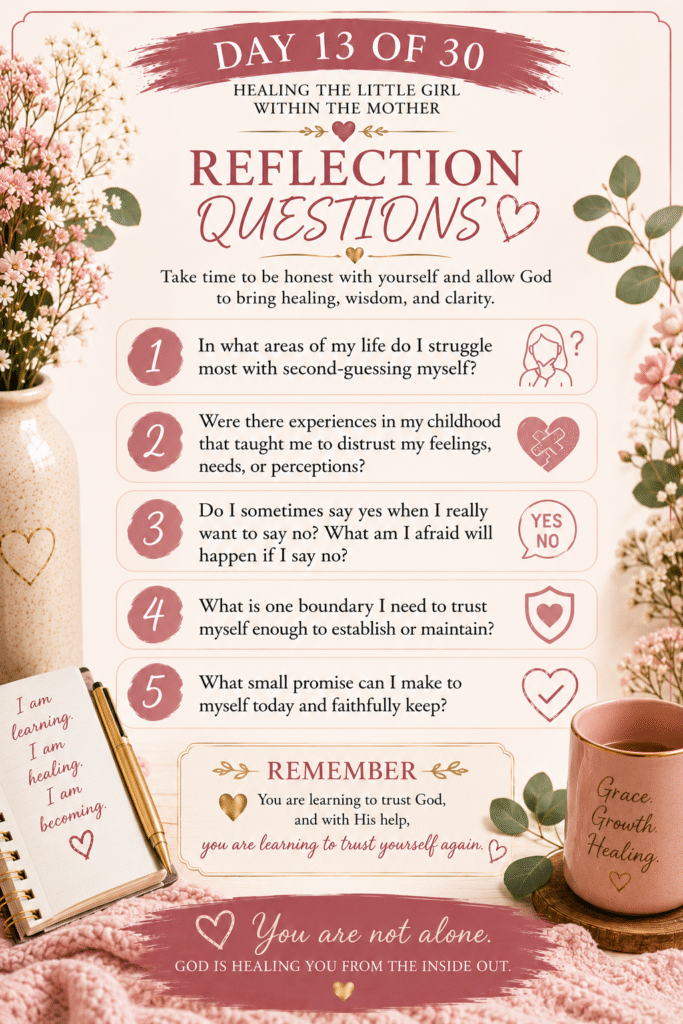
- In what areas of my life do I struggle most with second-guessing myself?
- Were there experiences in my childhood that taught me to distrust my feelings, needs, or perceptions?
- Do I sometimes say yes when I really want to say no? What am I afraid will happen if I say no?
- What is one boundary I need to trust myself enough to establish or maintain?
- What small promise can I make to myself today and faithfully keep?
Closing Prayer
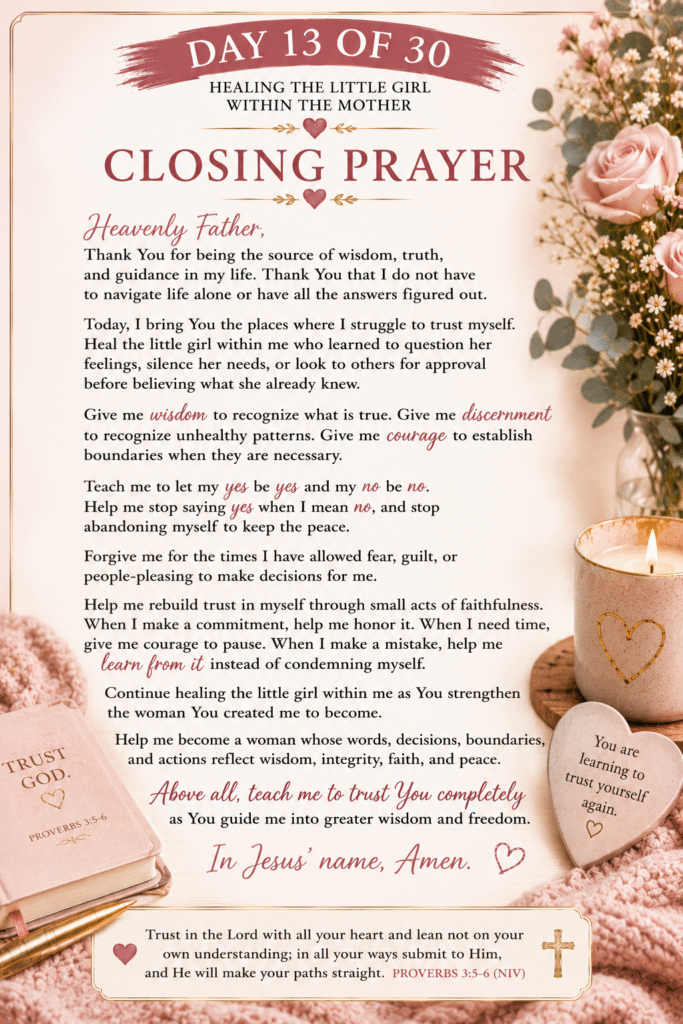
Heavenly Father,
Thank You for being the source of wisdom, truth, and guidance in my life.
Thank You that I do not have to navigate life alone or have every answer figured out.
Today, I bring You the places where I struggle to trust myself.
Heal the little girl within me who learned to question her feelings, silence her needs, ignore her discomfort, or seek everyone else’s approval before trusting what she experienced.
Teach me to bring my thoughts and emotions before You without dismissing them or allowing them to control me.
Give me wisdom to recognize what is true.
Give me discernment to recognize unhealthy patterns.
Give me courage to establish boundaries when they are necessary.
Teach me to let my yes be yes and my no be no.
Help me stop agreeing to things simply because I am afraid of disappointing someone.
Remind me that I can be loving without abandoning myself, compassionate without tolerating disrespect, and forgiving without removing every healthy boundary.
Forgive me for the times I have allowed fear, guilt, or people-pleasing to make decisions for me.
Help me rebuild trust in myself through small acts of faithfulness.
When I make a commitment, help me honor it.
When I need time, give me courage to pause.
When I need wisdom, remind me to seek You.
When I make a mistake, help me learn from it instead of using it as evidence that I cannot trust myself.
Continue healing the little girl within me as You strengthen the woman You created me to become.
Help me become a woman whose words, decisions, boundaries, and actions increasingly reflect wisdom, integrity, faith, and peace.
Above all, teach me to trust You completely as You guide me into greater wisdom and freedom.
In Jesus’ name,
Amen.
Today’s Affirmation
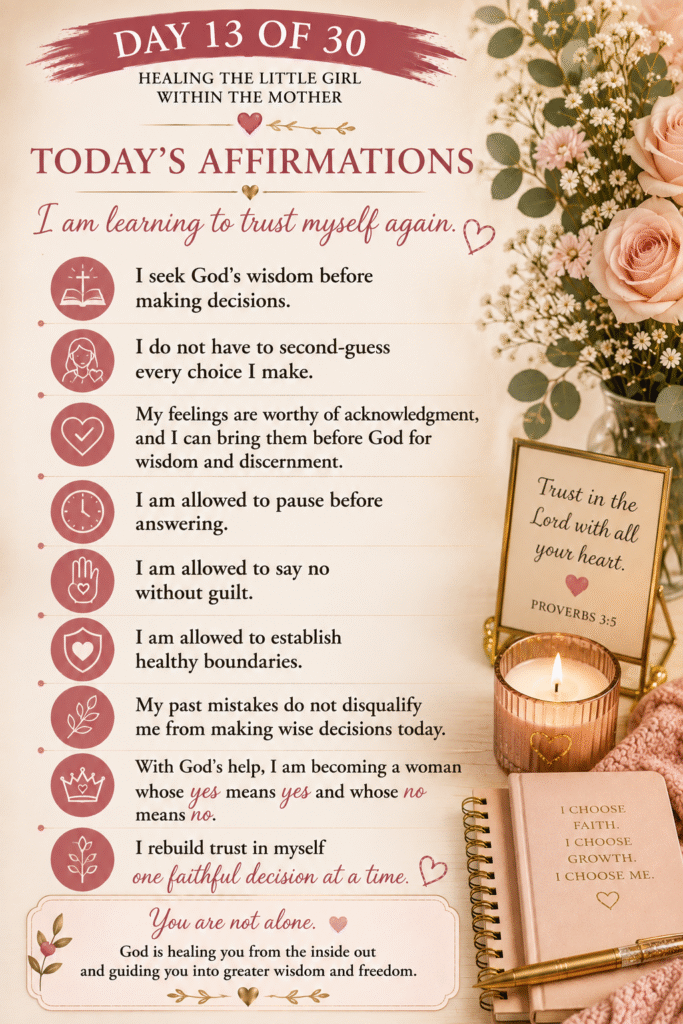
I AM LEARNING TO TRUST MYSELF AGAIN
I seek God’s wisdom before making decisions.
I do not have to second-guess every choice I make.
My feelings are worthy of acknowledgment, and I can bring them before God for wisdom and discernment.
I am allowed to pause before answering.
I am allowed to say no without guilt.
I am allowed to establish healthy boundaries.
My past mistakes do not disqualify me from making wise decisions today.
With God’s help, I am becoming a woman whose yes means yes and whose no means no.
I rebuild trust in myself one faithful decision at a time.
Journal Prompt
Today, create two columns in your journal.
Label the first:
Where I Have Been Abandoning Myself
Think about situations where you routinely ignore your needs, feelings, convictions, or boundaries.
Perhaps you say yes when you want to say no.
Perhaps you allow someone to speak disrespectfully to you because you don’t want conflict.
Perhaps you constantly ask others to validate decisions you already feel peaceful about.
Perhaps you ignore exhaustion because you believe resting makes you lazy.
Write those situations honestly.
Then label the second column:
What Wisdom Looks Like Now
Beside each situation, write a healthier response.
For example:
Old Pattern:
I immediately say yes when someone asks me for something.
New Response:
“I need to check my schedule. I’ll get back to you.”
Old Pattern:
I feel guilty whenever I establish a boundary.
New Response:
“I can feel uncomfortable and still maintain a healthy boundary.”
Old Pattern:
I criticize myself whenever I make the wrong decision.
New Response:
“I will learn from this decision without condemning myself.”
Then choose one small promise you can make to yourself today.
Make it realistic.
Write:
“Today, I will __________________________.”
At the end of the day, return to your journal and record whether you followed through.
This isn’t about perfection.
It is about rebuilding trust through consistency.
A Truth to Carry With You Today
There was a time when the little girl within you may not have had much control over what happened around her.
She couldn’t always leave.
She couldn’t always say no.
She couldn’t always protect herself.
She couldn’t always make adults listen.
But today is different.
You have choices now.
You can pause.
You can pray.
You can speak.
You can establish boundaries.
You can walk away from unhealthy situations.
You can ask for help.
You can change your mind.
You can learn.
And when you don’t know what to do, you can turn to the God who promises to give wisdom generously to those who ask Him.
You don’t have to become fearless before trusting yourself.
You simply have to stop allowing fear to make every decision.
Little by little, decision by decision, boundary by boundary, promise by promise, God can help you rebuild what your past taught you to surrender.
And one day you may realize:
I don’t need everyone’s permission anymore.
I can pray, listen, discern, decide, and move forward in peace.
Tomorrow – Day 14
Learning to Protect Your Peace
Theme Scripture
“Above all else, guard your heart, for everything you do flows from it.”
— Proverbs 4:23 (NIV)
Tomorrow we’ll build directly on today’s lesson.
Once you begin trusting yourself again, you must also learn that not everyone deserves unlimited access to your heart, time, energy, or peace.
Day 14 will explore healthy boundaries, protecting your emotional peace without becoming hardened, recognizing relationships and situations that repeatedly disturb your spirit, and understanding that guarding your heart is not the same as closing your heart.
Because healing isn’t only about recovering from what happened in the past.
It is also about learning how to protect the woman God is healing today.