Money worries can quietly consume our thoughts.
We may lie awake wondering how the bills will be paid, whether there will be enough food for the week, or how we will handle the next unexpected expense. We may feel anxious every time we check the bank account, ashamed of past financial decisions, or discouraged because we are working hard but still do not seem to be getting ahead.
Financial fear has a way of making us feel powerless. It tells us that we will never have enough, never recover from our mistakes, and never experience financial peace.
But fear does not have to control our relationship with money.
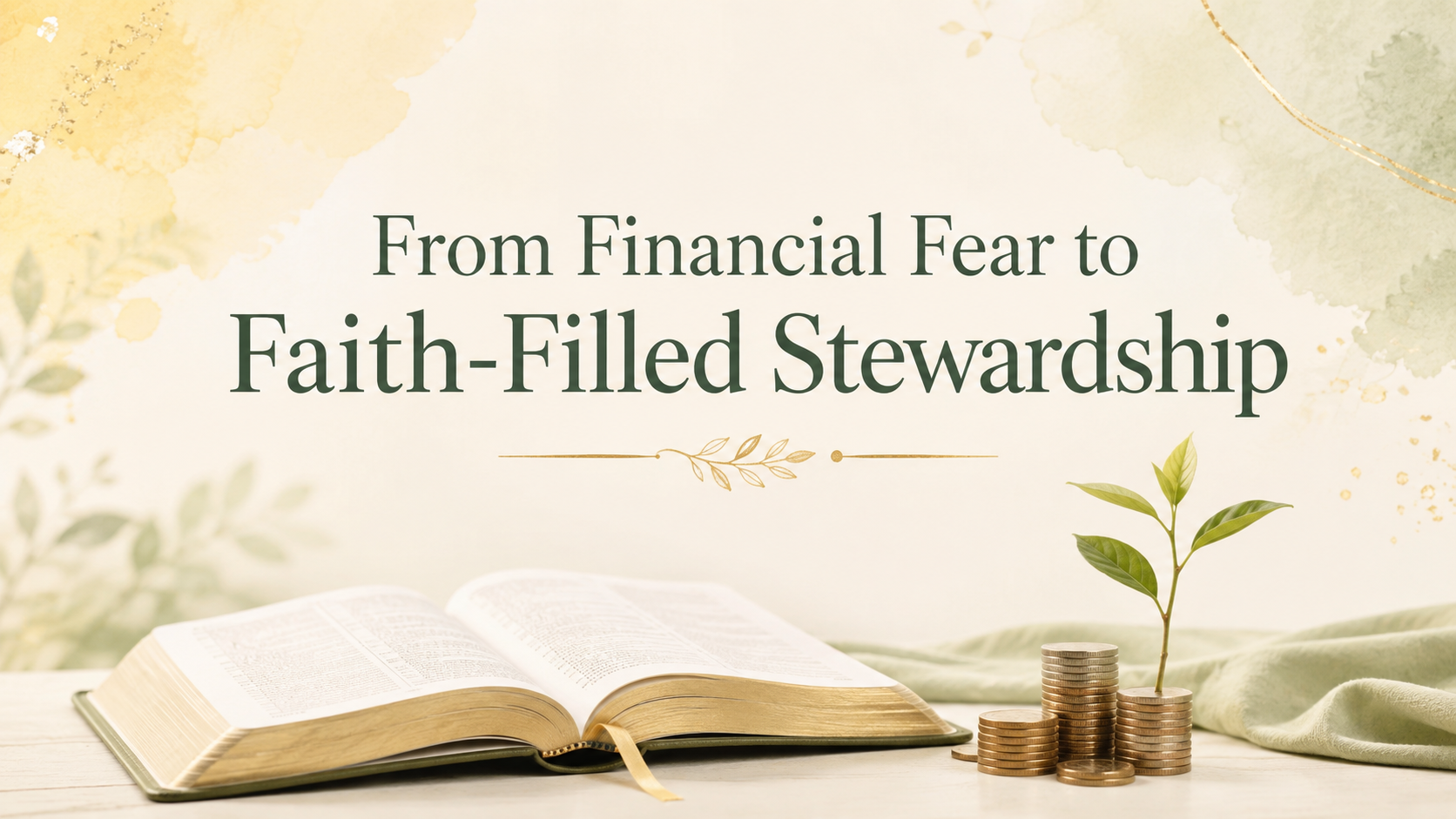
God invites us to move from financial fear to faith-filled stewardship—not by ignoring our responsibilities or pretending our problems do not exist, but by learning to manage what He has placed in our hands with wisdom, prayer, discipline, and trust.
Faith-filled stewardship means believing that God is our provider while also accepting our responsibility to plan, prepare, save, give, and make wise financial decisions. It is the place where faith and practical action meet.
“For God hath not given us the spirit of fear; but of power, and of love, and of a sound mind.”
—2 Timothy 1:7 (KJV)
When Financial Fear Takes Over
Financial fear does not always announce itself loudly. Sometimes, it appears through our everyday habits and decisions.
It may look like:
- Avoiding bills because we are afraid to see the total.
- Refusing to check our bank balance.
- Losing sleep over expenses.
- Feeling ashamed when we cannot afford what others have.
- Making impulsive purchases to temporarily feel better.
- Holding onto every dollar because we are afraid there will never be more.
- Constantly imagining the worst possible outcome.
- Feeling guilty whenever we spend money—even on necessities.
- Believing that our financial situation determines our worth.
- Trying to control everything because we are afraid to trust God.
Financial fear can also cause us to make decisions from panic rather than wisdom. We may borrow money without considering the repayment terms, spend to keep up appearances, avoid asking for help, or make quick financial choices because we feel desperate.
The problem is not simply that we are concerned about money. There are moments when financial concern is reasonable and necessary. The problem begins when fear becomes the voice directing our decisions.
Fear says, “There will never be enough.”
Faith says, “God will give me wisdom for what is in front of me.”
Fear says, “My situation will never change.”
Faith says, “I can take one faithful step at a time.”
Fear says, “I have ruined everything.”
Faith says, “God can teach me, restore me, and help me begin again.”
God Is Our Source
One of the most important truths we can remember is that our job, business, spouse, clients, customers, or bank account may be resources, but God is our ultimate source.
“But my God shall supply all your need according to his riches in glory by Christ Jesus.”
—Philippians 4:19 (KJV)
This Scripture does not promise that we will receive everything we want exactly when we want it. It reminds us that God sees our needs and remains faithful in every season.
His provision may come through an opportunity, an idea, a new skill, an unexpected connection, a reduced expense, help from another person, or the wisdom to manage our present income more effectively.
Trusting God as our source does not mean sitting still and waiting for money to appear. Throughout Scripture, faith is often accompanied by obedience, diligence, planning, and wise action.
We pray—and then we prepare.
We trust—and then we take the next responsible step.
We believe God will provide—and then we carefully steward what He has already provided.
What Is Faith-Filled Stewardship?
Stewardship begins with understanding that everything we have ultimately belongs to God.
Our money, possessions, gifts, ideas, time, opportunities, and ability to earn income have all been entrusted to us. We may work hard for what we have, but even our health, strength, knowledge, and opportunities are blessings.
“The earth is the Lord’s, and the fulness thereof; the world, and they that dwell therein.”
—Psalm 24:1 (KJV)
A steward is someone who responsibly manages what has been placed in their care.
Faith-filled stewardship is not measured only by how much money we have. A person with a modest income can be a faithful steward, while someone with great wealth can manage it carelessly.
Stewardship is about what we do with what is currently in our hands.
It means:
- Seeking God’s guidance before making financial decisions.
- Knowing where our money is going.
- Providing for our household responsibly.
- Living within our means whenever possible.
- Saving and preparing for future needs.
- Paying down debt with patience and consistency.
- Giving with wisdom and a willing heart.
- Avoiding comparison and unnecessary financial pressure.
- Using our resources to bless our family and others.
- Building something meaningful for the next generation.
Faith-filled stewardship replaces shame with responsibility, confusion with clarity, and fear with prayerful action.
Faith Does Not Mean Ignoring the Numbers
Sometimes we believe that looking closely at our finances demonstrates a lack of faith. But creating a budget, reviewing expenses, planning for emergencies, and addressing debt are not signs that we do not trust God.
They are expressions of wisdom.
Jesus Himself spoke about counting the cost before beginning a project:
“For which of you, intending to build a tower, sitteth not down first, and counteth the cost, whether he have sufficient to finish it?”
—Luke 14:28 (KJV)
You cannot faithfully manage what you are unwilling to examine.
Looking at your financial situation may feel uncomfortable, especially if you have avoided it for a long time. But the numbers are not there to condemn you. They are there to give you information.
A bank balance is information.
A credit report is information.
A debt total is information.
A monthly budget is information.
None of these things determines your value, your identity, or what God can do in your life. They simply help you understand where you are so that you can decide what to do next.
Clarity may initially feel frightening, but clarity is also where change begins.
Release the Shame of Past Financial Mistakes
Many people carry deep shame about money.
Perhaps you spent money you should have saved. Maybe you trusted the wrong person, accumulated debt, ignored important bills, or made decisions without understanding the consequences. You may have grown up without anyone teaching you how to budget, save, invest, or use credit wisely.
You cannot change the decisions you made yesterday, but you can allow those experiences to teach you how to make wiser decisions today.
“There is therefore now no condemnation to them which are in Christ Jesus.”
—Romans 8:1 (KJV)
Conviction teaches and redirects us. Shame tells us that we are hopeless and should remain hidden.
God does not want you trapped in financial shame. He wants you to grow in wisdom.
A mistake is something you made; it is not who you are.
You are not your debt.
You are not your credit score.
You are not the balance in your bank account.
You are not a failure because you are rebuilding.
You are a child of God who can learn, grow, change, and make a new financial decision one step at a time.
Seven Steps Toward Faith-Filled Stewardship
1. Bring Your Financial Concerns to God
Before you make another decision from panic, pause and pray.
Tell God exactly what is worrying you. You do not need polished words. Be honest about the bills, debt, income shortage, family needs, or financial mistakes weighing on your heart.
“Casting all your care upon him; for he careth for you.”
—1 Peter 5:7 (KJV)
Prayer may not immediately change every number, but it can change the condition of your heart. It creates space for peace, clarity, and wisdom.
Ask God:
- What do I need to see clearly?
- What habits do I need to change?
- Is there an expense I need to reduce?
- Is there a skill or opportunity I should pursue?
- Where have fear, pride, or comparison influenced my choices?
- What is the next responsible step I can take?
2. Face Your Current Financial Reality
Gather your bills, bank statements, debts, income information, and recurring expenses.
Write down:
- Your total monthly income.
- Your essential household expenses.
- Your minimum debt payments.
- Your subscriptions and automatic payments.
- Your variable spending.
- Your savings, if any.
- Any overdue accounts or urgent financial obligations.
Do not judge yourself while completing this process. Your goal is simply to understand your current position.
You cannot create a trustworthy plan using numbers you do not know.
3. Create a Simple, Realistic Spending Plan
A budget is not a punishment. It is a plan that gives each dollar a purpose.
Start with the essentials:
- Housing
- Utilities
- Food
- Transportation
- Medication and healthcare
- Insurance
- Minimum debt payments
- Necessary family expenses
Then consider savings, giving, personal spending, and other goals according to your present circumstances.
Your budget should reflect your actual income—not the income you hope to have or the lifestyle you feel pressured to maintain.
A simple plan you can follow is more useful than a perfect plan you abandon after one week.
4. Separate Needs, Priorities, and Desires
Not every desire is wrong. God wants us to enjoy the blessings He gives us. However, financial peace requires us to recognize the difference between what is necessary and what can wait.
Before purchasing something, ask:
- Do I truly need this right now?
- Is this included in my spending plan?
- Am I buying this because I feel pressured, sad, anxious, or left behind?
- Will this purchase move me closer to or further from my financial goals?
- Would waiting 24 or 48 hours help me make a clearer decision?
Small pauses can prevent expensive regrets.
5. Build a Small Emergency Cushion
If saving a large amount feels impossible, begin small.
Your first goal might be $100, $250, or one week of household expenses. The amount matters less than developing the habit.
Saving even a few dollars each week tells your future self, “I am preparing for you.”
“There is treasure to be desired and oil in the dwelling of the wise; but a foolish man spendeth it up.”
—Proverbs 21:20 (KJV)
An emergency fund will not prevent every difficulty, but it can help keep a small emergency from becoming a larger financial crisis.
6. Make a Patient Plan for Debt
Debt can feel overwhelming when we focus only on the total. Instead, focus on consistent progress.
List each debt, its balance, interest rate, and minimum payment. Choose a repayment approach that you can realistically maintain.
You might begin with the smallest balance to create momentum or focus on the debt with the highest interest rate to reduce long-term costs.
Do not allow embarrassment to keep you from contacting creditors, asking about hardship options, or seeking reputable financial guidance.
Debt repayment is often a journey. Slow progress is still progress.
7. Look for Ways to Increase What Is in Your Hands
Budgeting is important, but there are times when the problem is not excessive spending—the income is simply not enough to cover basic needs.
If that is your situation, do not shame yourself.
Ask God for wisdom about ways to increase your income. Consider whether you have a skill, service, product, experience, or area of knowledge that could create additional value.
You might explore:
- Part-time or flexible work.
- Freelance or virtual services.
- Selling a product you already know how to create.
- Offering meal planning, tutoring, cleaning, childcare, or administrative help.
- Learning a marketable skill.
- Applying for a better-paying position.
- Turning your knowledge into a digital product.
- Selling unused items to begin an emergency fund or pay a bill.
Every idea will not be the right opportunity, and every opportunity should be evaluated carefully. But you can remain prayerful, open, and willing to take a wise step.
Stewardship Is About More Than Money
How we manage money affects our homes, marriages, children, health, peace, and future.
When we practice stewardship, we are not simply trying to accumulate more. We are creating stability, options, and opportunities.
We are preparing to:
- Handle emergencies with less panic.
- Provide more consistently for our families.
- Give when God leads us to help someone.
- Pursue meaningful opportunities.
- Break unhealthy financial patterns.
- Teach our children healthier money habits.
- Build a legacy of faith, wisdom, and responsibility.
Generational wealth is not only about leaving money behind. It also includes leaving knowledge, discipline, faith, property, businesses, opportunities, and a healthier relationship with money.
Sometimes the first step toward changing your family’s financial story is simply deciding that fear will no longer make every decision.
Avoiding the Trap of Comparison
Comparison can make responsible stewardship feel inadequate.
Social media may show us someone else’s new house, vacation, car, wardrobe, business success, or beautifully decorated home. What we do not see is the complete financial story behind the picture.
We do not know what was borrowed, sacrificed, inherited, gifted, or financed. We do not know what someone earns, owes, or is privately facing.
Your financial journey does not need to look like anyone else’s.
“But let every man prove his own work, and then shall he have rejoicing in himself alone, and not in another.”
—Galatians 6:4 (KJV)
You do not have to go into debt to look successful.
You do not have to buy something because everyone else has it.
You do not have to apologize for choosing a slower, wiser path.
Quiet progress is still progress. A small savings account, one paid-off bill, a week without unnecessary spending, or an honest family budget meeting may not look impressive online, but these steps are helping you build a stronger foundation.
Trusting God While You Build
Faith-filled stewardship is not a one-time decision. It is a daily practice.
Some months will go according to plan. Other months will bring medical bills, home repairs, job changes, family emergencies, or unexpected expenses. You may occasionally overspend, become discouraged, or need to adjust your goals.
Give yourself grace—but remain accountable.
Return to prayer.
Return to your budget.
Return to the plan.
Return to the truth that progress does not require perfection.
“The steps of a good man are ordered by the Lord: and he delighteth in his way.”
—Psalm 37:23 (KJV)
You do not need to solve your entire financial future today. You need to identify the next wise and faithful step.
Perhaps your next step is opening the bill you have been avoiding.
Perhaps it is canceling an unused subscription.
Perhaps it is saving your first $10.
Perhaps it is discussing the household finances honestly with your spouse.
Perhaps it is asking for help, applying for a position, starting a small business, or forgiving yourself for a past mistake.
Whatever that step may be, take it with prayer, wisdom, and courage.
Reflection Questions
Take a few quiet moments to reflect or journal:
- What financial concern has been creating the most fear in my life?
- Have I been making money decisions from faith and wisdom or from fear and pressure?
- Is there a financial truth I have been avoiding?
- What past mistake do I need to release to God?
- Which spending habit needs more discipline?
- What has God already placed in my hands that I can manage more faithfully?
- What is one practical financial step I can take this week?
- What kind of financial legacy do I want to leave for my family?
Faith-Filled Financial Declarations
Speak these declarations over your life and finances:
- I will not allow financial fear to control my decisions.
- God has given me power, love, and a sound mind.
- I am capable of learning how to manage money wisely.
- My past financial mistakes do not define my future.
- I will faithfully manage what God has placed in my hands.
- I choose discipline over impulse and wisdom over comparison.
- I can make steady financial progress one decision at a time.
- God will guide me as I pray, plan, work, save, and prepare.
- I am breaking unhealthy financial cycles in my family.
- I am building a legacy rooted in faith, wisdom, and stewardship.
- I trust God as my source while taking responsibility for my choices.
- I am moving from financial fear to faith-filled stewardship.
Closing Prayer
Heavenly Father,
Thank You for being my provider, my source, and my help in every season. You know every financial concern I carry. You see the bills, the obligations, the needs of my household, the mistakes I regret, and the questions I do not yet know how to answer.
Today, I surrender my financial fear to You.
Forgive me for the times I have allowed panic, comparison, shame, or impulsiveness to guide my decisions. Help me release the mistakes of the past and receive the wisdom I need for the future.
Give me the courage to face my finances honestly. Help me understand what is coming in, what is going out, what needs to change, and what I need to prioritize. Teach me to budget wisely, spend carefully, save consistently, give prayerfully, and prepare responsibly.
Lord, guide me toward the right opportunities. Show me how to use the gifts, skills, ideas, and resources You have already placed within my hands. Open the doors that align with Your will, and give me discernment to recognize opportunities that are not right for me.
Help me remember that my worth is not determined by my income, my possessions, my debt, or my bank balance. My identity is found in You.
Bring peace into my home and unity into every financial conversation. Help my family break unhealthy cycles and build a new legacy—one marked by faith, wisdom, discipline, generosity, and responsible stewardship.
When fear tells me that there will never be enough, remind me that You are with me. When the journey feels slow, help me remain faithful. When I make a mistake, give me humility to correct it and courage to begin again.
Order my steps, renew my mind, and teach me to manage every blessing with gratitude and wisdom.
I choose today to move forward—not in financial fear, but in faith-filled stewardship.
In Jesus’ name, amen.
Final Encouragement
Your present financial situation is part of your story, but it does not have to be the final chapter.
You may not be able to change everything overnight, but you can begin today. One prayer, one budget, one canceled expense, one saved dollar, one paid bill, and one wise decision at a time can create meaningful change.
God is not asking you to have everything figured out. He is inviting you to trust Him, seek wisdom, and faithfully manage what is in your hands.
Release the shame. Face the numbers. Make the plan. Take the next step.
You are not simply managing money. You are building peace in your home, changing the way your family understands finances, and creating a foundation for the generations coming behind you.
This is how financial fear begins to lose its power.
This is how faithful stewardship begins.
And this is how we break cycles and build blessings.