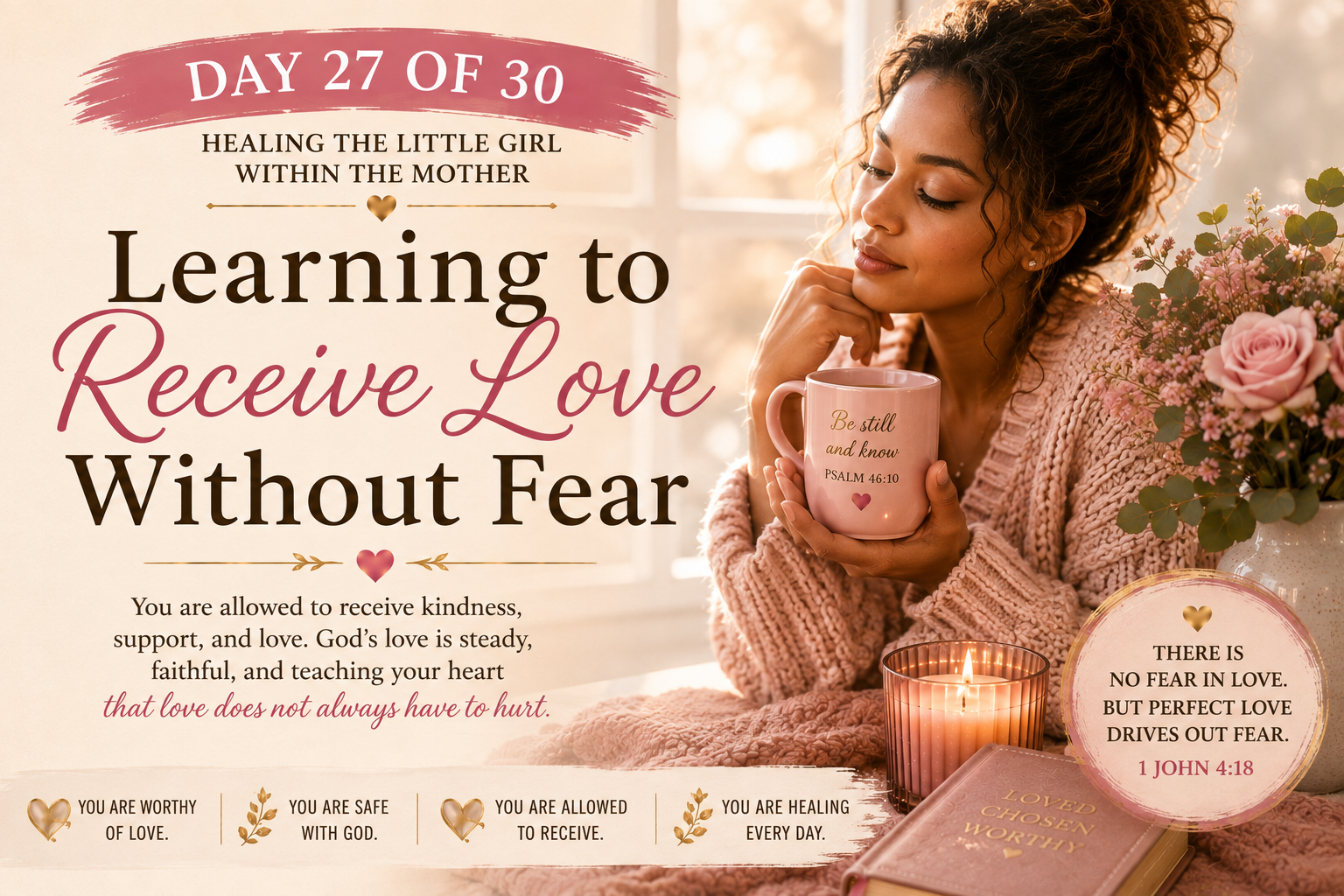
Day 27 of 30 — Learning to Receive Love Without Fear
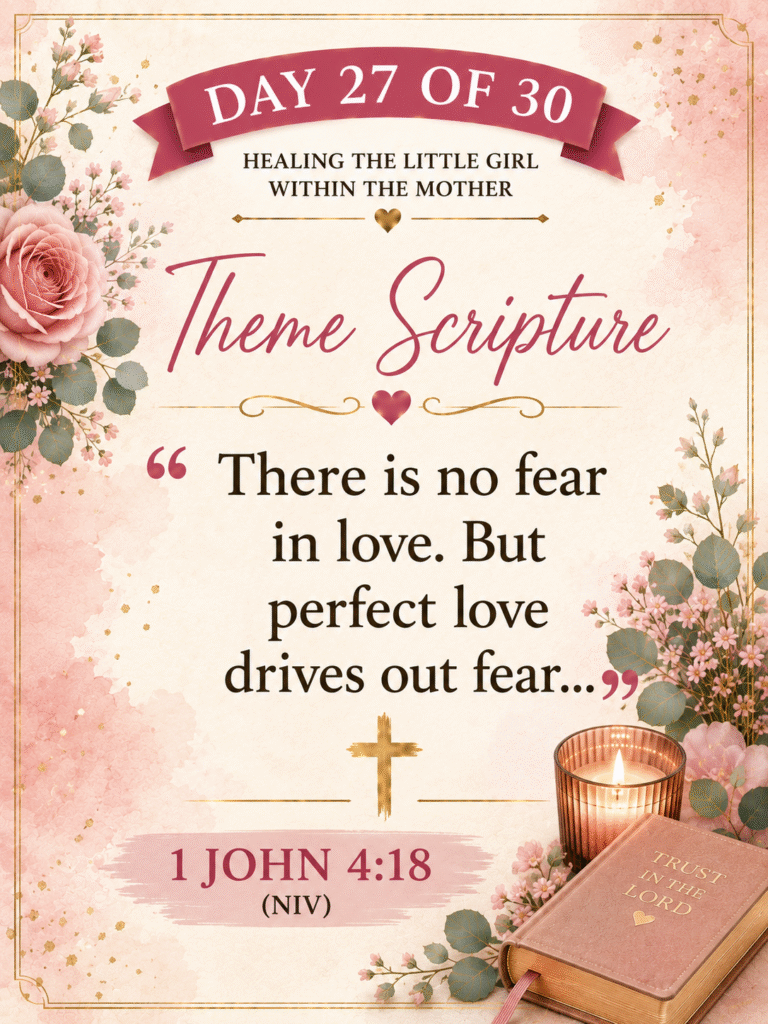
Theme Scripture
“There is no fear in love. But perfect love drives out fear…”
— 1 John 4:18 (NIV)
There is something we don’t talk about enough in healing:
Sometimes it isn’t only difficult to give love after you’ve been hurt.
It can also be difficult to receive it.
Someone is kind to you, and you wonder what they want.
Someone tells you they love you, and part of you waits for them to change their mind.
Someone treats you well, and instead of relaxing into the relationship, you find yourself searching for the warning signs.
Someone gets close to you, and suddenly you want to pull away.
Someone offers help, and your first response is:
“No, I’m fine. I can do it myself.”
Someone compliments you, and you immediately dismiss it.
Someone loves you consistently, but deep inside there is still a little girl whispering:
“Don’t get too comfortable.”
“People leave.”
“Love changes.”
“Don’t need anyone too much.”
“If they really knew you, they might not love you.”
Yesterday, on Day 26, we talked about releasing the need for an apology. We learned that our healing cannot remain dependent upon another person’s willingness to acknowledge what happened.
Today, we’re looking at what happens after we begin releasing some of those old wounds.
Because healing isn’t only about what you release.
Healing is also about what you learn to receive.
And one of the hardest things for a wounded heart to receive can be safe, consistent love.
When Love and Pain Became Connected
A little girl learns what love feels like largely through her earliest relationships.
If the people who loved you were also the people who frightened you, neglected you, rejected you, abandoned you, criticized you, or failed to protect you, your heart may have learned something confusing:
Love can hurt me.
Maybe someone said:
“I love you,”
but their behavior didn’t feel loving.
Maybe affection was unpredictable.
One day there were hugs.
The next day there was anger.
One day you felt wanted.
The next day you felt like a burden.
Perhaps love came with conditions.
Be good.
Be quiet.
Don’t embarrass me.
Do what I say.
Don’t upset anyone.
A child living in that environment may begin associating love with uncertainty.
And that little girl can become a woman who wants love deeply while simultaneously being afraid of it.
Sometimes You Want Love and Fear It at the Same Time
This can feel confusing.
You pray for healthy relationships.
You want closeness.
You want someone who truly sees you.
But when someone gets close enough to actually see you, fear appears.
You may start looking for reasons the relationship won’t work.
You may overanalyze every conversation.
You may become anxious when someone’s tone changes.
You may assume silence means rejection.
You may pull away before they can leave.
Part of you says:
“Please love me.”
While another part says:
“But don’t get close enough to hurt me.”
That inner conflict is not unusual after relational wounds.
Healing means learning that closeness does not automatically equal danger.
Hypervigilance Can Follow You Into Healthy Relationships
When you’ve experienced unpredictable relationships, you may become highly alert to small changes.
A delayed text.
A different tone of voice.
A facial expression.
A quiet evening.
A disagreement.
And immediately your mind begins asking:
“What’s wrong?”
“Are they upset with me?”
“Did I do something?”
“Are they going to leave?”
Sometimes there genuinely is something that needs attention.
But sometimes your present relationship is being interpreted through the alarm system created by your past.
The goal isn’t to ignore warning signs.
The goal is to learn the difference between a present warning and an old alarm.
Healthy Love Does Not Require Constant Anxiety
Many of us grew so accustomed to emotional unpredictability that peace can initially feel unfamiliar.
Sometimes healthy love feels almost too quiet.
There isn’t constant drama.
You aren’t repeatedly breaking up and making up.
You aren’t trying to prove your worth.
You aren’t begging for reassurance every day.
And if chaos once felt normal, peace can feel strange.
You may even mistake emotional intensity for love.
But love does not have to constantly hurt in order to be deep.
Peace is not boredom.
Consistency is not lack of passion.
Safety is not weakness.
Healthy love can be steady.
You May Question Kindness
Someone does something thoughtful for you.
Instead of simply receiving it, you wonder:
“Why are they doing this?”
“What do they expect in return?”
“Is this manipulation?”
Sometimes caution is appropriate.
But if every act of kindness creates suspicion, your past may still be teaching your present how to interpret love.
Try asking:
“Has this person given me evidence that their kindness is unsafe, or am I expecting a hidden motive because kindness used to come with conditions?”
That distinction matters.
Receiving Love Requires Discernment, Not Blind Trust
Today’s message is not telling you to trust everyone.
Healing does not mean becoming naïve.
You don’t need to remove every boundary.
You don’t need to ignore red flags.
You don’t need to give people immediate access to your deepest places.
Trust should be built.
Character should be observed.
Patterns matter.
Healthy love does not say:
“Trust everybody.”
Healthy love says:
“I can use wisdom without allowing fear to make every decision.”
Safe Love Respects Your Boundaries
One way to recognize healthy love is by observing what happens when you say no.
Healthy love may be disappointed, but it does not punish you for having boundaries.
It does not constantly pressure you.
Manipulate you.
Threaten you.
Guilt you.
Or withdraw affection to force compliance.
Safe love can hear:
“I’m not comfortable with that.”
“I need some time.”
“No.”
“I disagree.”
And still respect your dignity.
A person who truly loves you should not require you to abandon yourself in order to keep them.
Safe Love Allows You to Be Human
You do not have to be perfect to be loved.
You don’t have to always be cheerful.
Always helpful.
Always strong.
Always available.
Always agreeable.
Healthy relationships make room for humanity.
You can have a difficult day.
You can need rest.
You can misunderstand something.
You can apologize.
You can disagree.
You can say:
“That hurt me.”
You can need space.
And the relationship does not automatically collapse.
This can feel revolutionary to someone who learned:
“If I disappoint people, they will stop loving me.”
You Don’t Have to Earn Every Act of Love
Sometimes childhood teaches us to become useful.
You help.
You serve.
You fix.
You anticipate everyone’s needs.
You make yourself indispensable.
And somewhere inside is the belief:
“If I am useful enough, maybe they won’t leave.”
But healthy love is not wages paid for your performance.
You should not have to exhaust yourself to deserve affection.
You are allowed to receive.
A meal.
A compliment.
A gift.
Help.
Encouragement.
A hug.
A kind word.
A moment of care.
Without immediately asking:
“How do I repay this?”
Sometimes the appropriate response is simply:
“Thank you.”
Compliments Can Be Difficult to Receive Too
Someone says:
“You look beautiful.”
And you respond:
“No, I don’t.”
Someone says:
“You’re doing a wonderful job.”
And you immediately list everything you’re doing wrong.
Someone tells you:
“I’m proud of you.”
And part of you wants to cry.
Why?
Because sometimes receiving affirmation touches the very place that went without it.
Try practicing something simple.
When someone gives you a sincere compliment, instead of arguing with them, say:
“Thank you. I appreciate that.”
You don’t have to shrink from kind words.
Stop Testing People to See Whether They Will Leave
Sometimes fear creates tests we don’t even realize we’re giving.
You withdraw to see if they’ll chase you.
You say:
“It doesn’t matter,”
when it does matter.
You refuse help and then feel hurt when they don’t help.
You create distance and then interpret the distance as proof that nobody stays.
These behaviors often come from fear, not manipulation in a deliberate sense.
But healing asks us to communicate more directly.
Instead of testing:
“Will you notice that I’m upset?”
try saying:
“I’m having a hard day and could use some reassurance.”
Healthy love becomes easier to recognize when we learn to communicate honestly.
You May Push Away What You Prayed For
Sometimes God answers a prayer in a form our nervous system doesn’t recognize.
You prayed for peace.
But you’re accustomed to chaos.
You prayed for someone consistent.
But consistency feels unfamiliar.
You prayed for support.
But you’ve spent your whole life doing everything yourself.
You prayed for community.
But vulnerability feels frightening.
And sometimes we are tempted to retreat from the very things we’ve asked God to bring into our lives.
Healing may require asking:
“Is this actually unsafe—or is it simply unfamiliar?”
Those are not the same thing.
Love Should Not Require You to Betray Yourself
This is especially important.
Receiving love does not mean accepting everything someone calls love.
Possessiveness is not automatically love.
Control is not love.
Constant jealousy is not proof of devotion.
Manipulation is not love.
Humiliation is not love.
Threats are not love.
Repeated disrespect is not love.
Someone saying “I love you” does not automatically make every behavior loving.
Scripture describes love as patient and kind. Love is connected with truth, humility, endurance, and goodness.
Learn to evaluate love by its fruit, not merely its label.
Your Body May Need Time to Learn Safety
Sometimes your mind knows:
“This person is safe.”
But your body still reacts.
You tense during disagreement.
You panic when someone raises their voice.
You struggle to sleep after conflict.
You feel an overwhelming urge to fix everything immediately.
This doesn’t necessarily mean the relationship is unsafe.
Sometimes your body is remembering old experiences.
Give yourself time.
Slow down.
Breathe.
Pray.
Remind yourself:
“I am here, not there.”
“I am an adult now.”
“I have choices.”
“I can leave a conversation if I need to.”
“I can speak.”
“I can ask for what I need.”
Your body may need repeated experiences of safety before it fully believes what your mind is learning.
Healthy Conflict Is Not Abandonment
This can be a major lesson.
Someone can disagree with you and still love you.
Your husband can be frustrated and still love you.
Your friend can tell you something difficult and still care about you.
Your child can be upset with you and still feel securely connected to you.
Healthy relationships have conflict.
The difference is how conflict is handled.
Is there respect?
Can both people speak?
Can someone apologize?
Is repair possible?
Are boundaries respected?
Is there intimidation or fear?
Love is not the absence of disagreement.
Healthy love knows how to return to connection after disagreement.
You Don’t Have to Prepare for Every Relationship to End
If abandonment was part of your story, you may protect yourself by never fully settling into love.
Even in happy moments, part of you whispers:
“Don’t get too comfortable.”
So you prepare.
Emotionally.
Financially.
Mentally.
You imagine how you would survive without them.
Some practical independence is healthy.
But living in constant preparation for abandonment prevents you from fully experiencing the relationship you have today.
You cannot guarantee that no relationship will ever change.
But you also do not have to grieve every relationship before it has even been lost.
Let today’s love exist today.
God’s Love Is Not Temperamental
Human beings are imperfect.
Even the healthiest person will disappoint us sometimes.
But God’s character is not unstable.
Romans 8:38–39 reminds us that nothing can separate believers from the love of God in Christ.
His love is not based on whether you performed perfectly today.
You don’t have to earn your way back into His affection every time you make a mistake.
For the woman who learned that love could be withdrawn, God’s steadfastness can become deeply healing.
You are not auditioning for God’s love.
Perfect Love Drives Out Fear
Today’s Scripture does not mean Christians will never feel fear.
It points us toward the nature of God’s love.
Fear says:
“You will be abandoned.”
God’s love says:
“I will never leave you.”
Fear says:
“You must earn love.”
Grace says:
“You are loved.”
Fear says:
“Hide your imperfections.”
God says:
“Come to Me.”
Fear says:
“Protect yourself from everyone.”
Wisdom says:
“Use discernment, but don’t build your entire life behind a wall.”
God’s love begins teaching the wounded heart:
“Love does not always have to feel dangerous.”
Debbie’s Reflection
There are times when surviving teaches you to become very independent.
You learn how to keep going.
You learn how to take care of yourself.
You learn how to solve problems.
You learn how to carry things quietly.
And people may even admire your strength.
But sometimes underneath that strength is another truth:
You learned not to expect anyone to catch you.
When you’ve been disappointed by people who should have protected you, depending on someone can feel frightening.
Receiving love can feel vulnerable because love gives someone access to your heart.
And when your heart has already been hurt, part of you wants to keep the door cracked instead of fully opening it.
I have had to learn that healing doesn’t mean becoming someone who blindly trusts everybody.
That isn’t wisdom.
But neither does healing mean assuming everybody will eventually hurt me.
I can pay attention.
I can pray.
I can watch someone’s character.
I can have boundaries.
And I can also allow myself to recognize when someone is consistently showing me love.
I don’t have to question every kind gesture.
I don’t have to feel guilty when someone helps me.
I don’t have to earn every act of affection.
I don’t have to spend beautiful moments wondering when they will end.
And I don’t have to make the people who love me today pay emotionally for what someone else did yesterday.
That has been an important realization.
Because sometimes without realizing it, we expect present people to answer for past wounds.
We watch them too closely.
We assume.
We withdraw.
We protect ourselves.
But healing asks:
“Has this person actually shown me they are unsafe—or am I responding to someone who isn’t even in the room anymore?”
That’s a hard question.
But it’s a freeing one.
I want the little girl within me to know that she doesn’t have to spend the rest of her life afraid of love.
She can have boundaries.
She can use wisdom.
She can say no.
She can leave unsafe situations.
But she can also receive.
She can receive kindness.
Support.
Friendship.
Affection.
Encouragement.
And the love God has placed around her.
The goal isn’t to never feel afraid again.
The goal is to stop letting fear make every decision.
I am learning that safe love does exist.
And I am learning that I am allowed to receive it.
Don’t Make Safe People Pay for Unsafe People’s Choices
This is an important part of relational healing.
Someone who loves you today may occasionally touch a wound they did not create.
A forgotten phone call may trigger memories of being ignored.
A disagreement may awaken fear of rejection.
Someone needing space may feel like abandonment.
Your feelings are real.
But the person standing in front of you may not be the person who originally caused them.
When possible, communicate.
You might say:
“I know this reaction feels bigger than what just happened. I think something from my past is being triggered.”
That kind of self-awareness can protect healthy relationships.
Receiving Help Is Not Weakness
Perhaps you’ve become the woman everyone calls.
You help everyone.
Pray for everyone.
Cook for everyone.
Encourage everyone.
Solve everyone’s problems.
But when someone asks:
“What do you need?”
you freeze.
Maybe you don’t know.
Or maybe you know but feel guilty saying it.
Today, practice receiving.
Let someone carry the grocery bags.
Accept the meal.
Let your husband help.
Tell your friend you need prayer.
Say yes when someone offers support.
Strength does not mean carrying everything alone.
Sometimes strength says, “Yes, thank you. I could use some help.”**
You Are Allowed to Need People
We ultimately depend on God.
But God also created human beings for relationship.
Needing healthy community does not make you needy in a shameful sense.
We need encouragement.
Companionship.
Wise counsel.
Affection.
Accountability.
Help.
Laughter.
Belonging.
You don’t have to become completely self-sufficient in order to prove that nobody can hurt you again.
Healing is not learning to need nobody.
Healing is learning to choose healthier people, healthier relationships, and healthier ways of connecting.
Let Love Be Consistent Before You Call It Safe
Receiving love does not mean rushing.
Watch patterns.
Do their words and actions match?
Do they respect boundaries?
Can they take responsibility?
Do they celebrate your growth rather than feel threatened by it?
Can they disagree without degrading you?
Can they hear no?
Do they respect your faith, values, responsibilities, and individuality?
Do you feel free to be honest?
One grand gesture doesn’t establish safety.
Consistency does.
Give healthy relationships time to reveal themselves.
You Can Receive Love Without Losing Yourself
Some women learned that being loved meant becoming whoever the other person needed.
But healthy love does not erase identity.
You can be a wife and still be yourself.
A mother and still have needs.
A daughter and still have boundaries.
A friend and still say no.
A Christian woman and still disagree respectfully.
You don’t have to disappear inside relationships anymore.
You can belong without abandoning yourself.
Let Yourself Enjoy What Is Good
This may sound simple, but for someone accustomed to anticipating loss, joy can feel vulnerable.
Sometimes when life becomes peaceful, you begin looking for what is about to go wrong.
Today, practice staying in the moment.
If someone you love makes you laugh, laugh.
If your home feels peaceful, notice it.
If someone hugs you, receive the hug.
If your husband does something thoughtful, enjoy it.
If your child tells you they love you, let those words reach your heart.
You don’t have to immediately protect yourself from the possibility that good things can change.
You are allowed to experience today’s goodness while it is here.
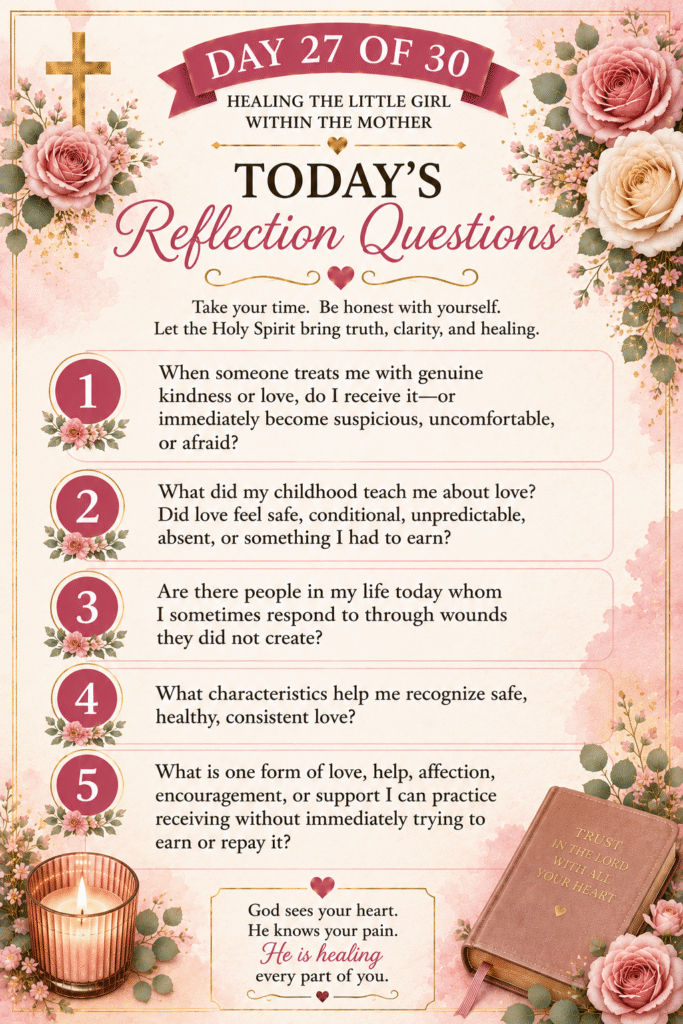
Reflection Questions
Take your time with today’s questions.
- When someone treats me with genuine kindness or love, do I receive it—or immediately become suspicious, uncomfortable, or afraid?
- What did my childhood teach me about love? Did love feel safe, conditional, unpredictable, absent, or something I had to earn?
- Are there people in my life today whom I sometimes respond to through wounds they did not create?
- What characteristics help me recognize safe, healthy, consistent love?
- What is one form of love, help, affection, encouragement, or support I can practice receiving without immediately trying to earn or repay it?
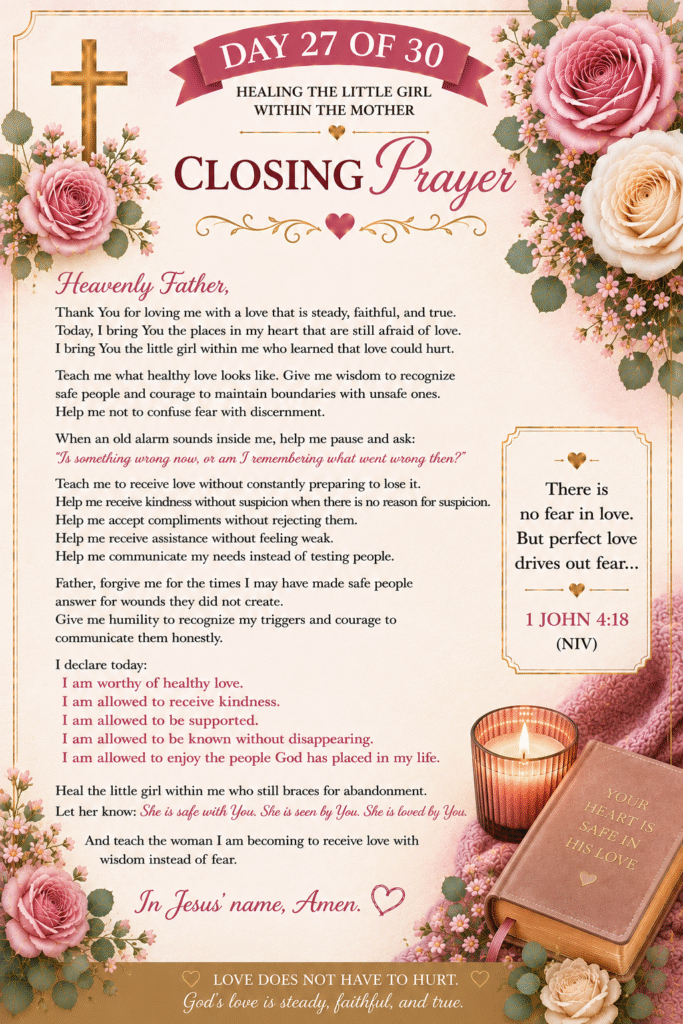
Closing Prayer
Heavenly Father,
Thank You for loving me with a love that is steady, faithful, and true.
Today, I bring You the places in my heart that are still afraid of love.
I bring You the little girl within me who learned that love could hurt.
The little girl who may have learned that affection could disappear.
That people could leave.
That kindness could come with conditions.
That trusting someone could be dangerous.
Father, heal the confusion between love and pain.
Teach me what healthy love looks like.
Give me wisdom to recognize safe people and courage to maintain boundaries with unsafe ones.
Help me not to confuse fear with discernment.
When an old alarm sounds inside me, help me pause and ask:
“Is something wrong now, or am I remembering what went wrong then?”
Teach me to receive love without constantly preparing to lose it.
Help me receive kindness without suspicion when there is no reason for suspicion.
Help me accept compliments without rejecting them.
Help me receive assistance without feeling weak.
Help me communicate my needs instead of testing people to see whether they will notice.
Father, forgive me for the times I may have made safe people answer for wounds they did not create.
Give me humility to recognize my triggers and courage to communicate them honestly.
Teach me that disagreement does not always mean abandonment.
Teach me that boundaries do not prevent love—they can help protect healthy love.
Teach me that I do not have to perform for affection.
I do not have to earn every kindness.
I do not have to exhaust myself to be worthy of care.
Most of all, Father, root me deeply in Your love.
When human love disappoints me, remind me that You remain faithful.
When fear tells me to build walls around my heart, give me wisdom about where I need boundaries and where I need courage.
Help me become a woman who can both give and receive healthy love.
I declare today:
I am worthy of healthy love.
I am allowed to receive kindness.
I am allowed to be supported.
I am allowed to be known without disappearing.
I am allowed to enjoy the people God has placed in my life.
Heal the little girl within me who still braces for abandonment.
Let her know:
She is safe with You.
She is seen by You.
She is loved by You.
And teach the woman I am becoming to receive love with wisdom instead of fear.
In Jesus’ name,
Amen.
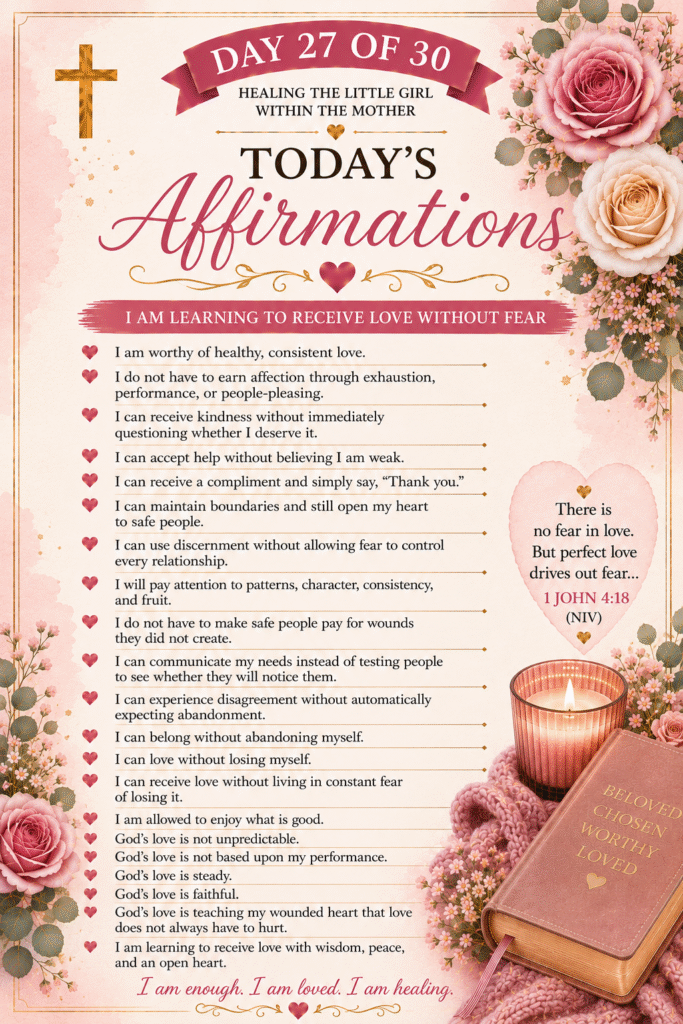
Today’s Affirmations
I AM LEARNING TO RECEIVE LOVE WITHOUT FEAR
I am worthy of healthy, consistent love.
I do not have to earn affection through exhaustion, performance, or people-pleasing.
I can receive kindness without immediately questioning whether I deserve it.
I can accept help without believing I am weak.
I can receive a compliment and simply say:
“Thank you.”
I can maintain boundaries and still open my heart to safe people.
I can use discernment without allowing fear to control every relationship.
I will pay attention to patterns, character, consistency, and fruit.
I do not have to make safe people pay for wounds they did not create.
I can communicate my needs instead of testing whether people will notice them.
I can experience disagreement without automatically expecting abandonment.
I can belong without abandoning myself.
I can love without losing myself.
I can receive love without living in constant fear of losing it.
I am allowed to enjoy what is good.
God’s love is not unpredictable.
God’s love is not based upon my performance.
God’s love is steady.
God’s love is faithful.
God’s love is teaching my wounded heart that love does not always have to hurt.
I am learning to receive love with wisdom, peace, and an open heart.
Journal Prompt — What Does Safe Love Look Like?
At the top of today’s journal page, write:
“Love Does Not Have to Hurt.”
Then complete:
Growing up, love felt like…
I learned that I had to ________ to be loved.
When someone gets close to me today, I sometimes fear…
When someone is kind to me, my first thought is often…
I find it difficult to receive…
I feel safest with people who…
Now create two columns:
Fear Says
and
Healthy Love Says
For example:
Fear: “If I say no, they will leave.”
Healthy Love: “A safe person can respect my boundary.”
Fear: “I have to be perfect.”
Healthy Love: “I can be loved while still growing.”
Fear: “If I need someone, I am weak.”
Healthy Love: “Healthy relationships include giving and receiving.”
Finally write:
“I do not have to approach every relationship as though my past is about to repeat itself. I will use wisdom, honor my boundaries, observe character, and allow safe love to reveal itself through consistency.”
End today’s journal entry by writing the names of three people—or, if that feels difficult, three ways—through which you currently experience healthy love or support.
Thank God for each one.
Today’s Healing Challenge
Practice Receiving
Today, intentionally receive one thing without minimizing it, rejecting it, or immediately trying to repay it.
It might be:
A compliment.
Help with a task.
A hug.
Encouragement.
Prayer.
A thoughtful gesture.
Someone cooking for you.
Someone listening to you.
Someone telling you:
“I love you.”
When it happens, resist the urge to deflect.
Simply say:
“Thank you.”
Then allow yourself to experience the moment.
You are teaching your heart something new:
“Receiving does not make me weak.”
A Truth to Carry With You Today
Little girl,
I know why you’re careful.
There was a time when trusting people didn’t always feel safe.
Maybe someone told you they loved you and still hurt you.
Maybe the person you depended upon wasn’t dependable.
Maybe affection disappeared when you disappointed someone.
Maybe you learned to study faces, tones, footsteps, moods, and silences because knowing what was coming helped you feel safer.
So now, even when someone loves you well, sometimes you’re still watching.
Waiting.
Preparing.
Wondering:
“When will this change?”
But little girl, look around.
We are not there anymore.
And we are not powerless anymore.
We have a voice now.
We have boundaries.
We have wisdom.
We have choices.
We can observe someone’s character.
We can say no.
We can walk away from what is unsafe.
And because we can protect ourselves differently now, we don’t have to hide from every good thing.
We can receive the hug.
We can accept the compliment.
We can let someone help.
We can tell someone when we’re hurting.
We can enjoy the peaceful day without spending it preparing for tomorrow’s storm.
And most importantly, we can rest in a love that has never depended upon our performance.
God loved us before we knew how to earn anything.
Little girl, love does not always have to hurt.
Some love is patient.
Some love is gentle.
Some love respects your no.
Some love stays present during difficult conversations.
Some love apologizes.
Some love celebrates you.
Some love makes room for your voice.
And when we encounter that kind of love, we don’t have to run.
We’ll move slowly.
We’ll use wisdom.
We’ll keep our boundaries.
But we will also allow ourselves to receive.
Because healing isn’t only about learning what we will never tolerate again.
Healing is also learning what we are finally willing to welcome.
And today, we welcome healthy love.
Tomorrow — Day 28
Becoming the Safe Place You Needed
Theme Scripture
“Above all, love each other deeply…”
— 1 Peter 4:8 (NIV)
Tomorrow, we will turn our attention toward something powerful.
What if part of healing the little girl within you involves becoming the woman she needed?
Not replacing the people who failed you.
Not pretending you can rewrite childhood.
But becoming a woman who treats herself with compassion, protects her peace, honors her boundaries, speaks truth, creates safety in her home, and refuses to abandon herself.
Day 28 will explore how the healed woman can begin creating the emotional safety she once longed to receive.
The little girl within you may once have asked:
“Who will protect me?”
But the woman God is healing is learning:
“With God’s help, I can create safety, love, truth, and peace within the life He has entrusted to me.”
Top of Form
Bottom of Form