
Day 23 — Learning to Speak Up for Yourself
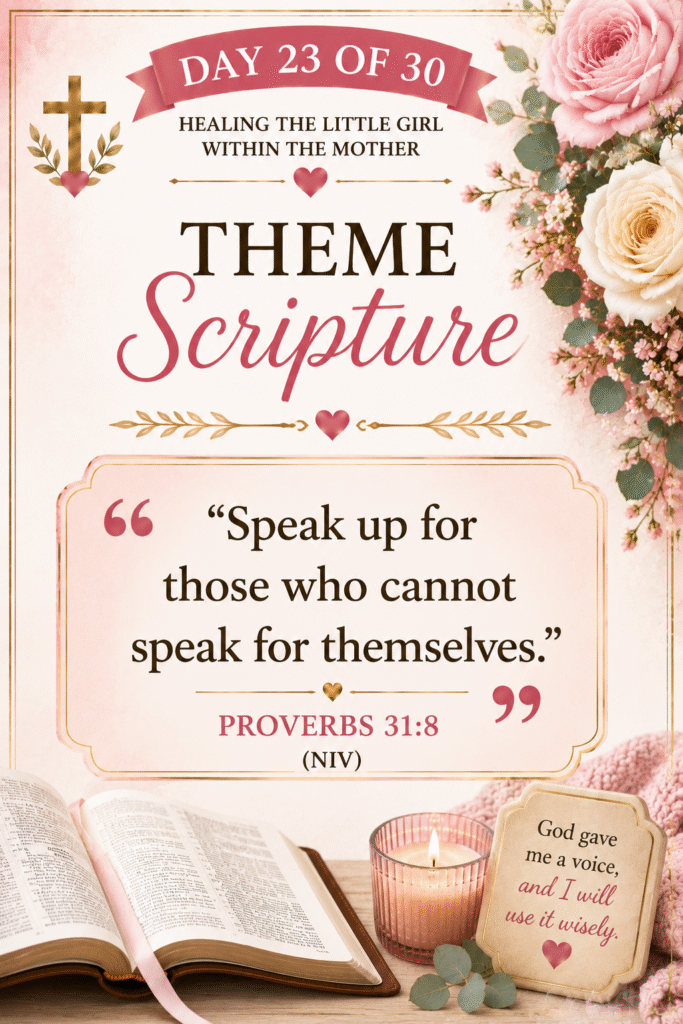
Theme Scripture
“Speak up for those who cannot speak for themselves.”
— Proverbs 31:8 (NIV)
Learning to Speak Up for Yourself
There are many reasons a little girl may learn to become quiet.
Sometimes she speaks and no one listens. Sometimes she tells the truth and isn’t believed. Sometimes expressing an opinion brings anger. Sometimes asking a question is considered disrespectful. Sometimes saying “no” isn’t allowed. Sometimes she discovers that keeping everyone else happy makes life easier. And sometimes silence becomes a form of protection.
So she learns: Don’t say anything. Don’t make them angry. Don’t tell anyone what happened. Don’t disagree. Don’t ask for too much. Don’t cause trouble. Just keep the peace.
Then that little girl grows up. She becomes a woman, a wife, a mother, a friend, a coworker, perhaps even a leader. She has a voice—but somewhere inside, she still wonders whether it is safe to use it.
Yesterday, on Day 22, we talked about learning to receive love without questioning it. Today, we’re talking about something that healthy love should make room for: your voice.
Healing does not mean becoming loud, argumentative, or confrontational. It means learning that you can express your thoughts, feelings, needs, concerns, and boundaries with wisdom, grace, and confidence.
The little girl within you may have learned: “It’s safer if I don’t say anything.” But the woman God is healing is learning: “My voice matters, and I am allowed to use it.”
When Silence Once Kept You Safe
Before judging yourself for struggling to speak up, it is important to understand why silence may have developed.
Children adapt to their environments. If speaking honestly created conflict, silence may have felt safer. If telling someone you were hurt led to dismissal, eventually you may have stopped telling. If expressing anger resulted in punishment, you may have learned to hide anger. If adults constantly interrupted or ignored you, you may have decided your thoughts weren’t important.
The little girl wasn’t necessarily weak. She was learning how to survive her environment.
But today you can thank that little girl for doing what she needed to do while teaching her: “We don’t have to be silent anymore.”
What Happens When a Child Isn’t Heard?
Every child needs to feel that her voice matters. That doesn’t mean children always get what they want. It means they learn: I can ask questions. I can tell someone when something hurts. I can express fear. I can say when something feels wrong. My feelings will be taken seriously.
When that doesn’t happen, a child can internalize a dangerous message: “What I think and feel doesn’t matter.”
That belief doesn’t automatically disappear when she becomes an adult. It may show up in relationships, work, parenting, friendships, and even the way she talks to herself.
You May Still Be Asking for Permission
Sometimes women who struggle with their voices don’t realize how often they seek permission.
“Is it okay if I…?” “I hope you don’t mind, but…” “I’m sorry, but I need…” “Maybe this is silly, but…” “I could be wrong, but…”
There is nothing wrong with politeness or humility. But notice when your language constantly minimizes you before you’ve even expressed your thought.
You don’t have to apologize for having a need, asking a reasonable question, or respectfully disagreeing.
Sometimes instead of, “I’m sorry, but I really don’t want to do that,” you can simply say: “Thank you for asking, but I’m not able to do that.” No long explanation required.
Your Voice Doesn’t Have to Be Loud to Be Powerful
Some people associate speaking up with confrontation. But confidence doesn’t require volume.
You can speak softly and still be clear. You can be kind and still be firm. You can be respectful and still disagree. You can remain calm and still say, “No.”
You can love someone and still say, “That isn’t okay with me.” You can forgive someone and still say, “That behavior cannot continue.” You can be a Christian woman and still have boundaries.
Gentleness and assertiveness can coexist.
Keeping the Peace Is Not the Same as Having Peace
Sometimes we say, “I just want peace,” but what we actually mean is, “I don’t want anyone upset with me.”
So we avoid difficult conversations. We don’t address hurt. We pretend everything is fine. We say yes when we mean no. We allow resentment to build quietly.
From the outside, everything may appear peaceful. But inside there may be frustration, exhaustion, disappointment, anger, and even bitterness.
That isn’t peace. That is suppressed conflict. Real peace sometimes requires an uncomfortable conversation.
You Are Allowed to Say “That Hurt Me”
Some women find it easier to endure pain than to tell someone they caused it.
Perhaps you fear they will become defensive, say you’re too sensitive, deny it, or turn it back on you. Those fears may come from past experiences.
But in healthy relationships, you should be able to say: “When that happened, it hurt me.”
You aren’t automatically accusing someone of being a terrible person. You’re communicating your experience.
Your Feelings Are Information, Not Instructions
Learning to speak up doesn’t mean every emotion must immediately become a conversation.
Sometimes we need to sit with our feelings first. Ask: What exactly am I feeling? What happened? What do I need? Is this about the present situation, or did it trigger something from my past? What outcome am I hoping for?
Then speak from clarity instead of reacting from the wound.
Instead of, “You never care about me!” perhaps the deeper truth is: “When that happened, I felt overlooked. Could we talk about it?”
That is emotional maturity.
Stop Expecting People to Read Your Mind
This can be difficult, especially for women accustomed to noticing everyone else’s needs.
You may think: “I shouldn’t have to ask.” Sometimes that’s understandable. But people cannot always know what you need unless you communicate it.
You may need to say: “I need some quiet time.” “Could you help me with dinner tonight?” “I need you to listen, not solve this.” “I’m overwhelmed.” “I need some time to think before we continue this conversation.”
Clear communication gives healthy people an opportunity to respond to the real need instead of guessing.
“No” Is a Complete Sentence—but Wisdom Determines How We Use It
Healthy communication doesn’t mean we need to become unnecessarily harsh.
Sometimes “No, thank you” is enough. Sometimes “I’m not available” is enough. Sometimes “That doesn’t work for me” is enough. And sometimes, particularly in close relationships, a little context may be appropriate.
The important lesson is: You don’t have to construct a courtroom argument every time you establish a boundary.
Your boundary does not become legitimate only after everyone agrees with it.
People May Not Like the Healed Version of Your Voice
When you’ve spent years being agreeable, available, accommodating, and quiet, some people may become uncomfortable when you change.
They may say: “You’ve changed.” And perhaps you have.
Maybe you stopped saying yes automatically. Maybe you stopped accepting disrespect. Maybe you started expressing your opinion, protecting your time, asking questions, or acknowledging when something hurt.
Someone benefiting from your silence may not celebrate your voice. That does not automatically mean you’re doing something wrong.
Continue checking your heart. Speak with humility, wisdom, respect, and truth. Healing isn’t permission to become cruel. It is permission to become clear.
Your Voice Is Not a Weapon
Sometimes after years of silence, finding your voice can initially feel powerful. And it is. But the goal isn’t to move from being voiceless to using your voice to wound others.
Ephesians 4:15 speaks about “speaking the truth in love.”
Truth without love can become harsh. Love without truth can become enabling. Healing teaches us to hold both.
Your voice was given to you to communicate truth—not to reproduce the pain that once silenced you.
Sometimes You Need to Speak Up for the Little Girl Within You
There are moments when setting a boundary today is about protecting the woman you are now. And there are moments when it also feels like standing up for the little girl who couldn’t.
Maybe she couldn’t say “Stop,” but you can now. Maybe she couldn’t say “I don’t like that,” but you can now. Maybe she couldn’t say “That isn’t true,” but you can now. Maybe she couldn’t say “I deserve better,” but you can now.
Every healthy boundary can become a quiet message to that little girl: “I will protect you now.”
Speaking Up Does Not Guarantee the Response You Want
Finding your voice does not mean everyone will suddenly understand.
You may communicate beautifully and someone still becomes defensive. You may establish a reasonable boundary and someone still becomes angry. You may explain your feelings and someone still dismisses them.
You cannot control another person’s response. Your responsibility is to communicate as honestly, respectfully, and wisely as you can.
Their response gives you information.
You Don’t Need Everyone to Agree With You
If you’ve spent much of your life seeking approval, disagreement may feel like rejection.
Someone disagrees with your opinion, and suddenly you feel the urge to explain more, defend yourself, change your answer, backtrack, or apologize.
But disagreement doesn’t always mean rejection. Two emotionally healthy adults can see something differently and still respect each other.
You are allowed to think: “I understand your perspective, but I see it differently.” And leave it there.
Your Voice Matters in Your Marriage
Healthy marriage requires communication—not mind-reading, resentment, silence, or constantly saying “It doesn’t matter” when it actually does.
You can say: “This is important to me.” “I need your help.” “That hurt my feelings.” “Can we talk about this?” “I need reassurance.” “I don’t agree.”
Marriage doesn’t require losing your individual voice. Healthy partnership should make room for two people to communicate honestly and respectfully.
Your Voice Matters as a Mother
There is something especially powerful about a healing mother finding her voice, because your children are watching how you communicate.
When you respectfully speak up, they learn: My voice matters too. When you apologize after speaking harshly, they learn: Strength includes accountability. When you say no without guilt, they learn: Boundaries are normal. When you listen to them, they learn: Home is a safe place to communicate.
You aren’t only healing your voice. You are helping create a family where voices can be heard.
Teach Your Children What You Had to Learn Later
Tell them: “You can tell me when something makes you uncomfortable.” “You can ask questions.” “You can disagree respectfully.” “You can tell me when I hurt your feelings.” “You never have to keep a secret about someone hurting you.”
Children need to know that if anyone tells them to keep harmful, inappropriate, or frightening behavior secret, they can tell a safe adult.
Breaking cycles includes creating homes where truth is safer than secrecy.
Your Voice Matters Outside Your Home Too
Speaking up for yourself may look different depending on the situation.
At work: “Could you clarify what is expected of me?”
With a doctor: “I still have concerns, and I’d like to discuss them.”
With a friend: “I value our friendship, but that comment hurt me.”
With family: “I’m not comfortable discussing that.”
With a business: “This isn’t what I agreed to.”
In ministry: “I need time to pray before committing.”
Finding your voice isn’t only about confronting mistreatment. Sometimes it’s simply learning to advocate for yourself.
God Can Give You Wisdom About When to Speak
Not every battle requires your voice. This is where discernment matters.
Ecclesiastes 3:7 reminds us there is “a time to be silent and a time to speak.”
Healing does not mean responding to every comment. You don’t have to correct every misunderstanding. You don’t have to attend every argument you’re invited to.
Sometimes wisdom says: Speak. Sometimes wisdom says: Wait. Sometimes wisdom says: Walk away. Sometimes wisdom says: This conversation needs to happen later when everyone is calmer.
The goal isn’t simply to become more vocal. The goal is to become wiser with your voice.
Pray Before Difficult Conversations
When possible, bring difficult conversations to God first.
Pray: “Lord, help me understand what I’m really feeling. Show me what part belongs to me. Give me the right words. Help me speak without attacking. Help me listen too. Give me courage not to abandon the truth just because the conversation becomes uncomfortable.”
Prayer doesn’t guarantee the other person will respond perfectly. But it can help you enter the conversation from a grounded place.
Debbie’s Reflection
There was a time in my life when silence felt easier.
When you’ve learned early that speaking doesn’t always change what happens, you can begin believing there is no point. You keep things inside. You try to handle them yourself. You convince yourself: “I’ll be okay.”
And sometimes you are. But being able to survive something silently doesn’t mean silence is always healthy.
Healing has taught me that my voice matters.
I can tell someone when something hurts. I can say when I disagree. I can ask questions. I can say no. I can communicate what I need. And I can do those things without becoming disrespectful or unkind.
One of the biggest lessons for me has been understanding that finding my voice does not mean becoming a different woman. I don’t have to become loud. I don’t have to become argumentative. I don’t have to prove anything.
I simply have to stop abandoning myself to keep everyone else comfortable.
There were things the little girl within me could not say. Things she may have wanted someone to hear. Things she needed someone to understand.
Today, the woman I am becoming can speak for her.
I can say: “What happened mattered.” “What I feel matters.” “What I need matters.” “My boundaries matter.” “My voice matters.”
And perhaps most importantly: “I don’t need everyone else’s permission to believe that.”
God gave me a voice. I want to use it with wisdom, grace, truth, love, and when necessary—with courage.
You Don’t Have to Explain Your Entire Life to Be Understood
Sometimes when people misunderstand us, we feel compelled to tell the entire story.
But not everyone needs access to every detail of your story.
Sometimes “That isn’t something I’m comfortable discussing” is enough. Sometimes “I’ve made the decision that is best for me and my family” is enough. Sometimes “I appreciate your concern, but I’ve made my decision” is enough.
Privacy and secrecy are not the same thing. You are allowed to have parts of your life that belong only to you, God, and the people you trust.
Your Voice Becomes Stronger With Practice
You don’t have to transform overnight. Start small.
Maybe today you express a preference instead of saying “Whatever you want.” Maybe you tell someone, “Actually, I’d prefer this.” Maybe you decline something without inventing an excuse. Maybe you ask a question you’ve been afraid to ask. Maybe you communicate a need.
Every time you use your voice wisely, you teach yourself: “I can speak and still be safe.”
That is healing.
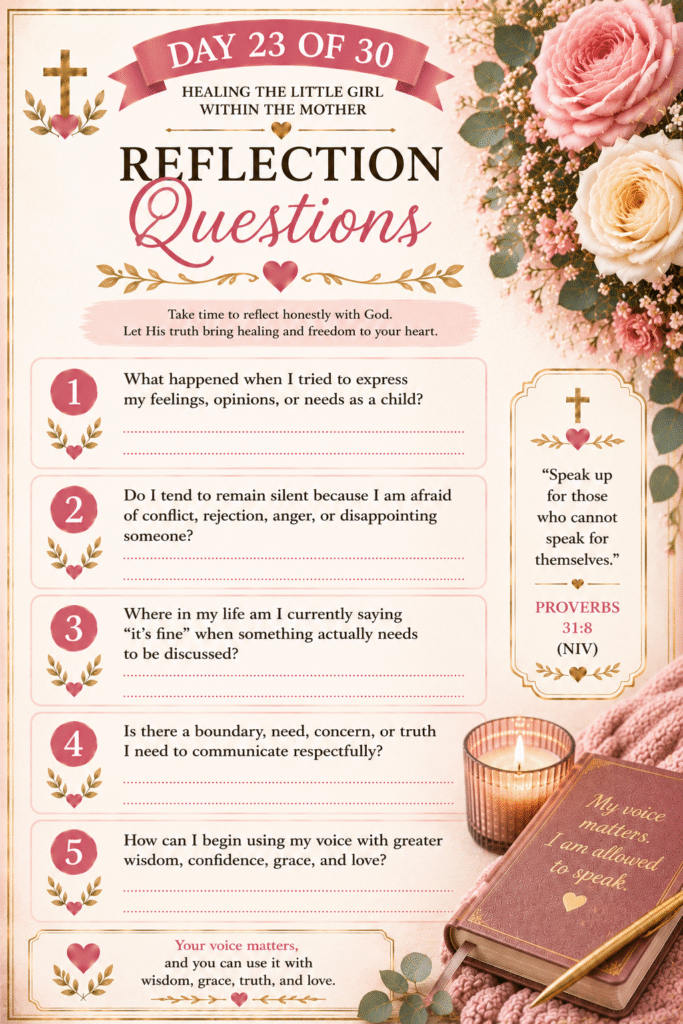
Reflection Questions
- What happened when I tried to express my feelings, opinions, or needs as a child?
- Do I tend to remain silent because I am afraid of conflict, rejection, anger, or disappointing someone?
- Where in my life am I currently saying “it’s fine” when something actually needs to be discussed?
- Is there a boundary, need, concern, or truth I need to communicate respectfully?
- How can I begin using my voice with greater wisdom, confidence, grace, and love?
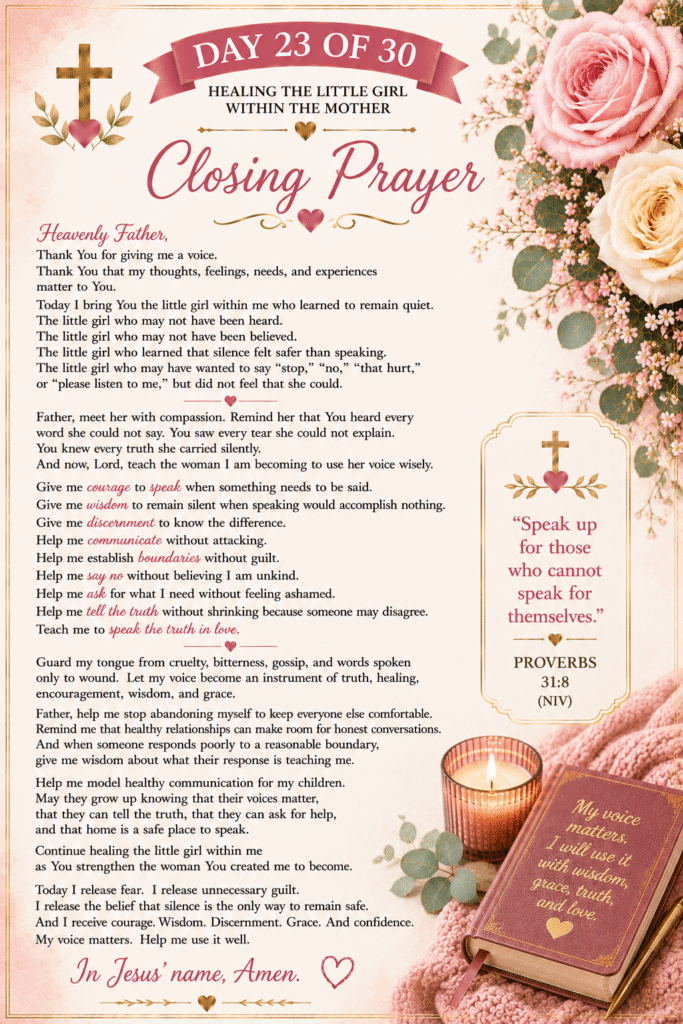
Closing Prayer
Heavenly Father,
Thank You for giving me a voice.
Thank You that my thoughts, feelings, needs, and experiences matter to You.
Today I bring You the little girl within me who learned to remain quiet. The little girl who may not have been heard. The little girl who may not have been believed. The little girl who learned that silence felt safer than speaking. The little girl who may have wanted to say “stop,” “no,” “that hurt,” or “please listen to me,” but did not feel that she could.
Father, meet her with compassion.
Remind her that You heard every word she could not say. You saw every tear she could not explain. You knew every truth she carried silently.
And now, Lord, teach the woman I am becoming to use her voice wisely.
Give me courage to speak when something needs to be said. Give me wisdom to remain silent when speaking would accomplish nothing. Give me discernment to know the difference.
Help me communicate without attacking. Help me establish boundaries without guilt. Help me say no without believing I am unkind. Help me ask for what I need without feeling ashamed. Help me tell the truth without shrinking because someone may disagree.
Teach me to speak the truth in love.
Guard my tongue from cruelty, bitterness, gossip, and words spoken only to wound. Let my voice become an instrument of truth, healing, encouragement, wisdom, and grace.
Father, help me stop abandoning myself to keep everyone else comfortable.
Remind me that healthy relationships can make room for honest conversations. And when someone responds poorly to a reasonable boundary, give me wisdom about what their response is teaching me.
Help me model healthy communication for my children. May they grow up knowing that their voices matter, that they can tell the truth, that they can ask for help, and that home is a safe place to speak.
Continue healing the little girl within me as You strengthen the woman You created me to become.
Today I release fear. I release unnecessary guilt. I release the belief that silence is the only way to remain safe.
And I receive courage, wisdom, discernment, grace, and confidence.
My voice matters. Help me use it well.
In Jesus’ name,
Amen.
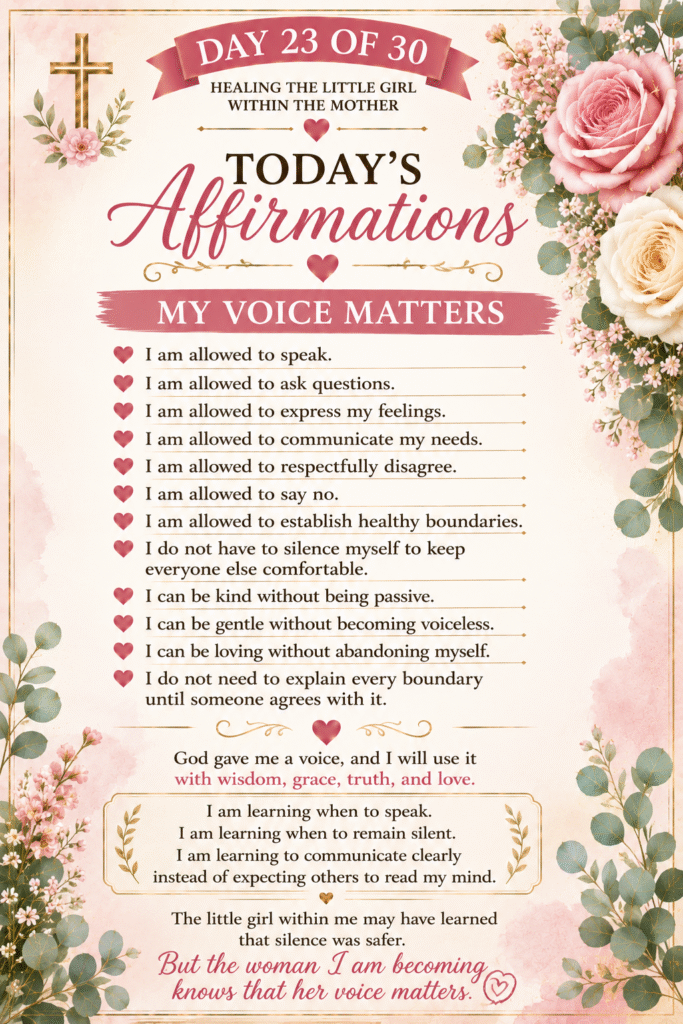
Today’s Affirmation
MY VOICE MATTERS
I am allowed to speak.
I am allowed to ask questions.
I am allowed to express my feelings.
I am allowed to communicate my needs.
I am allowed to respectfully disagree.
I am allowed to say no.
I am allowed to establish healthy boundaries.
I do not have to silence myself to keep everyone else comfortable.
I can be kind without being passive.
I can be gentle without becoming voiceless.
I can be loving without abandoning myself.
I do not need to explain every boundary until someone agrees with it.
God gave me a voice, and I will use it with wisdom, grace, truth, and love.
I am learning when to speak.
I am learning when to remain silent.
I am learning to communicate clearly instead of expecting others to read my mind.
The little girl within me may have learned that silence was safer.
But the woman I am becoming knows that her voice matters.
Journal Prompt — Finding My Voice
At the top of today’s journal page, write: “What Have I Been Afraid to Say?”
Then complete these sentences:
Growing up, I learned that speaking up would…
When someone becomes upset with me, I usually…
I find it hardest to speak up when…
I often say “it’s fine” when I actually feel…
One boundary I have been afraid to communicate is…
One need I wish I could express more clearly is…
Now write: What Silence Once Protected Me From.
Perhaps: Conflict. Punishment. Rejection. Being misunderstood. Someone becoming angry. Feeling embarrassed.
Then write: What My Voice Can Help Me Create Today.
Honesty. Healthy boundaries. Clear communication. Mutual respect. Safety. Deeper relationships. Self-respect. Protection.
Finally, write: “I honor the little girl who used silence to survive. But today, I give the woman I am becoming permission to speak.”
Finish by writing three things you’re grateful for today.
Today’s Healing Challenge
Today, use your voice in one small, healthy way.
You do not have to begin with your most difficult relationship or biggest boundary. Start somewhere manageable.
Express a preference. Ask for help. Say, “No, thank you.” Tell someone, “I need some time to think about that.” Say, “Actually, I see it differently.” Or tell someone you trust, “There’s something I’ve been wanting to talk about.”
Then notice what happens inside you.
If guilt appears, don’t automatically assume the guilt means you’ve done something wrong.
Remind yourself: “I can be respectful and still have a voice.”
A Truth to Carry With You Today
Little girl, there were things you couldn’t say.
Maybe nobody asked. Maybe nobody listened. Maybe someone told you to stay quiet. Maybe you tried to speak and discovered that telling the truth didn’t always bring the protection you deserved.
So you became quiet. You learned how to read the room. You learned when not to speak. You learned how to keep people happy. You learned how to survive.
But you are not that powerless little girl anymore.
Today, the woman you have become can speak.
She can say: “No.” “Stop.” “That hurt me.” “I don’t agree.” “I need help.” “I need some space.” “That doesn’t work for me.” “This is important to me.” “Please listen.”
And she can also say: “I love you.” “I forgive you.” “I’m sorry.” “I appreciate you.” “I’m proud of you.” “Thank you.”
Because healing your voice isn’t only about learning how to protect yourself. It’s also about learning how to express the beautiful things that were buried beneath survival.
Your tenderness. Your wisdom. Your creativity. Your convictions. Your faith. Your love. Your testimony. Your story.
You have something to say.
And you don’t need to shout for your voice to matter.
Speak when God gives you something to say. Be quiet when wisdom tells you silence is better.
But never again confuse having peace with having no voice.
Your voice matters. And the woman God is healing is learning how to use it.
Tomorrow — Day 24
Learning to Trust Yourself Again
Theme Scripture:
“For the LORD gives wisdom; from his mouth come knowledge and understanding.”
— Proverbs 2:6 (NIV)
Tomorrow, we’re going to talk about what happens when years of being dismissed, criticized, manipulated, second-guessed, or told that your feelings were wrong cause you to stop trusting your own judgment.
You may find yourself constantly asking: “Am I overreacting?” “What if I’m wrong?” “Should I ask someone else what they think?” “Can I trust this feeling?”
Day 24 will be about rebuilding trust in yourself—not by believing you will always make the perfect decision, but by learning to seek God’s wisdom, pay attention to what you’ve learned, and trust that you are capable of making thoughtful choices.
The little girl within you may have learned: “I can’t trust myself.”
But the woman God is healing is learning: “With God’s wisdom guiding me, I can make decisions with greater confidence and peace.”

1 Comment
[…] Healing the Little Girl Within the Mother […]