
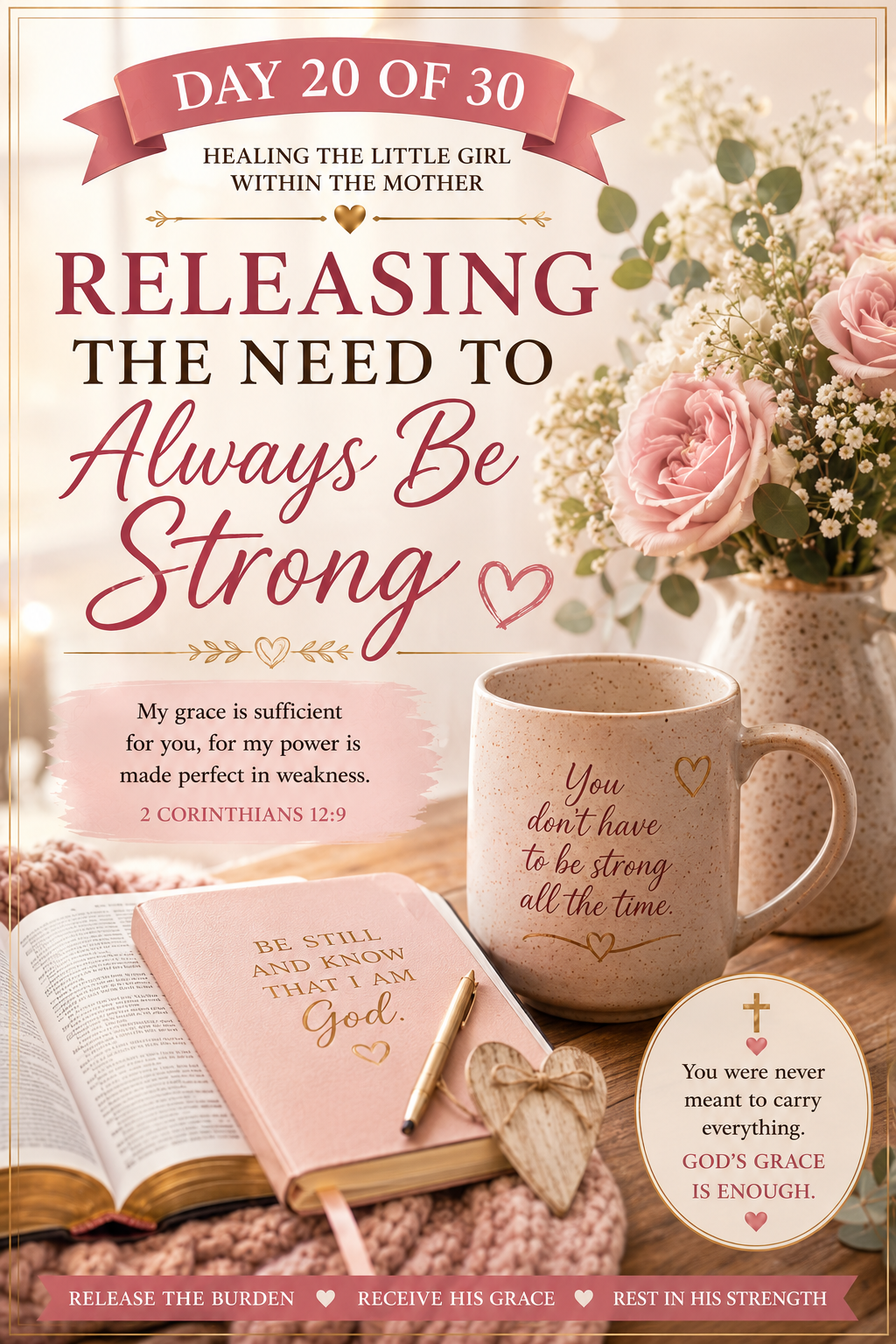
Day 20 — Releasing the Need to Always Be Strong
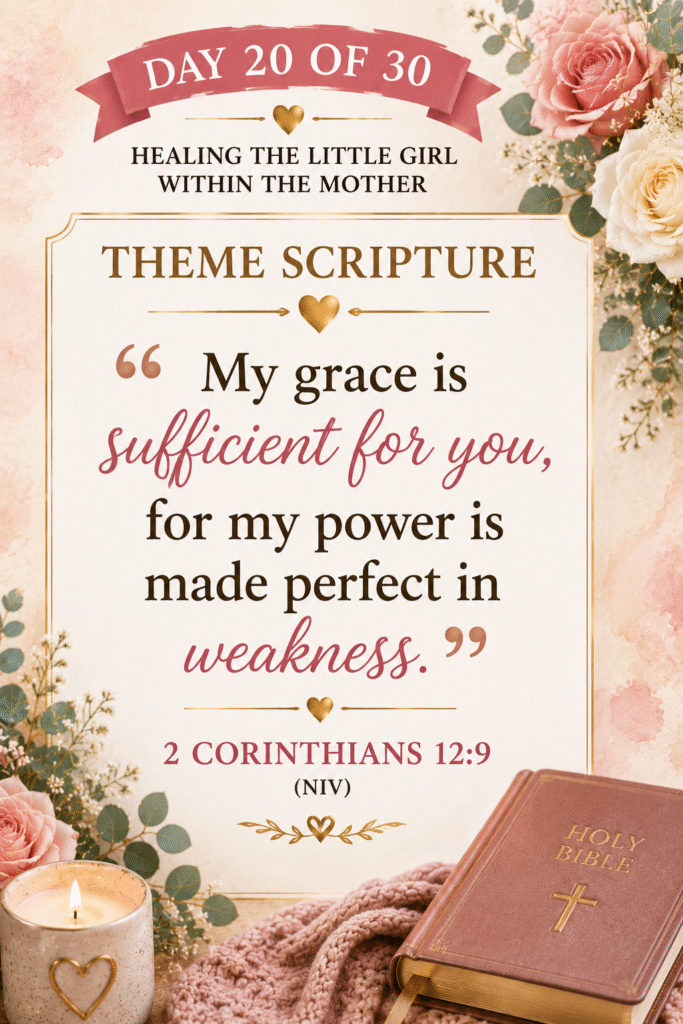
Theme Scripture
“My grace is sufficient for you, for my power is made perfect in weakness.”
— 2 Corinthians 12:9 (NIV)
Releasing the Need to Always Be Strong
There is a woman people describe as strong. She is the one they call when something goes wrong. She finds a solution. She takes care of everyone. She keeps the family moving. She prays for other people while quietly carrying her own burdens.
Somewhere along the way, she began believing: “I have to be strong.” So she keeps going—even when she is exhausted, hurting, needs help, or wishes someone else would say, “I’ve got this. You can rest.”
For many women healing childhood wounds, strength was not originally something they chose. Strength was something survival required. The little girl learned: Don’t cry. Don’t depend on anyone. Figure it out. Keep going. Protect yourself. Handle it.
Yesterday, on Day 19, we talked about learning that your needs matter too. Today, we’re going deeper, because acknowledging your needs sometimes requires admitting: “I cannot do everything by myself.” God’s Word gives us a different understanding of strength. God does not require you to be strong every moment. Sometimes His strength becomes most visible when you finally admit: “Lord, I need You.”
When Strength Begins in Childhood
Some children have the privilege of simply being children. They know someone else is responsible, will protect them, and will make sure things are okay. But some little girls learn very early: “I need to take care of myself.”
Maybe the adults around you were emotionally unavailable. Maybe home was unpredictable. Maybe you experienced things no child should have had to process. Maybe you had responsibilities beyond your years. Maybe asking for help brought disappointment.
So you adapted. You became strong. That strength helped you survive. But survival skills that were necessary in childhood do not always need to remain in control of adulthood. The little girl needed strength to survive. The woman you are becoming needs to learn: It is safe to receive support.
“I’m Fine” Can Become Armor
Sometimes “I’m fine” means: I don’t know how to explain what I’m feeling. I don’t want to burden you. I’m afraid you won’t understand. I’ve learned not to expect help. Or, if I start talking about it, I might cry.
So “I’m fine” becomes armor. It keeps emotions contained and allows you to continue functioning. But armor is heavy. Healing may require learning that you can take the armor off sometimes.
Being Strong Is Not the Same as Being Silent
Many women absorb the idea that strong women don’t complain. So we remain silent, tolerate things that hurt us, and don’t admit we’re overwhelmed.
But silence is not always strength. Sometimes strength sounds like: “That hurt me.” “I need help.” “I’m overwhelmed.” “I don’t know what to do.” “I need someone to pray with me.” Sometimes the strongest thing you can do is tell the truth.
Tears Do Not Cancel Your Strength
Some little girls learned not to cry. But tears are not weakness. Scripture repeatedly shows people crying before God. David cried. Jeremiah wept. Hannah wept. Peter wept. And Jesus wept.
The Son of God did not consider tears incompatible with strength. Neither should you. Sometimes tears are simply the heart saying: “I have carried this long enough.”
You Don’t Have to Be the Strong One Every Day
Families often develop roles, and sometimes yours becomes “the strong one.” Everyone assumes you’ll figure it out and bounce back.
But resilience doesn’t mean you never need care. Strong people still need encouragement, prayer, rest, someone to check on them, and safe places to fall apart.
Stop Carrying What Other Adults Can Carry Themselves
Sometimes strength becomes over-functioning. You manage not only your responsibilities but everyone else’s too. You solve, remind, organize, rescue, fix, anticipate, and carry.
Sometimes healing means asking: “Is this actually mine to carry?” You can love someone without taking responsibility for everything in their life.
God’s Strength Is Different From Self-Sufficiency
Our culture often celebrates self-sufficiency, but Christianity is built on dependence. We depend on God, live in community, pray for one another, and carry one another’s burdens.
God can strengthen you, and sometimes His provision comes through another person—a spouse, friend, family member, church community, counselor, doctor, mentor, or neighbor. Receiving help does not mean God failed to help you. Sometimes the help is how God answered.
“My Grace Is Sufficient”
Paul asked God to remove something difficult from his life. Instead, God answered: “My grace is sufficient for you, for my power is made perfect in weakness.”
There will be moments when your strength runs out. You don’t have enough wisdom, energy, patience, resources, or answers. Those moments do not mean God has abandoned you. Sometimes they become the place where you discover His grace is enough for this moment.
Vulnerability Requires Courage
Vulnerability can feel dangerous when people have hurt you. Healthy vulnerability requires discernment; not everyone deserves access to your deepest wounds.
But healing often requires at least a few safe places where you don’t have to perform strength—someone with whom you can say, “Today is hard,” and hear, “I’m here.” Safe relationships can teach your heart: I can be vulnerable without being abandoned.
Asking for Help Is a Skill
If you’ve spent decades doing everything yourself, asking for help may feel awkward. Start small. Ask, “Could you help me with this?” Instead of saying, “Never mind, I’ll do it,” allow someone else to try.
They may not do it exactly like you would. Sometimes receiving help also requires releasing control, and that can be part of healing too.
You Are Not a Burden
One of the deepest fears behind hyper-independence is: “I don’t want to be a burden.” So you carry your pain privately.
But healthy relationships include mutual care. There will be seasons when you help someone else and seasons when someone helps you. You don’t have to earn belonging by always being the giver.
Your Children Don’t Need an Invincible Mother
Children should not be burdened with adult problems they are not equipped to carry. But there is value in age-appropriate honesty.
Your children can learn: Mom gets tired. Mom asks for help. Mom prays when she doesn’t know what to do. Mom sometimes cries. Mom apologizes. Mom rests. Mom trusts God. Strength isn’t pretending nothing hurts. Strength is knowing where to go when it does.
You Can Be Strong and Soft
Survival can make us hard because softness once felt dangerous. But healing allows strength and softness to exist together.
You can be strong and gentle, compassionate, vulnerable, affectionate, emotional, rested, and supported. Boundaries can protect you without bitterness. Discernment can protect you without isolation.
Debbie’s Reflection
There have been many seasons in my life when strength didn’t feel optional. Life happened, and I had to keep going. There were responsibilities and children who needed me. Things had to be handled whether I felt ready or not.
When you’ve survived difficult things, people sometimes say, “You’re so strong.” But sometimes what people call strength was simply: I didn’t have the option to stop.
God carried me through things I once wondered whether I would survive. But healing has taught me that I don’t have to prove my strength anymore. I don’t have to carry every burden silently, pretend I’m okay when I’m not, know the answer to everything, or handle every problem by myself.
There are moments when I can simply say: “God, I need You.” The little girl within me learned: Be strong because you have to be. But the woman God is healing is learning: I can be strong because God is strengthening me.
One says: Everything depends on me. The other says: I depend on God. And I would rather live from the second one.
Stop Measuring Strength by How Much You Can Endure
Some women measure strength by endurance: how much pain, exhaustion, or disrespect can I tolerate? But endurance without wisdom can become self-destruction.
Sometimes strength means enduring. Sometimes it means leaving, speaking, resting, asking for help, establishing a boundary, or saying, “This is too much for me right now.” Wisdom helps us know the difference.
Let God Redefine Strength
Perhaps your old definition of strength was: Never cry. God may be teaching: Bring your tears to Me.
Never need anyone becomes: Receive the people I send. Handle everything yourself becomes: Let Me carry what you cannot. Keep going no matter what becomes: Rest.
Your old definition may have been: I am strong because I survive alone. God’s definition can become: I am strong because His grace sustains me.
What If You Didn’t Have to Prove Anything Today?
Imagine waking up without needing to prove that you’re capable, strong, okay, or able to handle everything.
Maybe you’d ask for help sooner, rest before exhaustion, cry without apologizing, stop carrying something that isn’t yours, or pray: “Father, I don’t know what to do.” Perhaps instead of seeing that prayer as weakness, you’d recognize it as faith.
Reflection Questions
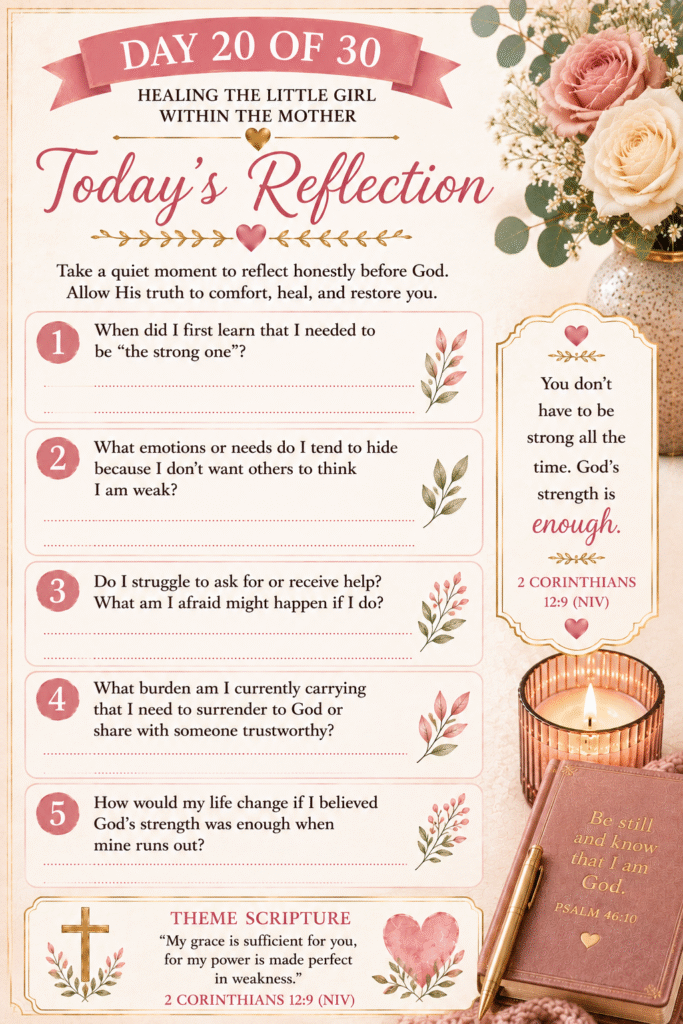
- When did I first learn that I needed to be “the strong one”?
- What emotions or needs do I tend to hide because I don’t want others to think I am weak?
- Do I struggle to ask for or receive help? What am I afraid might happen if I do?
- What burden am I currently carrying that I need to surrender to God or share with someone trustworthy?
- How would my life change if I believed God’s strength was enough when mine runs out?
Closing Prayer
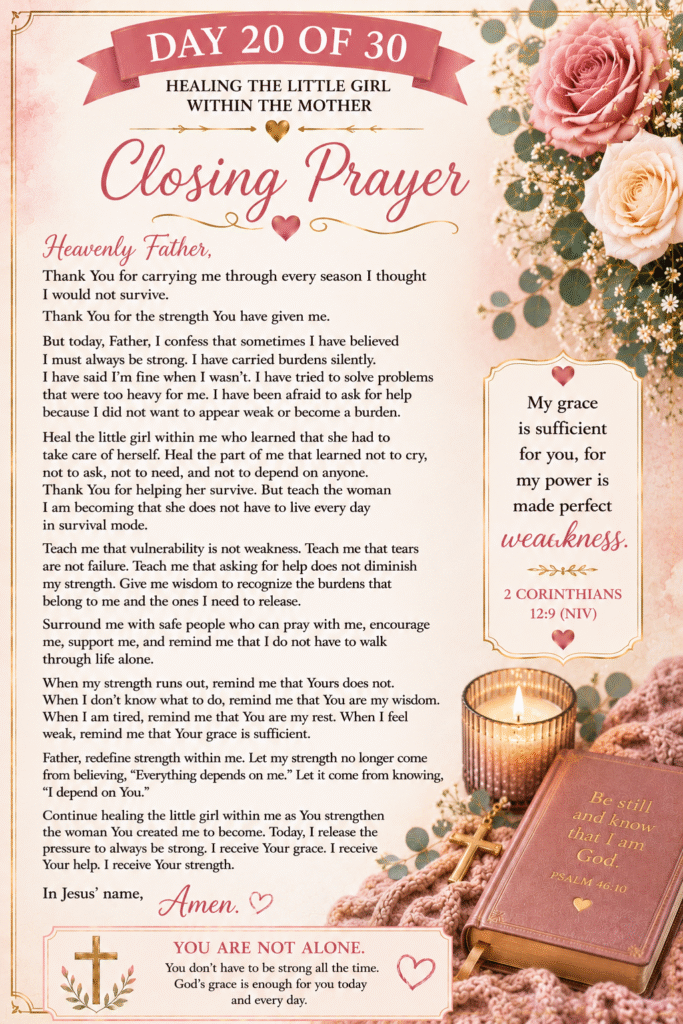
Heavenly Father,
Thank You for carrying me through every season I thought I would not survive. Thank You for the strength You have given me.
But today, Father, I confess that sometimes I have believed I must always be strong. I have carried burdens silently. I have said I’m fine when I wasn’t. I have tried to solve problems that were too heavy for me. I have been afraid to ask for help because I did not want to appear weak or become a burden.
Heal the little girl within me who learned that she had to take care of herself. Heal the part of me that learned not to cry, not to ask, not to need, and not to depend on anyone.
Thank You for helping her survive. But teach the woman I am becoming that she does not have to live every day in survival mode.
Teach me that vulnerability is not weakness. Teach me that tears are not failure. Teach me that asking for help does not diminish my strength.
Give me wisdom to recognize the burdens that belong to me and the ones I need to release. Surround me with safe people who can pray with me, encourage me, support me, and remind me that I do not have to walk through life alone.
When my strength runs out, remind me that Yours does not. When I don’t know what to do, remind me that You are my wisdom. When I am tired, remind me that You are my rest. When I feel weak, remind me that Your grace is sufficient.
Father, redefine strength within me. Let my strength no longer come from believing, “Everything depends on me.” Let it come from knowing, “I depend on You.”
Continue healing the little girl within me as You strengthen the woman You created me to become.
Today, I release the pressure to always be strong. I receive Your grace. I receive Your help. I receive Your strength.
In Jesus’ name,
Amen.
Today’s Affirmation
I DON’T HAVE TO BE STRONG ALL THE TIME
I release the pressure to carry everything by myself.
I am allowed to ask for help. I am allowed to cry. I am allowed to admit when I am tired. I am allowed to say, “I don’t know.” I am allowed to need support.
Vulnerability does not make me weak. Receiving help does not make me a burden. My worth is not measured by how much pain I can endure. I do not have to prove my strength.
God’s grace is sufficient for me. When my strength runs out, His strength remains. I am learning to depend on God instead of believing everything depends on me.
Journal Prompt — Redefining Strength
At the top of today’s journal page, write: “What Does Strength Mean to Me?”
Complete these sentences: Growing up, being strong meant… I learned not to show… When I need help, I usually… I am afraid that if people see me struggling, they will… The burden I am most tired of carrying is…
Then create two sections: My Old Definition of Strength and My New Definition of Strength.
Under the old definition, list messages such as: Never cry. Never ask. Handle it yourself. Don’t let anyone see you struggling. Keep going no matter how tired you are.
Under the new definition, write: I can ask for help. I can tell the truth about how I feel. I can rest. I can cry. I can establish boundaries. I can depend on God. I can receive support.
Finish with: “I no longer measure my strength by how much I can carry. I measure it by how willingly I trust God with what I cannot.” Then write three things you’re grateful for today.
Today’s Healing Challenge
Today, practice one act of vulnerability. Tell someone trustworthy, “I’m tired today.” Ask, “Could you help me with this?” Allow yourself to cry if tears come. Tell someone you trust, “I could use some encouragement.” Or simply sit with God and pray: “Father, I cannot carry this by myself anymore.”
Then resist the urge to immediately put your armor back on. Let yourself receive.
A Truth to Carry With You Today
Maybe people have called you strong your entire life. And perhaps you are. But you were never meant to be invincible.
You are allowed to be human. Sometimes being human means saying: “I need help.”
The little girl within you may have believed: “I have to be strong because nobody is coming to rescue me.” But today she can learn something different: God is here. He sees you. He hears you. He cares for you.
You don’t have to prove how strong you are anymore. You have already survived. Now God is teaching you how to live—how to rest, receive, trust, soften, ask, and surrender.
Perhaps the strongest sentence you will speak today is simply: “God, I need You.” His strength is enough.
Tomorrow — Day 21
Learning to Feel Safe in Peace
Theme Scripture: “In peace I will lie down and sleep, for you alone, LORD, make me dwell in safety.” — Psalm 4:8 (NIV)
Tomorrow we will talk about something that can be surprisingly difficult after living through instability or trauma: learning to trust peace.
The little girl within you learned: “Stay alert. Something could happen.” But the woman God is healing is learning: “I do not have to fear peaceful seasons. I am allowed to feel safe in the life God is helping me build.”

1 Comment
[…] Healing the Little Girl Within the Mother […]