
Day 19 – Learning That Your Needs Matter Too
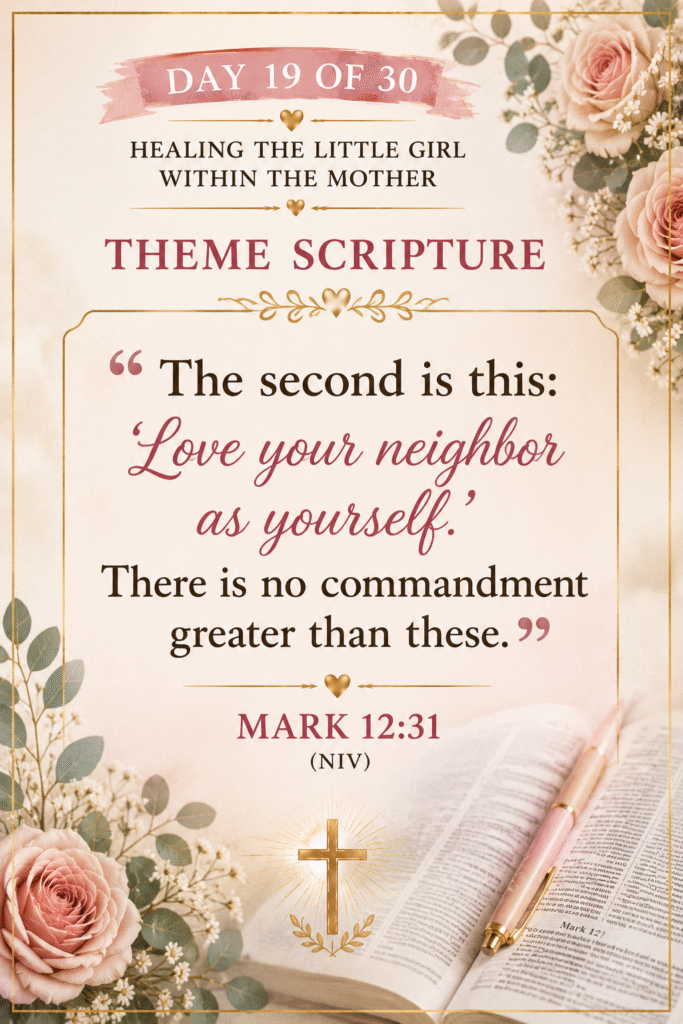
Theme Scripture
“The second is this: ‘Love your neighbor as yourself.’ There is no commandment greater than these.”
— Mark 12:31 (NIV)
Learning That Your Needs Matter Too
For many women, caring for other people comes almost automatically.
You notice when someone is hungry. You notice when the children need something. You notice when your husband is tired. You remember appointments, birthdays, groceries, bills, school schedules, family responsibilities, and all the little things that keep a household moving.
Someone asks, “What does everybody need?” and you probably have an answer.
But what happens when the question becomes: “What do you need?”
For some women, that question is surprisingly difficult. You may know exactly what everyone around you needs while being completely disconnected from your own needs.
Yesterday, we talked about giving yourself permission to rest. Today we’re going deeper, because sometimes the reason we struggle to rest is that somewhere along the way, we learned: Everyone else’s needs matter more than mine.
But Jesus said, “Love your neighbor as yourself.” Those two little words—as yourself—matter.
Jesus did not teach selfishness. But neither did He teach self-erasure.
Today, we’re going to begin learning that caring about your own legitimate needs does not make you selfish. Your needs matter too.
When a Little Girl Learns Not to Need Anything
Children naturally have needs. They need affection, protection, attention, food, comfort, encouragement, guidance, safety, reassurance, consistency, someone to listen, someone to notice, and someone to care.
But what happens when those needs repeatedly go unmet?
Sometimes the child continues asking. But sometimes she adapts. She begins telling herself, “I don’t need anybody.”
Maybe asking for help resulted in disappointment. Maybe expressing emotion brought criticism. Maybe crying was discouraged. Maybe the adults around her had little emotional capacity left for hers.
So she stopped asking. She became independent, responsible, helpful, low-maintenance, and strong.
Underneath those qualities might have been a little girl who quietly concluded: My needs are inconvenient.
That belief can follow her into adulthood.
You May Have Learned to Become the Caregiver
Some women became caregivers long before motherhood.
Maybe you cared for younger siblings. Maybe you tried to emotionally support a parent. Maybe you became the peacekeeper in the family. Maybe you learned how to read everyone’s mood and adjust yourself accordingly.
You became skilled at asking, “Is everybody okay?” But perhaps nobody regularly asked, “Are you okay?”
Caring for others may have become part of your identity. There is something beautiful about being compassionate and nurturing. The problem begins when you believe your role is always to give and never to need.
That isn’t sustainable, and it isn’t what healthy love looks like.
Selflessness and Self-Neglect Are Not the Same
Christian women sometimes struggle with this because we are taught the importance of sacrifice—and rightly so.
Jesus modeled sacrificial love. Scripture teaches generosity, humility, service, compassion, and putting others before ourselves.
But there is an important difference between selflessness and self-neglect.
Selflessness says, “I am willing to sacrifice when love requires it.”
Self-neglect says, “My needs never matter.”
Selflessness is an intentional act of love. Self-neglect becomes a pattern of abandoning yourself.
Chronic self-neglect eventually produces exhaustion, resentment, burnout, and sometimes anger toward the very people we are trying to love.
Jesus Included “Yourself”
Mark 12:31 says, “Love your neighbor as yourself.”
Jesus did not say, “Love your neighbor and hate yourself.” He did not say, “Care for your neighbor while pretending you have no needs.”
The command assumes an appropriate understanding of caring for oneself.
This does not mean self-centeredness. It means recognizing that you, too, are a person created in God’s image.
Your neighbor matters. Your husband matters. Your children matter. Your friends matter.
And you matter.
Your Needs Are Not the Same as Your Wants
Learning that your needs matter doesn’t mean every desire must immediately be fulfilled. Maturity requires discernment.
There are wants, and there are genuine needs.
You may want an expensive vacation, but what you actually need may be rest. You may want everyone to leave you alone forever, but what you may actually need is a quiet afternoon.
Learning to care for yourself means becoming curious about what is happening beneath the surface.
Instead of automatically ignoring discomfort, ask: “What is this telling me?”
Your Body Has Needs
Your body communicates constantly: hunger, thirst, fatigue, tension, pain, restlessness, the need for movement, and the need for sleep.
Women can become so busy caring for everyone else that they ignore their bodies. You skip meals, delay drinking water, stay awake too late, push through exhaustion, and keep going because someone needs something.
Your body is not an inconvenience attached to your responsibilities. It is part of the life God has entrusted to you.
Caring for it is not vanity. It is stewardship.
Your Emotional Needs Matter
Physical needs are often easier to acknowledge than emotional ones. But emotional needs matter too.
Maybe you need encouragement, reassurance, affection, connection, a conversation, space, understanding, to be heard, to cry, to laugh, to feel appreciated, or to process disappointment.
None of these make you weak.
Sometimes emotional exhaustion comes because we continually dismiss what we’re feeling.
You can be grateful and still be hurting. You can love your life and still need support. You can trust God and still experience disappointment. Two things can be true at once.
Your Spiritual Needs Matter
There is another need mothers sometimes neglect: time with God that isn’t rushed.
There is value in talking to God throughout your busy day. But there is also something precious about intentional time in His presence.
Sometimes what your soul needs is quiet, prayer, worship, Scripture, journaling, sitting still, crying before God, and listening.
Not performing. Not producing. Simply being with Him.
You Are Allowed to Ask for Help
Sometimes acknowledging a need means allowing someone else to meet it. That requires vulnerability.
You may need to say, “Can you help me with dinner tonight?” “I need someone to listen.” “I’m overwhelmed.” “I need a break.” “Would you pray for me?”
Asking does not guarantee that everyone will respond perfectly. But refusing to communicate your needs guarantees that people may not know they exist.
Sometimes healthy communication begins with giving someone the opportunity to show up for you.
Stop Expecting People to Know What You Never Said
Sometimes we silently hope someone will notice.
We think: They should know I’m tired. They should see I need help. They should know that hurt me.
And sometimes people should be more attentive. But healthy relationships still require communication.
Unspoken expectations can quietly become resentment.
Healing may require replacing silent resentment with honest communication: “I need help with this. Can you take care of it?”
That is not weakness. That is clarity.
You Don’t Need Permission From Everyone
Sometimes we know exactly what we need, but we wait for someone else to approve it.
Permission to rest. Permission to say no. Permission to step away. Permission to spend a little time alone. Permission to pursue something meaningful. Permission to protect our peace. Permission to heal.
You may never receive unanimous approval.
Healing sometimes means recognizing: Other people’s disappointment does not automatically mean you made the wrong decision.
Boundaries Help Protect Legitimate Needs
Your voice becomes especially important when protecting your needs.
Maybe you need to say, “I can’t do that today.” “I need some quiet.” “I need time to think before answering.” “I won’t be available this weekend.” “I need you to speak to me respectfully.”
A boundary is not punishment. It is information.
It communicates: This is where my capacity ends.
Healthy people have limits.
You Don’t Have to Explain Every No
Some women give a long explanation every time they decline something because “no” feels mean.
Sometimes an explanation is appropriate. But sometimes, “I’m sorry, I won’t be able to do that,” is enough.
You don’t need a courtroom argument to prove that your capacity matters.
Caring for Yourself Can Make You More Present
There is a myth that taking care of yourself means taking something away from your family. Sometimes the opposite is true.
Rest can make you more patient. Quiet can make you less irritable. Eating properly can improve your energy. Setting boundaries can reduce resentment. Time with God can restore perspective. Asking for help can create partnership.
When you care for yourself appropriately, you can often offer your family a healthier version of you.
The Goal Is Not to Put Yourself First in Everything
Healing is not about moving from “Everyone matters except me” to “Nobody matters except me.”
Both are unhealthy.
There will be seasons when someone else’s needs genuinely require sacrifice. Love sometimes costs us something.
But temporary sacrifice and chronic self-erasure are not the same.
The goal is not: Me first.
The goal is: I matter too.
Debbie’s Reflection
For a long time, being responsible felt normal to me.
When you learn responsibility early, you become very good at noticing what needs to be done. You don’t always wait for someone to ask. You handle it. You solve it. You take care of it.
And when you become a mother, that instinct can become even stronger. There is always someone to think about, something to prepare, something to remember, or something to fix.
It can become easy to put yourself at the bottom of the list—sometimes so far down that you forget you’re even on it.
But God has been teaching me that caring for myself does not mean I care less about my family.
I can love my family deeply and still acknowledge: I’m tired. I need help. I need quiet. I need prayer. I need rest. I need time with God. I need something that brings me joy.
Those needs don’t make me selfish. They make me human.
The little girl within me learned how to keep going. She learned how to survive. She learned how to take care of what needed taking care of.
But the woman God is healing is learning to turn toward that little girl and ask: “What do you need?”
Sometimes she needs reassurance. Sometimes she needs rest. Sometimes she needs to know she is safe. Sometimes she needs permission to enjoy life.
Sometimes she simply needs to hear: “You matter too.”
Ask Yourself What You Need Before You Become Overwhelmed
One powerful practice is checking in with yourself regularly.
Ask: What do I need today?
Maybe the answer is practical: water, food, sleep, or completing something important.
Maybe it’s emotional: encouragement, a cry, a conversation, or quiet.
Maybe it’s relational: asking for help, having an honest conversation, or setting a boundary.
Maybe it’s spiritual: prayer, Scripture, worship, or sitting quietly before God.
Recognizing a need doesn’t mean it must immediately be met exactly how you want. But naming it helps you respond wisely instead of waiting until everything becomes overwhelming.
Teach Your Children That Their Needs Matter Too
When you begin honoring healthy needs, you can teach your children to do the same.
Help them learn the difference between wants and needs. Teach them to express feelings respectfully, that needing help is okay, to rest, to communicate, and to have boundaries.
And let them see you practicing those same things.
You are showing them: We care for others, and we care for ourselves. We serve, and we rest. We give, and we receive. We love people without abandoning ourselves.
That is a healthy legacy.
God Cares About What You Need
Sometimes we become so accustomed to minimizing ourselves that we unconsciously bring the same attitude into prayer.
We pray for everyone else, and all of that is beautiful. But God also wants you to come—with your fears, needs, disappointments, questions, weariness, desires, tears, and hopes.
You are not bothering Him. You are His daughter.
You can simply say: “Father, this is what I need today.”
And trust Him with the answer.
Reflection Questions
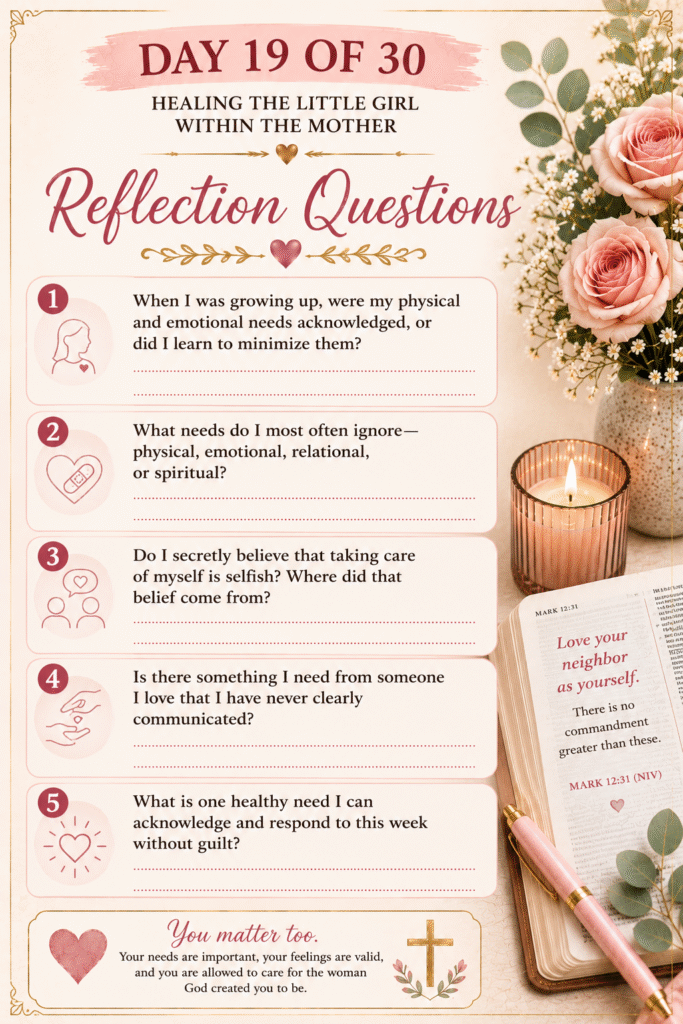
- When I was growing up, were my physical and emotional needs acknowledged, or did I learn to minimize them?
- What needs do I most often ignore—physical, emotional, relational, or spiritual?
- Do I secretly believe that taking care of myself is selfish? Where did that belief come from?
- Is there something I need from someone I love that I have never clearly communicated?
- What is one healthy need I can acknowledge and respond to this week without guilt?
Closing Prayer
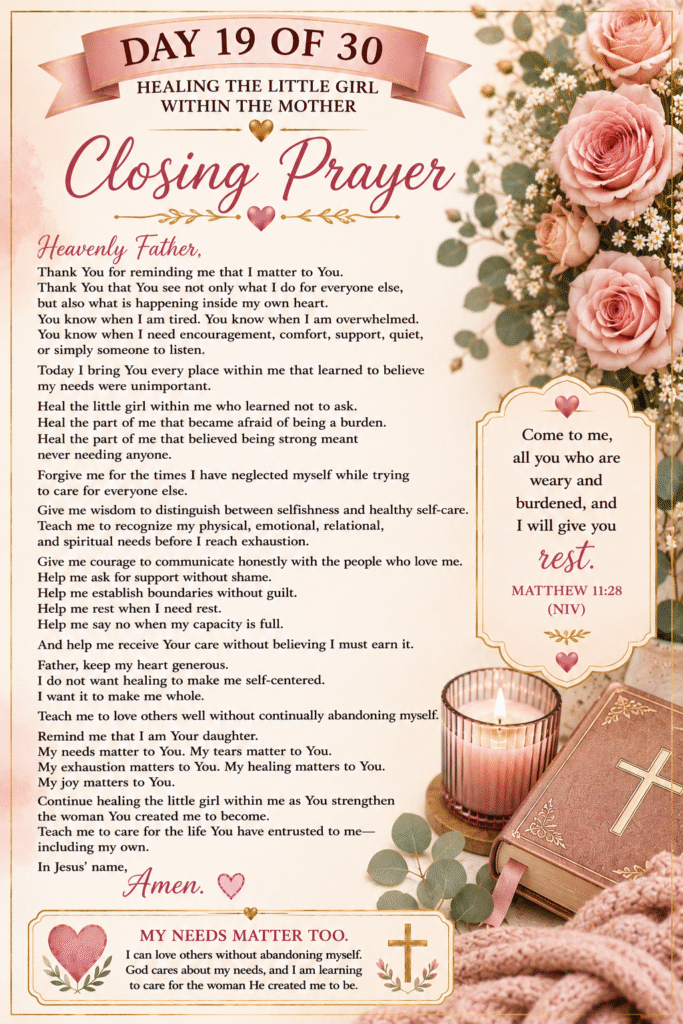
Heavenly Father,
Thank You for reminding me that I matter to You.
Thank You that You see not only what I do for everyone else, but also what is happening inside my own heart.
You know when I am tired. You know when I am overwhelmed. You know when I need encouragement, comfort, support, quiet, rest, or simply someone to listen.
Today I bring You every place within me that learned to believe my needs were unimportant.
Heal the little girl within me who learned not to ask. Heal the part of me that became afraid of being a burden. Heal the part of me that believed being strong meant never needing anyone.
Forgive me for the times I have neglected myself while trying to care for everyone else.
Give me wisdom to distinguish between selfishness and healthy self-care.
Teach me to recognize my physical, emotional, relational, and spiritual needs before I reach exhaustion.
Give me courage to communicate honestly with the people who love me. Help me ask for support without shame. Help me establish boundaries without guilt. Help me rest when I need rest. Help me say no when my capacity is full.
Father, keep my heart generous. I do not want healing to make me self-centered. I want it to make me whole.
Teach me to love others well without continually abandoning myself.
Remind me that I am Your daughter. My needs matter to You. My tears matter to You. My exhaustion matters to You. My healing matters to You. My joy matters to You.
Continue healing the little girl within me as You strengthen the woman You created me to become.
Teach me to care for the life You have entrusted to me—including my own.
In Jesus’ name,
Amen.
Today’s Affirmation
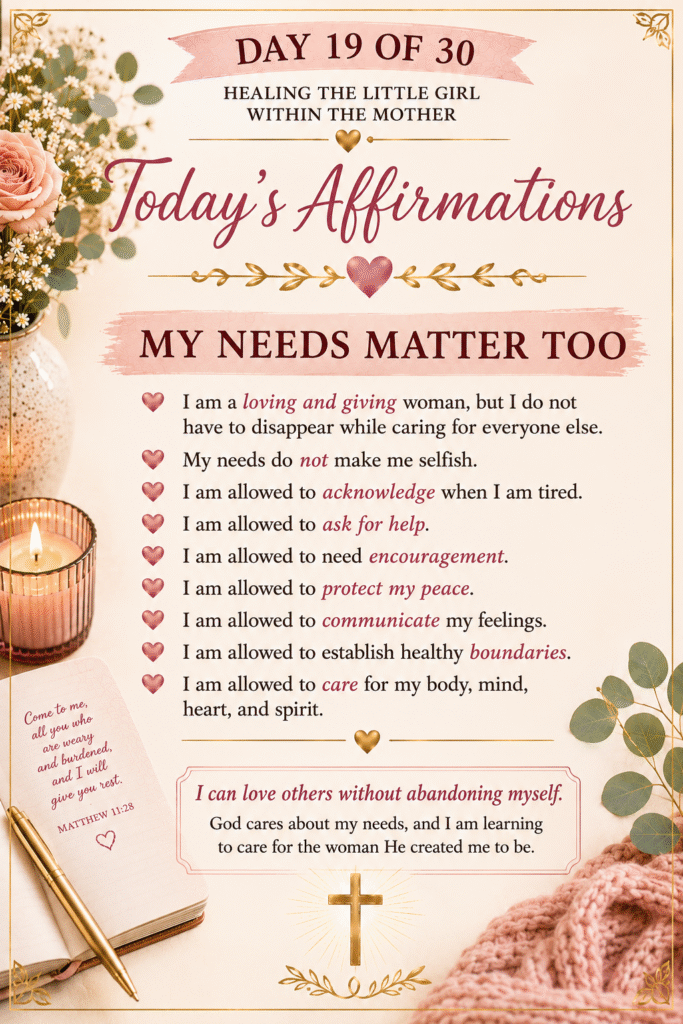
MY NEEDS MATTER TOO
I am a loving and giving woman, but I do not have to disappear while caring for everyone else.
My needs do not make me selfish.
I am allowed to acknowledge when I am tired. I am allowed to ask for help. I am allowed to need encouragement. I am allowed to protect my peace. I am allowed to communicate my feelings. I am allowed to establish healthy boundaries.
I am allowed to care for my body, mind, heart, and spirit.
I can love others without abandoning myself.
God cares about my needs, and I am learning to care for the woman He created me to be.
Journal Prompt
At the top of today’s page, write: “What Do I Need?”
Create four sections: Physical, Emotional, Relational, and Spiritual.
Under Physical, ask: What does my body need? Perhaps rest, water, nourishing food, movement, sleep, appropriate medical care, or quiet.
Under Emotional, ask: What does my heart need? Perhaps encouragement, comfort, permission to cry, joy, laughter, reassurance, or space to process something.
Under Relational, ask: What do I need from the people around me? Perhaps help, honest communication, affection, support, a boundary, an apology, time together, or time alone.
Under Spiritual, ask: What does my soul need? Perhaps prayer, Scripture, worship, quiet time with God, surrender, forgiveness, or community.
Then circle one need you can realistically address today.
Write underneath it: “Acknowledging my needs does not make me selfish. It helps me care for the life God has entrusted to me.”
Finish by writing three things you are grateful for today.
Today’s Healing Challenge
Today, before automatically saying, “I’m fine,” pause.
Ask yourself: “What do I actually need?”
Then respond to one legitimate need in a healthy way.
Maybe that means drinking water instead of continuing to rush. Maybe it means asking your husband or family member for help. Maybe it means going to bed earlier. Maybe it means spending thirty quiet minutes with God. Maybe it means declining something you don’t have capacity for.
One need. One intentional response. No guilt.
A Truth to Carry With You Today
For years, you may have asked: “What does everyone else need?”
That question reflects something beautiful about your heart. You care. You nurture. You give. You notice people.
Don’t lose that.
But perhaps God is adding another question: “Daughter, what do you need?”
Not because He wants you to become selfish. Because He wants you to become whole.
The little girl within you may have learned that being low-maintenance kept her safe. She may have believed that being useful made her lovable.
But today, remind her: You don’t have to earn the right to have needs.
You are allowed to need rest. You are allowed to need love. You are allowed to need help. You are allowed to need comfort. You are allowed to need boundaries. You are allowed to need quiet. You are allowed to need God.
And you are allowed to say: “I matter too.”
You can love generously without disappearing. You can serve faithfully without destroying yourself. You can care deeply without carrying everyone.
Your needs matter too.
Tomorrow – Day 20
Releasing the Need to Always Be Strong
Theme Scripture: “My grace is sufficient for you, for my power is made perfect in weakness.” — 2 Corinthians 12:9 (NIV)
Tomorrow we will talk about the pressure to always be “the strong one”—the woman everyone depends on, the woman who keeps going, and the woman who says she’s fine even when she’s hurting.
Healing teaches us that strength does not mean never needing help, never crying, or never feeling overwhelmed.
The little girl within you may have learned: “I have to be strong because nobody is coming to rescue me.”
But the woman God is healing is learning: “I don’t have to be strong every moment. God’s strength is enough for me.”

1 Comment
[…] Healing the Little Girl Within the Mother […]