
Day 14 – Learning to Protect Your Peace
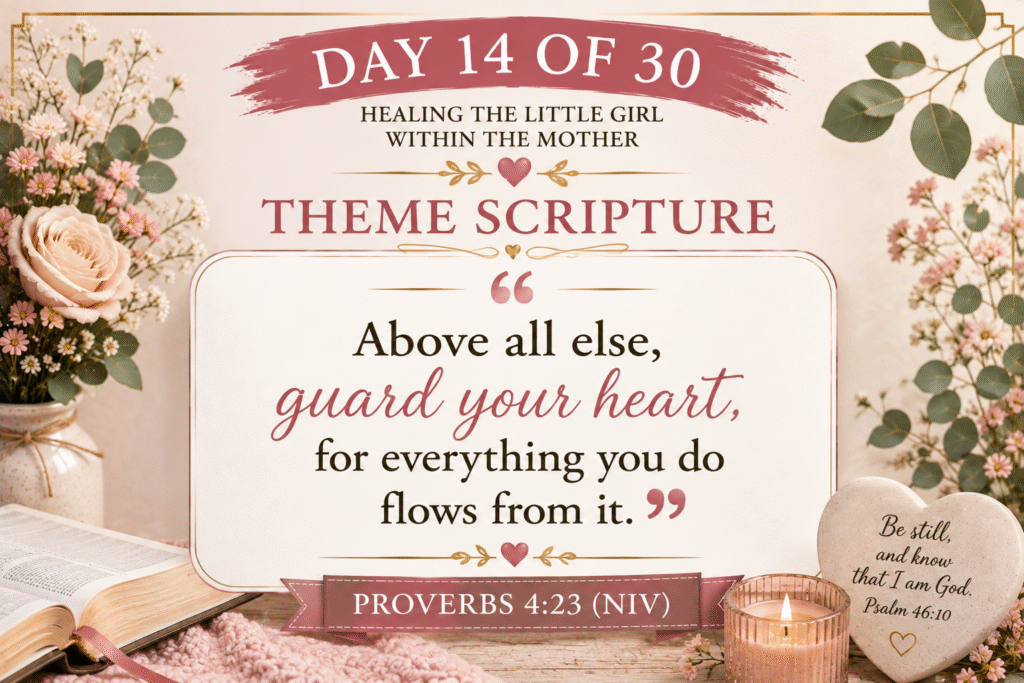
Theme Scripture
“Above all else, guard your heart, for everything you do flows from it.”
— Proverbs 4:23 (NIV)
Learning to Protect Your Peace
There comes a point in healing when you realize something important:
You cannot keep asking God to heal wounds while continually giving people, situations, and unhealthy patterns permission to reopen them.
Healing requires tenderness.
But healing also requires wisdom.
For many women—especially women who learned from childhood to keep everyone happy—the idea of protecting your peace can feel uncomfortable.
You may wonder:
Am I being selfish?
Shouldn’t Christians always forgive?
What if they think I’ve changed?
What if setting this boundary hurts someone’s feelings?
What if saying no makes me a bad person?
So instead of protecting the heart God is restoring, you continue allowing unlimited access.
You answer every phone call.
You respond to every demand.
You explain every decision.
You tolerate disrespect.
You remain in conversations that leave you emotionally exhausted.
You carry problems that were never yours to solve.
You keep saying yes when your body, mind, and spirit desperately need rest.
And then you wonder why peace feels so difficult to maintain.
Today’s Scripture gives us a different instruction:
“Above all else, guard your heart.”
God is not telling you to harden your heart.
He is teaching you to guard it.
There is a difference.
Guarding Your Heart Is Not Closing Your Heart
When someone has experienced deep hurt, it can be tempting to build walls.
Walls say:
“Nobody will ever hurt me again because nobody will ever get close enough.”
But boundaries say:
“I can love people while exercising wisdom about the access they have to my life.”
A wall keeps everyone out.
A boundary determines what is healthy.
A wall is often built from fear.
A healthy boundary is built from wisdom.
God doesn’t want your heart to become cold, suspicious, or unreachable.
He wants your heart to remain tender toward Him while becoming wiser about what you allow to influence it.
You can be loving and discerning.
Compassionate and boundaried.
Forgiving and wise.
Softhearted and strong.
Those things can coexist.
The Little Girl Who Learned to Keep the Peace
Some children learn very early how to read a room.
They notice facial expressions.
Tone of voice.
Body language.
Footsteps.
Silence.
Mood changes.
They learn who is angry before anyone says a word.
They learn when to disappear.
When to become quiet.
When to make someone laugh.
When not to ask for anything.
When to pretend everything is fine.
A child living in an unpredictable environment may become extremely skilled at managing everyone else’s emotions.
And that little girl may grow into a woman who believes:
“It is my responsibility to make sure everyone is okay.”
She becomes the fixer.
The rescuer.
The mediator.
The dependable one.
The person everyone calls when something goes wrong.
She knows how everyone else feels.
But sometimes she has no idea what she feels.
Because she has spent so much of her life monitoring everyone else’s emotional temperature that she has forgotten how to check her own.
Peacekeeping Is Not Always Peace
There is an important difference between keeping people happy and living in genuine peace.
Sometimes what we call peace is actually avoidance.
We don’t address disrespect because we don’t want an argument.
We don’t establish boundaries because someone might become upset.
We don’t speak honestly because we fear rejection.
We allow the same unhealthy behavior repeatedly because confronting it feels uncomfortable.
Everything may look peaceful from the outside.
But inside, resentment is growing.
Anxiety is growing.
Exhaustion is growing.
Frustration is growing.
That isn’t peace.
That is silence purchased at the expense of your emotional well-being.
Real peace sometimes requires difficult conversations.
Real peace sometimes requires saying no.
Real peace sometimes requires distance.
Real peace sometimes requires changing patterns that other people have become comfortable with.
You Are Not Responsible for Everyone’s Emotions
This can be difficult for a recovering people-pleaser to accept.
Someone can be disappointed with your boundary, and your boundary can still be appropriate.
Someone can misunderstand your decision, and your decision can still be wise.
Someone can disagree with you, and you can still be at peace.
Someone can become upset because you said no, and you do not automatically have to change your answer.
You can care about someone’s feelings without assuming responsibility for managing them.
There is a tremendous difference between compassion and emotional responsibility.
Compassion says:
“I care that you’re hurting.”
Unhealthy responsibility says:
“I must fix your feelings, even if doing so requires abandoning myself.”
Healing teaches us the difference.
Your Peace Is Worth Protecting
Peace is not simply the absence of problems.
Biblical peace is deeper.
It is the ability to remain anchored in God even when circumstances are uncertain.
Jesus told His disciples in John 14:27:
“Peace I leave with you; My peace I give you.”
God’s peace is precious.
And because it is precious, we should become intentional about recognizing what repeatedly disrupts it.
Ask yourself:
What conversations consistently leave me emotionally drained?
What environments trigger unhealthy behaviors?
What relationships require me to constantly betray my boundaries?
What habits fill my mind with fear?
What situations keep pulling me back into patterns God is helping me leave?
Not everything that disturbs your peace needs to be removed from your life.
Sometimes discomfort is part of growth.
Sometimes God calls us to difficult conversations and challenging responsibilities.
So protecting your peace does not mean avoiding everything uncomfortable.
It means learning the difference between healthy discomfort that produces growth and unhealthy chaos that continually damages your emotional well-being.
Pay Attention to Patterns
One difficult interaction does not necessarily define a relationship.
People have bad days.
People make mistakes.
We misunderstand one another.
Healthy relationships require patience and grace.
But healing teaches us to notice patterns.
Is someone repeatedly disrespectful?
Do they continually ignore your boundaries?
Do they manipulate you with guilt whenever you say no?
Do they constantly create crises that you are expected to solve?
Do conversations repeatedly become verbally harmful?
Do you constantly leave interactions questioning your worth?
Patterns provide information.
You don’t have to demonize someone to acknowledge that a pattern is unhealthy.
Sometimes wisdom simply says:
“This relationship needs a different boundary.”
Not Everyone Needs the Same Access to You
We sometimes assume that loving people means giving everyone equal access to our lives.
But even Jesus had different levels of relationship.
He ministered to crowds.
He had disciples.
Within the disciples, He had a closer circle.
And He also regularly withdrew to pray.
That tells us something important.
Access and love are not the same thing.
You can love someone without telling them everything.
You can forgive someone without returning the relationship to exactly what it was before.
You can pray for someone without allowing them to repeatedly disrupt your home.
You can wish someone well from a healthy distance.
Forgiveness addresses the condition of your heart.
Reconciliation involves the participation of people.
And restored trust requires evidence of trustworthiness.
Those are not always the same process.
Stop Explaining Every Boundary
Sometimes we explain boundaries because we secretly hope the other person will approve of them.
We think:
If I explain this perfectly, they’ll understand.
So we give five reasons.
Then ten reasons.
Then we defend every reason.
Before long, the boundary has become a debate.
You do not always need to convince another person that your boundary is reasonable.
Sometimes:
“I’m not available for that.”
is enough.
Sometimes:
“I won’t be able to attend.”
is enough.
Sometimes:
“I’m not comfortable discussing that.”
is enough.
Sometimes:
“If the conversation continues in this direction, I’m going to step away.”
is enough.
Your boundary does not require unanimous approval.
Protecting Your Peace May Change Some Relationships
Healing changes relationships.
Not necessarily because you become difficult.
But because you become different.
The woman who once tolerated everything begins speaking up.
The woman who always said yes begins saying:
“Let me think about it.”
The woman who constantly rescued everyone allows adults to handle their own responsibilities.
The woman who accepted disrespect begins ending unhealthy conversations.
The woman who spent years explaining herself stops defending every decision.
Some people will celebrate that growth.
Others may resist it.
Why?
Because your old patterns may have been convenient for them.
Your lack of boundaries may have benefited them.
Your silence may have protected them from accountability.
Your constant availability may have made their lives easier.
So when you change, the relationship may feel different.
That doesn’t automatically mean your healing is wrong.
Sometimes it simply means the relationship is adjusting to a healthier version of you.
Peace in Your Home Matters
As mothers, protecting our peace affects more than ourselves.
The emotional atmosphere we carry often enters our homes with us.
When we continually allow outside drama to consume our emotional energy, our families may receive what is left over.
We may spend all day solving other people’s problems and then have little patience left for the people living under our roof.
We may carry frustration from a phone conversation into dinner.
We may allow someone else’s crisis to occupy our minds while our children are trying to connect with us.
Protecting your peace can therefore become an act of stewardship.
You are guarding the emotional energy you bring into your home.
That doesn’t mean ignoring people who genuinely need help.
It means recognizing that you cannot carry everyone.
Only God can do that.
Sometimes the Boundary Is With Yourself
Not every disturbance comes from another person.
Sometimes we need boundaries with our own habits.
Maybe you need a boundary with social media.
A boundary with constantly checking your phone.
A boundary with comparing yourself to other women.
A boundary with spending.
A boundary with overcommitting.
A boundary with staying awake late when your body needs rest.
A boundary with replaying conversations that cannot be changed.
A boundary with consuming content that repeatedly produces fear.
Sometimes protecting your peace means asking:
“What am I repeatedly allowing into my own mind?”
Proverbs says everything we do flows from the heart.
What we continually consume matters.
Protect Your Peace Without Worshiping Comfort
There is an important balance here.
“Protecting my peace” should never become an excuse to avoid accountability.
Sometimes someone tells us something we need to hear.
Sometimes relationships require uncomfortable conversations.
Sometimes motherhood is noisy and inconvenient.
Sometimes serving others requires sacrifice.
Sometimes obedience to God takes us outside our comfort zone.
So the goal isn’t:
“Anything that makes me uncomfortable must go.”
The goal is:
“I want to protect my heart from unnecessary chaos while remaining open to God’s correction, growth, service, and calling.”
Peace is not the same as comfort.
Sometimes you can feel uncomfortable and still have deep peace because you know you are doing what is right.
Debbie’s Reflection
For a long time, I thought strength meant carrying everything.
Handling everything.
Helping everyone.
Pushing through.
Keeping going.
And when you have spent years surviving difficult things, that can become part of your identity.
You become accustomed to being strong.
But God has been teaching me that strength also knows when to put something down.
Not every burden belongs to me.
Not every problem requires my intervention.
Not every disagreement needs my explanation.
Not everyone needs unlimited access to my thoughts, emotions, time, and energy.
And protecting my peace does not mean that I no longer love people.
It means I am learning to love from a healthier place.
I can pray for someone without carrying what belongs to God.
I can forgive without pretending something did not hurt.
I can be compassionate while still recognizing unhealthy behavior.
I can say no and still be a loving woman.
I can step away from chaos without feeling guilty for choosing peace.
The little girl within me may have learned that keeping everyone else happy helped keep her safe.
But the woman I am today is learning something different:
I do not have to sacrifice my peace to prove my love.
God is teaching me to guard the heart He is healing.
You Don’t Have to Attend Every Argument You’re Invited To
Healing also teaches us that not every disagreement requires participation.
Sometimes someone wants to misunderstand you.
Sometimes someone wants the last word.
Sometimes a conversation has stopped being productive.
The old you may have stayed engaged because you desperately wanted to be understood.
But healing may look like recognizing:
“I have explained myself clearly. Continuing this conversation will not produce anything good.”
Then you stop.
You don’t send the additional paragraph.
You don’t make the additional phone call.
You don’t rehearse the argument for the rest of the evening.
You release it.
There is power in knowing when a conversation is finished.
What Protecting Your Peace Can Look Like
Protecting your peace might mean:
Turning your phone on Do Not Disturb during family time.
Waiting before responding to emotionally charged messages.
Declining invitations when your schedule is already full.
Limiting conversations that repeatedly become unhealthy.
Praying before reacting.
Choosing not to participate in gossip.
Taking breaks from social media.
Creating quiet time with God.
Going to bed instead of staying awake worrying.
Not discussing private matters with people who have proven they cannot handle them responsibly.
Leaving a conversation when someone becomes disrespectful.
Allowing someone else to solve a problem that belongs to them.
And sometimes it simply means saying:
“Lord, this is too heavy for me. I give it back to You.”
The Goal Is Not Isolation—It Is Healthy Connection
Healing should not lead us into a life where nobody can reach us.
God created us for relationship.
Healthy friendships matter.
Community matters.
Marriage matters.
Family matters.
Church community matters.
Wise counsel matters.
Support matters.
The goal is not to become so guarded that love cannot enter.
The goal is to become wise enough to recognize where love, trust, vulnerability, and access belong.
A healed heart can remain open without remaining unprotected.
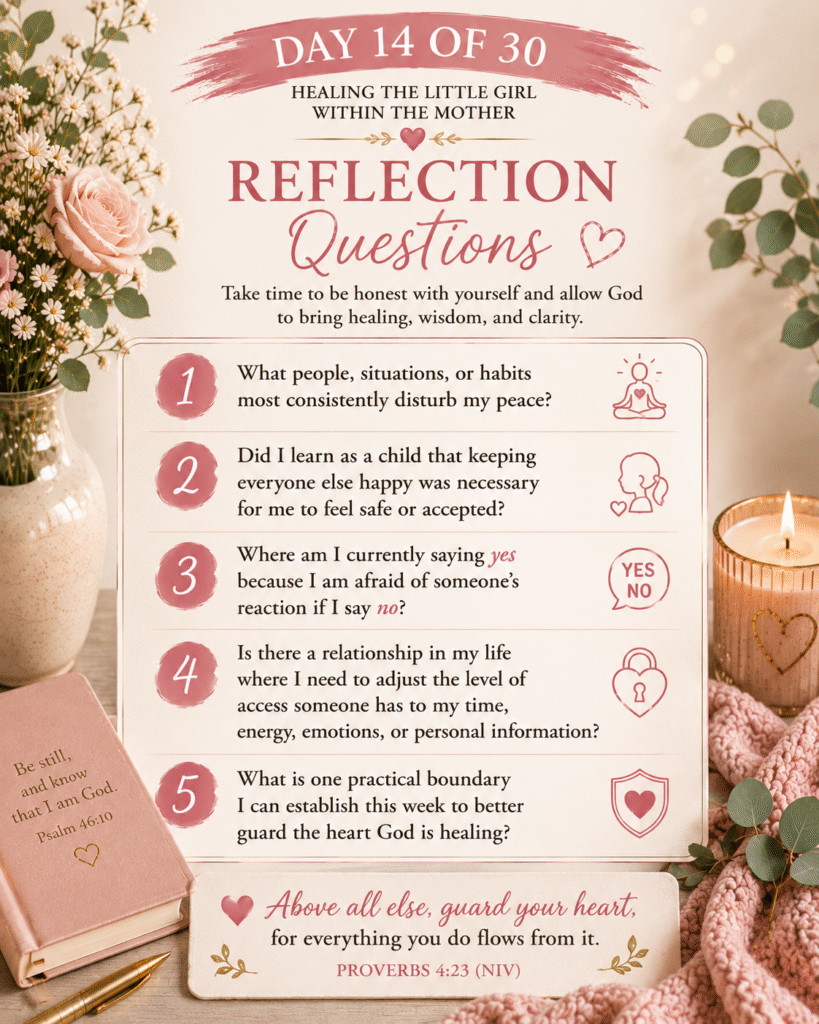
Reflection Questions
- What people, situations, or habits most consistently disturb my peace?
- Did I learn as a child that keeping everyone else happy was necessary for me to feel safe or accepted?
- Where am I currently saying yes because I am afraid of someone’s reaction if I say no?
- Is there a relationship in my life where I need to adjust the level of access someone has to my time, energy, emotions, or personal information?
- What is one practical boundary I can establish this week to better guard the heart God is healing?
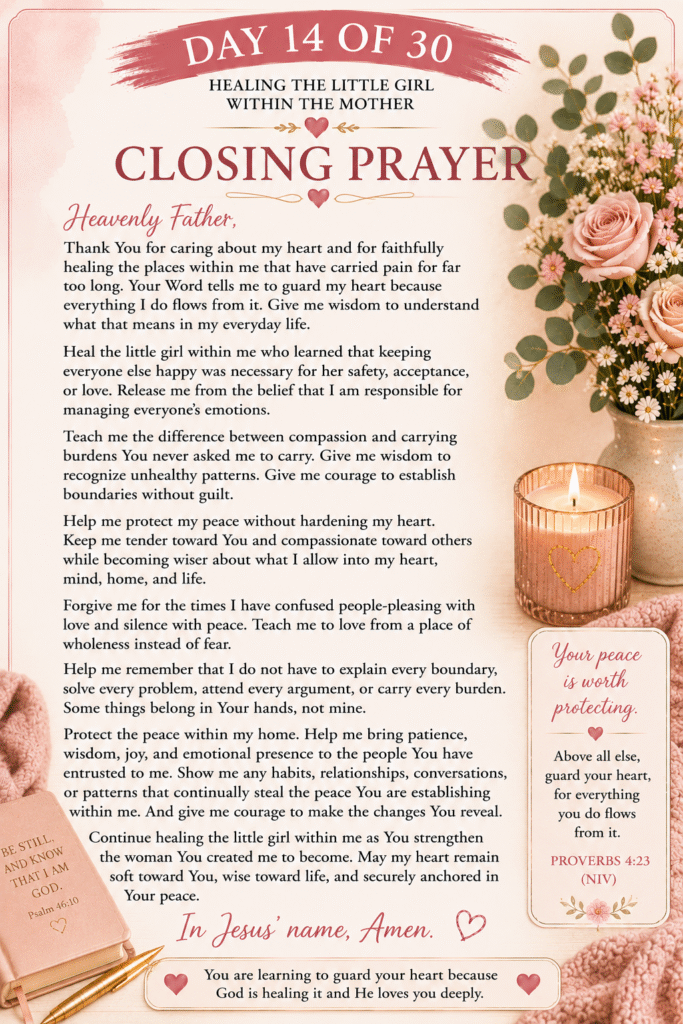
Closing Prayer
Heavenly Father,
Thank You for caring about my heart and for faithfully healing the places within me that have carried pain for far too long.
Your Word tells me to guard my heart because everything I do flows from it.
Give me wisdom to understand what that means in my everyday life.
Heal the little girl within me who learned that keeping everyone else happy was necessary for her safety, acceptance, or love.
Release me from the belief that I am responsible for managing everyone’s emotions.
Teach me the difference between compassion and carrying burdens You never asked me to carry.
Give me wisdom to recognize unhealthy patterns.
Give me courage to establish boundaries without guilt.
Give me discernment to know when I should speak, when I should listen, when I should help, and when I should step away.
Help me protect my peace without hardening my heart.
Keep me tender toward You and compassionate toward others while becoming wiser about what I allow into my heart, mind, home, and life.
Forgive me for the times I have confused people-pleasing with love and silence with peace.
Teach me to love from a place of wholeness instead of fear.
Help me remember that I do not have to explain every boundary, solve every problem, attend every argument, or carry every burden.
Some things belong in Your hands, not mine.
Protect the peace within my home.
Help me bring patience, wisdom, joy, and emotional presence to the people You have entrusted to me.
Show me any habits, relationships, conversations, or patterns that continually steal the peace You are establishing within me.
And give me courage to make the changes You reveal.
Continue healing the little girl within me as You strengthen the woman You created me to become.
May my heart remain soft toward You, wise toward life, and securely anchored in Your peace.
In Jesus’ name,
Amen.
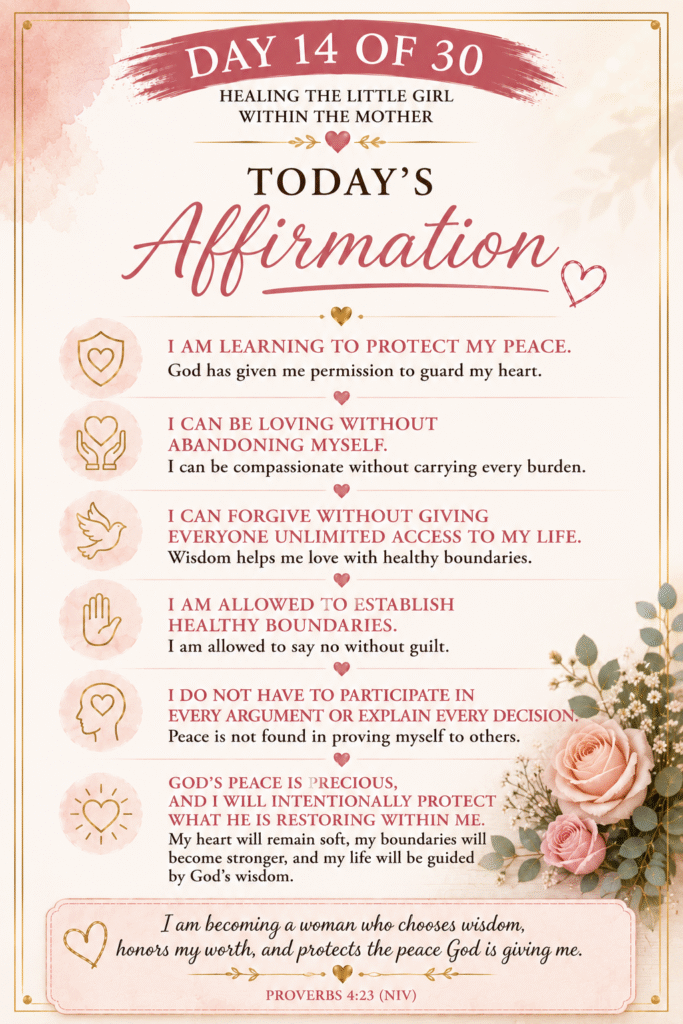
Today’s Affirmation
I AM LEARNING TO PROTECT MY PEACE
God has given me permission to guard my heart.
I can be loving without abandoning myself.
I can be compassionate without carrying every burden.
I can forgive without giving everyone unlimited access to my life.
I am allowed to establish healthy boundaries.
I am allowed to say no without guilt.
I do not have to participate in every argument or explain every decision.
God’s peace is precious, and I will intentionally protect what He is restoring within me.
My heart will remain soft, my boundaries will become stronger, and my life will be guided by God’s wisdom.
Journal Prompt
Today, draw a large heart in the center of your journal page.
Inside the heart, write:
WHAT GOD IS HEALING & I AM LEARNING TO PROTECT
Inside the heart, write the things God is restoring within you.
Perhaps:
My peace
My confidence
My faith
My joy
My emotional health
My relationship with my children
My marriage
My ability to rest
My self-respect
My voice
My relationship with God
Then, outside the heart, write anything that repeatedly threatens those things.
This may include:
Overcommitting.
People-pleasing.
Gossip.
Unhealthy relationships.
Constant comparison.
Social media.
Fear.
Guilt.
Negative self-talk.
Unnecessary arguments.
Taking responsibility for everyone else’s problems.
Then ask:
“What boundary would help protect what God is healing?”
Choose one.
Not ten.
One.
Write your boundary beneath the page:
This week, I will protect my peace by ____________________.
Then pray:
“Lord, give me wisdom and courage to honor this boundary without guilt.”
A Truth to Carry With You Today
You do not need to become cold to become wise.
You do not need to stop loving people to establish boundaries.
You do not need everyone to understand your decisions before you are allowed to make them.
You do not need to answer every call.
Fix every problem.
Explain every boundary.
Respond to every accusation.
Accept every invitation.
Attend every argument.
Or carry every burden.
Some things can simply be released.
The little girl within you may have learned:
“If everyone else is okay, then maybe I will be okay.”
But the woman you are becoming understands:
“God is responsible for being God. I am responsible for faithfully stewarding the life He has given me.”
And that includes your heart.
Your home.
Your time.
Your energy.
Your relationships.
And your peace.
So today, imagine yourself gently placing a hand over your heart.
Not building a wall around it.
Not closing it.
Not hardening it.
Simply guarding it.
And whisper:
“God is healing this heart. I will no longer give everything permission to enter it.”
That is not selfishness.
That is wisdom.
Tomorrow – Day 15
Releasing the Need for Everyone’s Approval
Theme Scripture
“Am I now trying to win the approval of human beings, or of God? Or am I trying to please people?”
— Galatians 1:10 (NIV)
Tomorrow we will reach the halfway point of our 30-day healing journey by confronting one of the deepest habits childhood rejection can create: people-pleasing.
We will explore why approval can become emotionally addictive when love once felt conditional, how fear of rejection keeps us performing for others, and how freedom begins when we understand that our identity is already secure in God.
Because the little girl within you may still be asking:
“Do they like me?”
But the woman God is healing is learning to ask a different question:
“Am I living faithfully before God?”