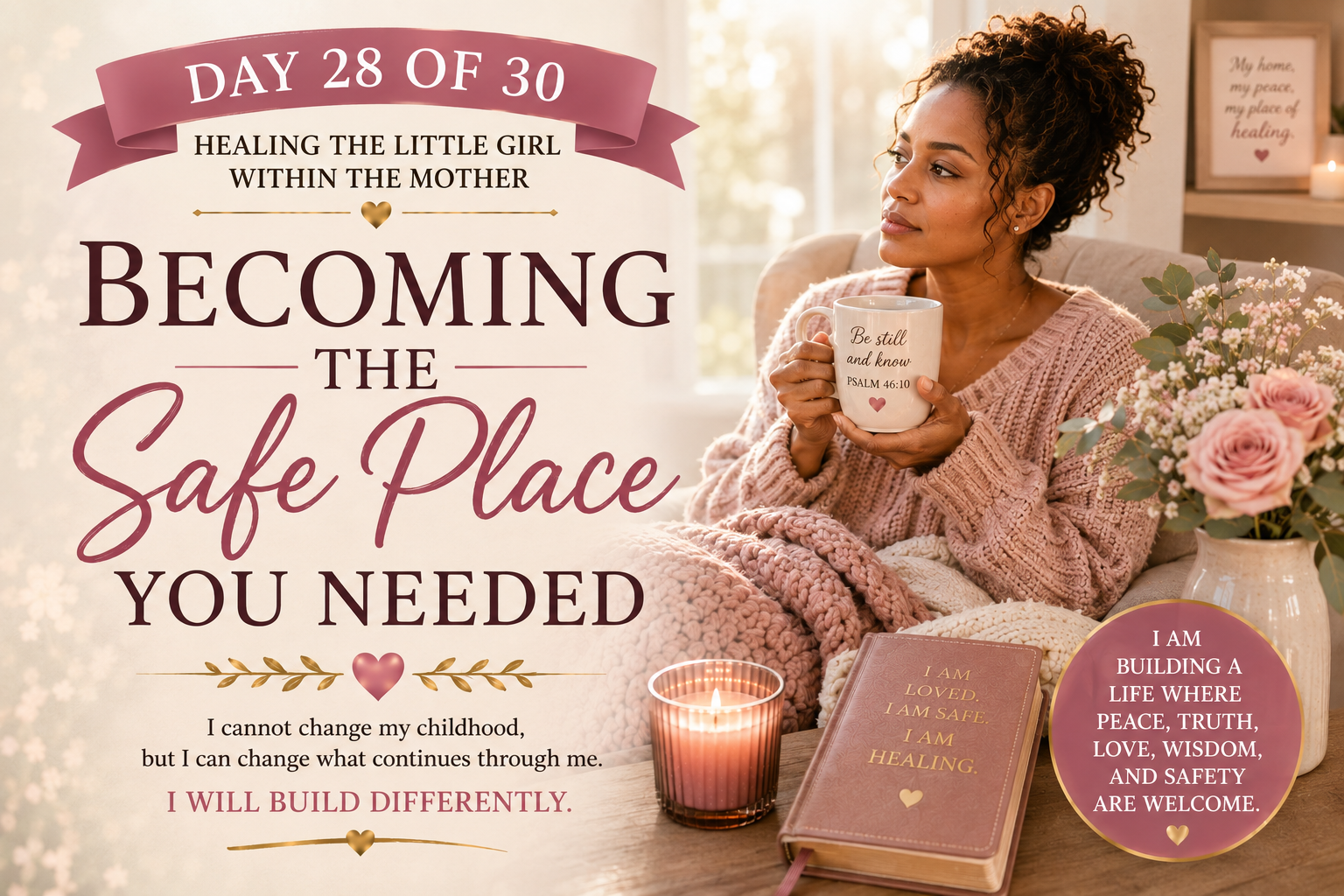
Day 28 of 30 — Becoming the Safe Place You Needed
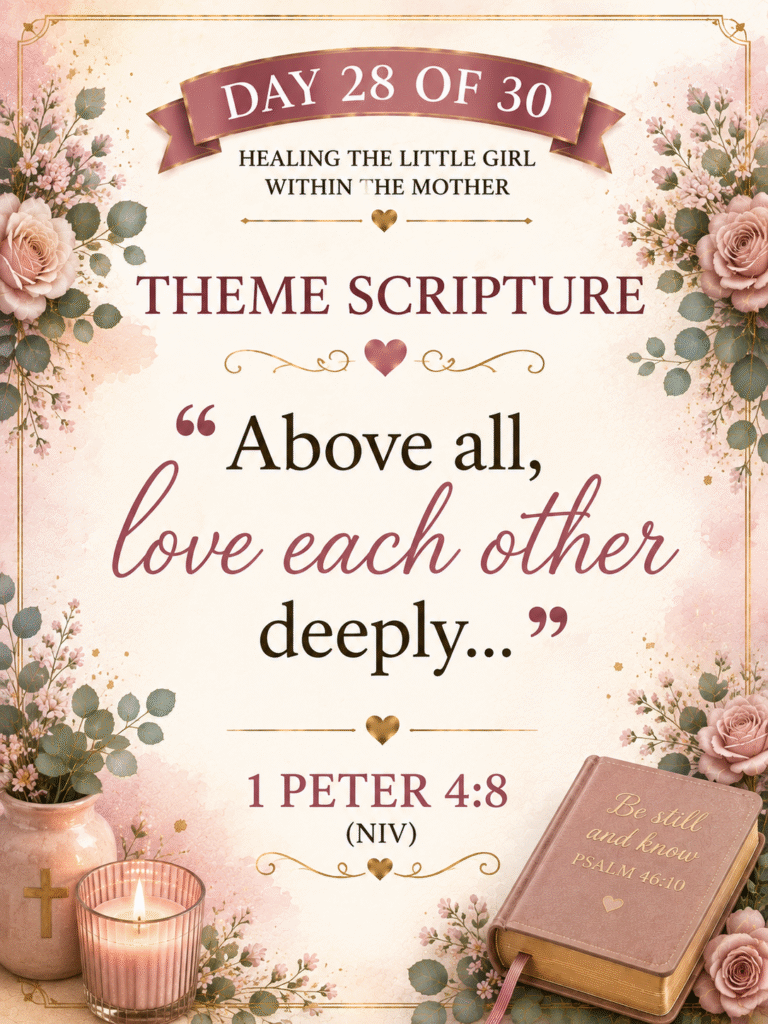
Theme Scripture
“Above all, love each other deeply…”
— 1 Peter 4:8 (NIV)
There comes a point in healing when we begin to recognize something powerful:
I cannot go back and change who was there for the little girl I used to be—but I can decide how I will care for the woman I am today.
Maybe you needed someone to protect you. Someone to listen. Someone to believe you. Someone to notice when you were afraid. Someone to tell you: “You are safe here.”
Perhaps you needed a mother who comforted you instead of dismissing you. A father who was present. An adult who paid attention. A home where you didn’t have to constantly read the room. A place where you could simply be a child.
You cannot travel backward and give yourself another childhood.
But something beautiful can happen as you heal.
You can begin building today what you desperately needed then.
You can create a peaceful home. You can establish boundaries. You can choose healthier relationships. You can learn to speak kindly to yourself. You can stop abandoning yourself to keep other people comfortable.
Yesterday, on Day 27, we talked about learning to receive love without fear.
Today, we’re taking another step.
We are learning to become a safe place for ourselves and the people God has entrusted to us.
Not a perfect place. Not a place where nothing difficult ever happens. But a place where love, truth, boundaries, accountability, compassion, and peace are allowed to live.
What Does It Mean to Become a Safe Place?
Becoming a safe place does not mean you never make mistakes. Safety is not perfection.
Safety is knowing that mistakes can be acknowledged and repaired.
A safe person can say: “I was wrong.” “I’m sorry.” “Tell me what happened.” “I believe you.” “Your feelings matter.” “You can say no.” “Let’s try again.”
Safety is created through patterns: consistency, respect, listening, truth, boundaries, accountability, and love.
The Little Girl Needed Someone to Notice
Sometimes childhood wounds aren’t only about what happened. They’re about what nobody noticed.
Maybe nobody noticed you became quieter. Nobody asked why you didn’t want to be around a certain person. Nobody noticed your anxiety. Nobody recognized that something had changed.
Today, begin practicing something different: Notice yourself.
Notice when you’re exhausted, uncomfortable, overwhelmed, resentful, saying yes while everything inside you is screaming no, or when you need rest or prayer.
Self-awareness is not selfishness. Sometimes it is how we stop abandoning ourselves.
You Can Listen to Yourself Now
Maybe nobody listened when you were little, or perhaps you tried to speak and were dismissed.
Healing means learning to listen again—not assuming every feeling is automatically a fact, but treating your feelings as information worthy of attention.
Ask: “What is this feeling trying to tell me?”
Then pray, think, observe, seek wisdom, and respond intentionally.
Believe Yourself Enough to Investigate
One painful consequence of childhood invalidation is constantly doubting yourself.
Healing does not mean believing every fear unquestioningly. It means believing yourself enough to investigate.
If something concerns you, look closer. Ask questions. Watch patterns. Pray for discernment. Seek wise counsel.
You don’t have to immediately dismiss yourself anymore.
Protection Looks Different When You’re an Adult
As a little girl, protection depended largely upon adults. As an adult, you have more choices.
Protection may now look like setting boundaries, leaving a conversation, ending an unhealthy relationship, managing who has access to your children, seeking help, saying no, speaking up, creating financial stability, and choosing what you tolerate.
You cannot control everything that happens, but you are no longer as powerless as you once were.
Stop Abandoning Yourself to Keep the Peace
Many women who grew up around conflict learned to become peacemakers.
But sometimes what we call keeping the peace is actually self-abandonment.
You swallow your feelings, accept disrespect, say yes when you mean no, avoid difficult conversations, apologize when you did nothing wrong, and take responsibility for everyone’s emotions.
Peace purchased by abandoning yourself isn’t healthy peace.
You can be kind and still honest. You can be loving and still have boundaries. You can forgive and still say: “This cannot continue.”
Your No Can Become Part of Your Safety
Maybe the little girl within you wasn’t allowed to say no.
As an adult, no can become an important word.
“No, I can’t do that.” “No, I’m not comfortable with that.” “No, that doesn’t work for me.” “No, you cannot speak to me that way.”
You don’t need to become harsh. You don’t need to explain every boundary for twenty minutes.
Sometimes “No, thank you” is enough.
Boundaries Are Not Walls Around Your Heart
Walls say: “Nobody gets close.”
Boundaries say: “Healthy people can come close in healthy ways.”
Walls are designed to eliminate vulnerability. Boundaries help make vulnerability safer.
The goal is learning who receives access, how much access they receive, and what behavior is required to maintain that access.
Your Home Can Become What You Needed
Maybe your childhood home was chaotic, fearful, silent, tense, neglectful, or unpredictable.
Your home today does not have to reproduce that atmosphere.
Perhaps in your home people apologize, children can ask questions, prayer is normal, affection is expressed, feelings can be discussed, boundaries are respected, mistakes are corrected without humiliation, laughter is welcome, rest is allowed, and truth is safe.
Your home can become part of your cycle-breaking testimony.
Your Children Need Safety More Than Perfection
Sometimes we become so determined not to repeat our parents’ mistakes that we place impossible expectations upon ourselves.
Your children do not need a mother who never gets anything wrong.
They need a mother who demonstrates what healthy accountability looks like when she does.
When you make a mistake: acknowledge it, apologize, listen, correct what you can, and reconnect.
Let Your Children Have a Voice
Giving children a voice does not mean children run the home. Parents still lead and rules still matter.
But children can be taught that their voice matters.
Ask: “How did that make you feel?” “Did something happen?” “Is there something you want to tell me?” “You can always talk to me.”
When they speak, listen.
Teach Them That Their Body Belongs to Them
Safety also means teaching children appropriate bodily autonomy.
They should know they can tell you if someone’s touch makes them uncomfortable, that inappropriate secrets should be told to a safe adult, and that they will not be punished for telling the truth.
You can teach respect while also teaching: “Your body matters. Your discomfort matters. You can tell me.”
Do Not Let Fear Become Overprotection
When you know how badly children can be hurt, fear may tempt you to control everything.
Your children need protection. They also need age-appropriate independence, wisdom, skills, confidence, discernment, and opportunities to grow.
We are not trying to raise children who are afraid of the world. We are trying to raise children who know how to navigate it wisely.
Become Safe in the Way You Speak to Yourself
You can create a peaceful home for everyone else and still speak brutally to yourself.
Imagine speaking those harsh words to a frightened little girl. You wouldn’t.
Becoming your own safe place includes changing your internal language.
Try: “I made a mistake, but I can correct it.” “I’m overwhelmed. I need a moment.” “I’m learning.” “I deserve compassion too.” “God is still working in me.”
Your inner voice should not become another person the little girl within you has to survive.
Rest Can Be an Act of Safety
Some women only feel valuable when they’re working, serving, helping, producing, or solving.
But safety also means knowing: I am allowed to rest without something terrible happening.
Practice rest. Sit. Breathe. Drink your tea. Read Scripture. Take the nap when appropriate. Enjoy a quiet house.
Rest tells your body: “You don’t have to be on duty every second.”
Keep Promises to Yourself
Trust is built through consistency—even trust in yourself.
Start small. If you say you’re going to drink more water today, do it. If you say you’re going to take 20 quiet minutes, protect them. If you decide a boundary matters, honor it.
Every small promise you keep tells yourself: “I can trust me to care for me.”
Become the Adult Who Checks In
Ask yourself regularly: How am I really doing? What am I feeling? What do I need? Is something bothering me that I keep ignoring? Am I tired? Am I resentful? Am I afraid? Do I need help? Have I prayed about this?
You may have spent years checking on everyone else.
Check on yourself too.
Safety Includes Asking for Help
Becoming a safe place for yourself does not mean doing everything alone.
Sometimes the safest thing you can do is seek support from a trusted friend, pastor, qualified therapist, doctor, financial counselor, support group, mentor, or appropriate safety service.
Wisdom recognizes when a problem requires more support than we can provide ourselves.
Strong women ask for help too.
God Is Still Your Ultimate Refuge
We are not saying: “I am all I need.”
Psalm 46:1 says: “God is our refuge and strength, an ever-present help in trouble.”
You are learning to care for yourself under God’s care.
You are learning to use the wisdom, voice, resources, boundaries, and discernment He has given you.
You do not replace God as your refuge.
Debbie’s Reflection
There is something very emotional about realizing how little you really were.
When you are a child going through difficult things, you don’t necessarily understand how young and vulnerable you are. You just survive.
Then you grow up. You become a mother. And you look at children around the age you were when certain things happened.
And sometimes it hits you: “I was just a little girl.”
That realization can hurt because suddenly you understand how much protection you actually needed.
There were things I should never have had to understand. Things I should never have had to carry. Times when an adult should have stepped in. Times when somebody should have noticed.
For years, part of healing has meant accepting that I cannot go backward and make someone protect that little girl.
But I can do something now.
I can stop abandoning her too.
I can listen when something inside me says, “This doesn’t feel right.” I can set boundaries. I can protect my peace. I can decide who has access to my life. I can create a home where truth can be spoken. I can apologize when I am wrong. I can listen to my children.
The little girl within me has already heard enough harshness. She needs me to say: “I hear you. I believe you. We’re going to pay attention. We’re going to pray. We’re going to use wisdom. We’re going to protect our peace.”
I cannot give myself another childhood.
But with God’s help, I can build a different adulthood.
I can build a different home. I can create different traditions. I can respond differently to my children. I can choose differently in my relationships.
Every time I do, I am telling that little girl: “What happened to you mattered—but it does not get to decide everything that happens through you.”
You Can Become a Safe Place Without Becoming Your Own Savior
Healing culture sometimes talks about becoming everything you ever needed. But there are things only God can provide.
You cannot heal every wound through willpower, control every outcome, or protect yourself from every future disappointment.
God remains your Father, refuge, healer, provider, and guide.
Becoming a safe place means partnering with the wisdom God gives you and becoming a better steward of your heart, body, home, relationships, responsibilities, and peace.
You Are Allowed to Change the Rules
Maybe your family had unspoken rules: We don’t talk about that. Adults are never wrong. Children don’t have opinions. Keep everyone happy. Family gets unlimited access no matter how they behave.
Healing may require changing those rules.
Your new family rules might become: We tell the truth. We apologize when we’re wrong. We protect children. We respect boundaries. We ask for help. We pray about hard things. We don’t use love to manipulate. We do not protect appearances at the expense of people.
That is how family culture changes.
Your Peace Deserves Protection
Not everyone deserves unlimited access to you—your phone, home, time, emotions, children, personal information, or energy.
Access should correspond with trust.
You can love people and still limit access. You can pray for people and still have boundaries. You can forgive people and still recognize: “This relationship needs distance.”
Protecting your peace is about becoming intentional.
Safety Also Means Allowing Joy
If you spent years surviving, you may think safety only means avoiding danger.
But safety also creates room for joy.
Laughing loudly. Dancing in the kitchen. Cooking something special. Decorating your home. Playing music. Having family movie night. Taking photographs. Celebrating birthdays. Praying together. Enjoying quiet mornings. Creating traditions.
Healing isn’t only about removing pain.
It is also about making room for beauty.
You Don’t Have to Wait Until You’re Fully Healed
You can start building safety while you’re still healing.
You can establish a boundary today. Speak kindly to yourself today. Apologize today. Rest today. Listen to your child today. Pray over your home today. Ask for help today.
You don’t need to become the finished version of yourself before you begin living differently.
Healing and rebuilding can happen together.
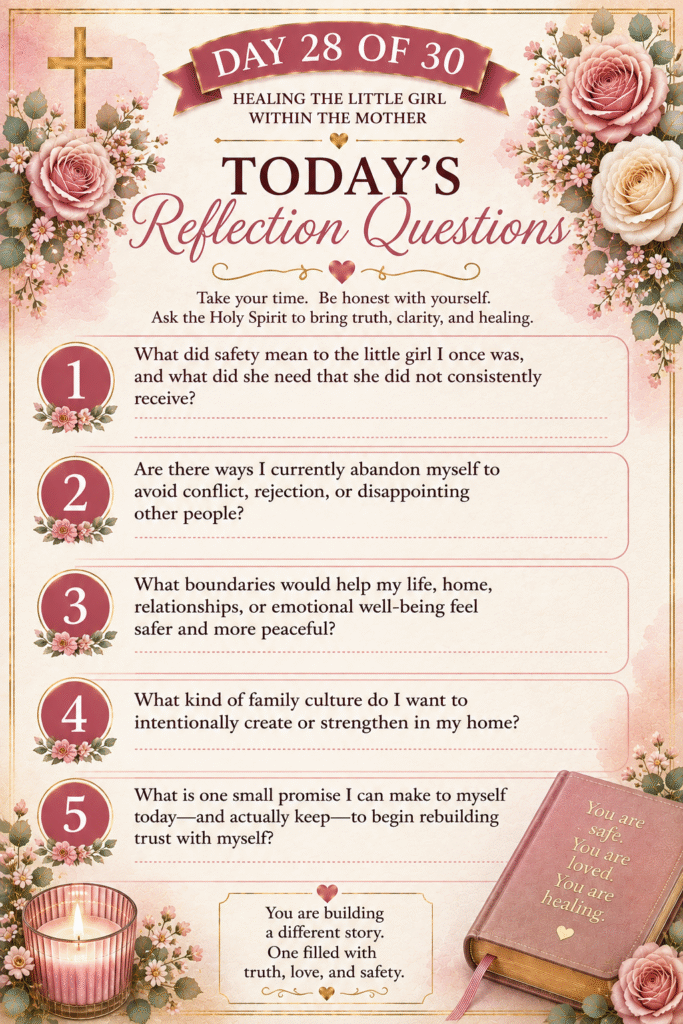
Reflection Questions
- What did safety mean to the little girl I once was, and what did she need that she did not consistently receive?
- Are there ways I currently abandon myself to avoid conflict, rejection, or disappointing other people?
- What boundaries would help my life, home, relationships, or emotional well-being feel safer and more peaceful?
- What kind of family culture do I want to intentionally create or strengthen in my home?
- What is one small promise I can make to myself today—and actually keep—to begin rebuilding trust with myself?
Closing Prayer
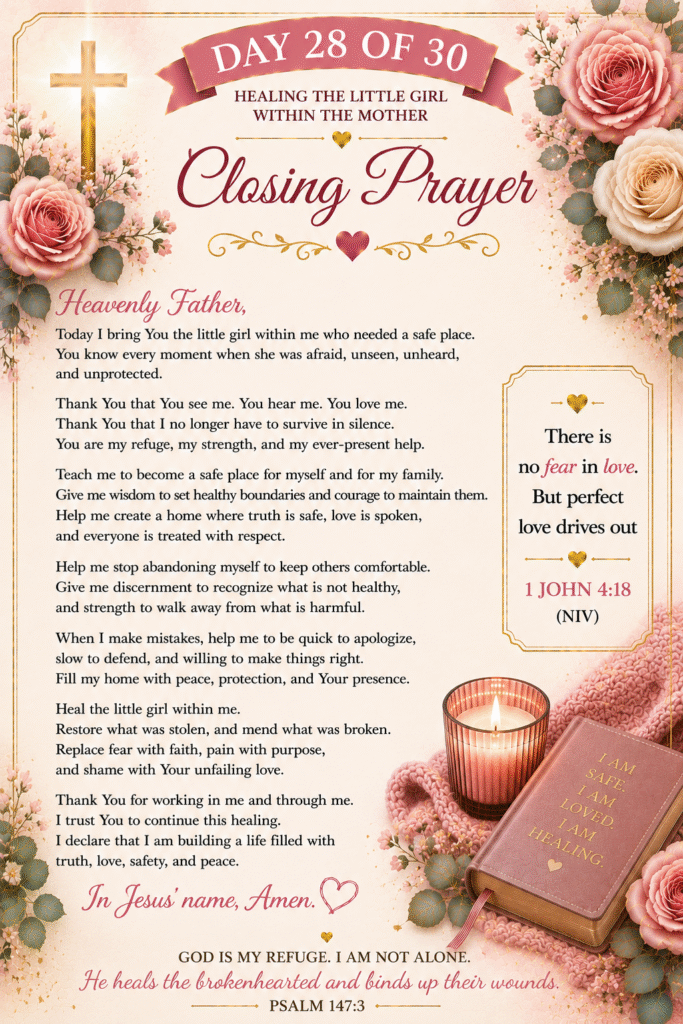
Heavenly Father,
Today I bring You the little girl within me who needed a safe place.
You know every moment when she was afraid. Every moment when she needed someone to notice, protect, listen, believe, comfort, or defend her.
Father, I cannot return to those years. I cannot change the people who failed me. I cannot rewrite what happened.
But I ask You to help me build differently now.
Teach me to become a woman who listens to herself instead of constantly dismissing herself. Give me discernment to recognize danger without allowing fear to control my life. Give me courage to establish boundaries.
Help me stop abandoning myself simply to keep other people comfortable.
Father, make my home a place of peace. Let truth be safe here. Let children be heard here. Let apologies happen here. Let boundaries be respected here. Let prayer fill this home. Let laughter live here. Let affection be expressed here. Let mistakes be corrected without humiliation.
Teach me to speak kindly to myself. The little girl within me has already heard enough harsh words. Let my own voice become one she no longer has to fear.
When I am tired, help me rest. When I need help, give me courage to ask. When something feels wrong, give me wisdom to investigate instead of immediately dismissing myself.
Most importantly, remind me that I am not my own savior.
You are my refuge. You are my protector. You are my source. You are my Father.
Today, I declare:
My past will not determine the atmosphere of my future.
I will build differently.
I will love differently.
I will speak differently.
I will protect differently.
I will respond differently.
And when I don’t get it right, I will return to You, make repairs, receive grace, and try again.
Father, heal the little girl within me.
And teach the woman I am becoming how to create a life where peace, truth, love, wisdom, and safety can grow.
In Jesus’ name,
Amen.
Today’s Affirmations
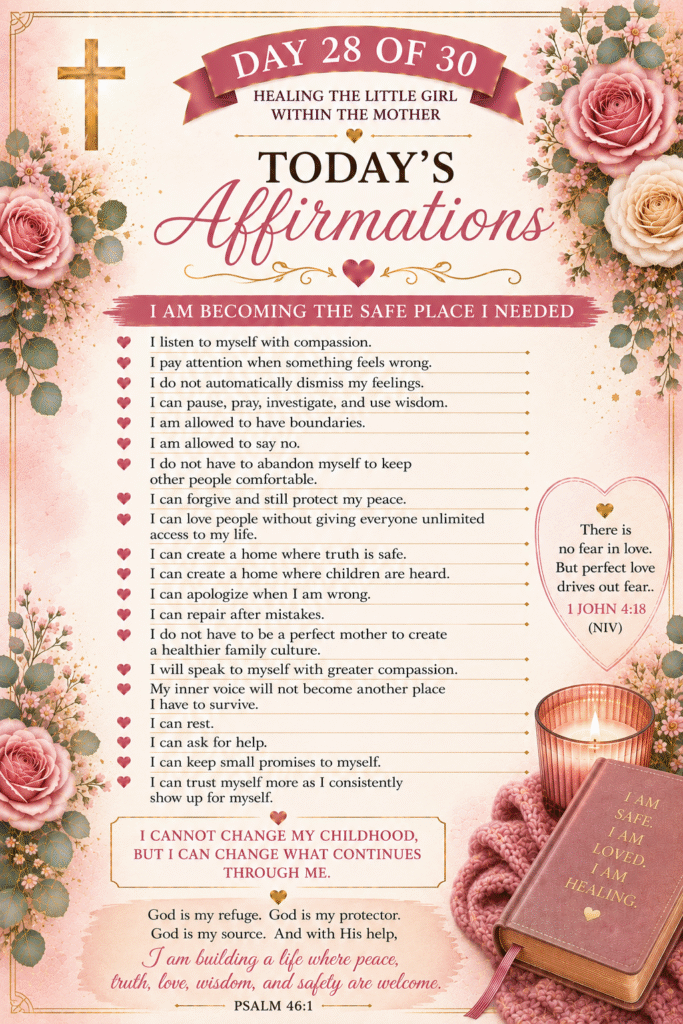
I AM BECOMING THE SAFE PLACE I NEEDED
I listen to myself with compassion.
I pay attention when something feels wrong.
I do not automatically dismiss my feelings.
I can pause, pray, investigate, and use wisdom.
I am allowed to have boundaries.
I am allowed to say no.
I do not have to abandon myself to keep other people comfortable.
I can forgive and still protect my peace.
I can love people without giving everyone unlimited access to my life.
I can create a home where truth is safe.
I can create a home where children are heard.
I can apologize when I am wrong.
I can repair after mistakes.
I do not have to be a perfect mother to create a healthier family culture.
I will speak to myself with greater compassion.
My inner voice will not become another place I have to survive.
I can rest.
I can ask for help.
I can keep small promises to myself.
I can trust myself more as I consistently show up for myself.
I cannot change my childhood, but I can change what continues through me.
God is my refuge.
God is my protector.
God is my source.
And with His help:
I am building a life where peace, truth, love, wisdom, and safety are welcome.
Journal Prompt — Creating My Safe Place
At the top of today’s journal page, write: “The Safe Place I Am Building”
Complete these statements:
As a little girl, I felt safest when…
I felt unsafe when…
I wish an adult had noticed…
I wish someone had told me…
Today, I feel safest when…
One boundary I need is…
One thing I need to stop tolerating is…
One way I can speak more kindly to myself is…
One way I can make my home feel more peaceful is…
Now create two sections: “What Stops With Me” and “What Begins With Me.”
Finish today’s journal entry by writing:
“I cannot rewrite where I came from, but with God’s help, I can become intentional about what grows from me.”
Today’s Healing Challenge — Create One Sign of Safety
Choose one small action today that tells your mind, body, or home: “We are creating something different here.”
You might set one boundary you’ve been avoiding, take 20 minutes of uninterrupted rest, create a peaceful corner for prayer, tell your child “You can always talk to me,” apologize for something you handled poorly, turn off your phone for an hour, say no without over-explaining, write yourself a compassionate note, or ask someone you trust for help.
One action may seem small. But healing is often built through small, repeated experiences that tell us: “Things are different now.”
A Truth to Carry With You Today
Little girl,
I wish someone had noticed sooner.
I wish someone had seen the fear behind your eyes. I wish someone had asked the right questions. I wish someone had listened carefully. I wish someone had stood between you and the things that frightened you and said: “No. You will not hurt her.”
You deserved that.
You deserved adults who paid attention. You deserved protection. You deserved tenderness. You deserved to feel safe enough to simply be a child.
We cannot go backward.
But little girl, we have choices now.
We have a voice. We can say no. We can leave. We can ask questions. We can ask for help. We can decide who enters our home. We can decide what behavior receives access to us. We can tell the truth. We can pray. We can rest.
And little girl, I promise you something else:
I will work on not abandoning you anymore.
When you’re afraid, I’ll listen. When you’re tired, I’ll stop calling you lazy. When something hurts, I won’t immediately tell you you’re overreacting. When we make a mistake, I won’t call us worthless.
We’ll acknowledge it. We’ll apologize. We’ll learn. And we’ll try again.
We’re going to build something different: a peaceful home, healthy boundaries, honest conversations, prayer, laughter, traditions, affection, and truth.
We’re going to make room for joy too.
Because safety isn’t only about avoiding what hurts.
Safety is also having enough peace to enjoy what is good.
Little girl, I cannot become the adult who should have protected you back then.
But I can become a woman who honors what you needed.
And together, under God’s care, we are going to keep building.
Not perfectly.
But intentionally.
One boundary. One prayer. One honest conversation. One act of compassion. One peaceful day at a time.
We are creating something different now.
Tomorrow — Day 29: Giving Yourself Permission to Become Someone New
Theme Scripture:
“Therefore, if anyone is in Christ, the new creation has come: The old has gone, the new is here!”
— 2 Corinthians 5:17 (NIV)
For 28 days, we have been looking backward with compassion so that we can move forward with greater freedom.
But sometimes healing creates another unexpected question:
“Who am I if I’m no longer living from my wounds?”
Tomorrow, we will talk about releasing identities built around survival and giving yourself permission to grow into the woman God is calling you to become.
You are not required to remain the same woman simply because people are accustomed to an older version of you.
The little girl within you learned how to survive.
Now the woman God is healing is learning how to live.